O-ring: A Little Journey Around the World
An O-ring might be the simplest part of our diving equipment: a small rubber ring that keeps air and water where they belong. But behind this seemingly insignificant component lies a surprisingly rich story. From the rubber forests of South America and the brutal colonial rubber trade in Africa to the invention of the modern O-ring and the development of synthetic rubber, we take a little journey through world history. Along the way, we explore how O-rings work, why they come in so many different materials, hardnesses and sizes, and what designations like NBR, FKM, Shore A and AS568 actually mean. We also look at the practical side: why O-rings fail, when they need replacing and what matters when maintaining diving equipment. A whole world of history, chemistry and physics, hidden in a tiny rubber ring.
1. From milky sap to rubber: a material with a turbulent past
Long before anyone thought of using a rubber ring to make a seal, Indigenous peoples in Central and South America were already making use of rubber’s unusual properties. They collected the milky white sap of certain tropical trees and plants, turning it into balls, waterproof items and everyday objects. That white sap is called latex. Rather than liquid rubber in its pure form, latex is a mixture of water, microscopic rubber particles and other naturally occurring substances. When those particles are made to coagulate, they form an elastic mass that can be processed further. The best-known source of natural rubber is Hevea brasiliensis, originating from the Amazon region. To obtain latex, a shallow, angled cut is made in the bark. The latex runs down the cut into a collecting cup.
European demand for rubber grew rapidly during the nineteenth century. Industrialization created a growing need for materials that were flexible, waterproof and resistant to wear. By the end of the century, demand had surged, driven in particular by the pneumatic tire: first for bicycles, then for cars. Initially, most natural rubber was harvested in the tropical rainforests of South America, especially in the Amazon region of Brazil. But collecting latex from trees scattered across vast forests was labor-intensive. As demand grew, European trading companies and colonial powers looked for other sources of rubber.

One of those areas was Central Africa, which, in the late nineteenth century, was controlled as the personal colony of Belgium’s King Leopold II. In the vast rainforests of the Congo Basin grew rubber-producing climbing plants, including species from the genus Landolphia. As in the Amazon, the rubber came from plants scattered through dense tropical forest. Soaring rubber prices offered the colonial authorities and private concession companies enormous profits. Villages in the rainforest were given compulsory rubber quotas. Men sometimes had to trek through the rainforest for days to collect enough rubber, often at the expense of their own farming and food supply. Failure to meet a quota could bring brutal punishment. Forced rubber collection formed part of a violent system of exploitation that devastated countless lives. The cutting off of hands became one of the most notorious symbols of colonial violence. For a detailed account of this dark chapter of colonial history, see Red Rubber: Leopold II and his Congo (1985, reprinted 2010) by Belgian historian Daniel Vangroenweghe.
Meanwhile, events in Asia were about to reshape the rubber trade. In 1876, the British adventurer Henry Wickham brought roughly 70,000 seeds of the Brazilian rubber tree to Kew Gardens, near London. Only a small proportion germinated, but seedlings were sent on to Ceylon (now Sri Lanka) and, later, Singapore. In the following decades, large rubber plantations arose in British Malaya, the Dutch East Indies and other parts of Southeast Asia. Plantations made production far more systematic than gathering rubber from wild plants across vast rainforests. Trees grew in orderly rows, tapping followed established routines, and transporting latex to processing facilities became easier. By carefully tapping the rubber trees, plantations could produce for years without needing to replace the trees each time.
The Asian plantations proved remarkably successful. Around 1914 plantation rubber production surpassed that from wild plants. The center of the global rubber trade shifted decisively away from the Amazon and toward Asia. Plantation agriculture was by no means free of colonial exploitation, but its methods differed fundamentally from the forced collection of wild rubber in the Congo. More than a century later, the centerpiece of global natural rubber production is still in Asia. Thailand is by far the largest producer, followed by Indonesia, Vietnam, China, India and Cambodia. Malaysia, which once played a leading role in the rubber trade, has since become a relatively smaller producer. In Africa, Ivory Coast is also an important rubber producer.
The rubber tree originates from South America, but the vast majority of natural rubber used worldwide today comes from Asian plantations. In little more than a century, a material once gathered in the Amazon had traveled halfway around the world—and transformed entire economies along the way.
2. The invention of the O-ring
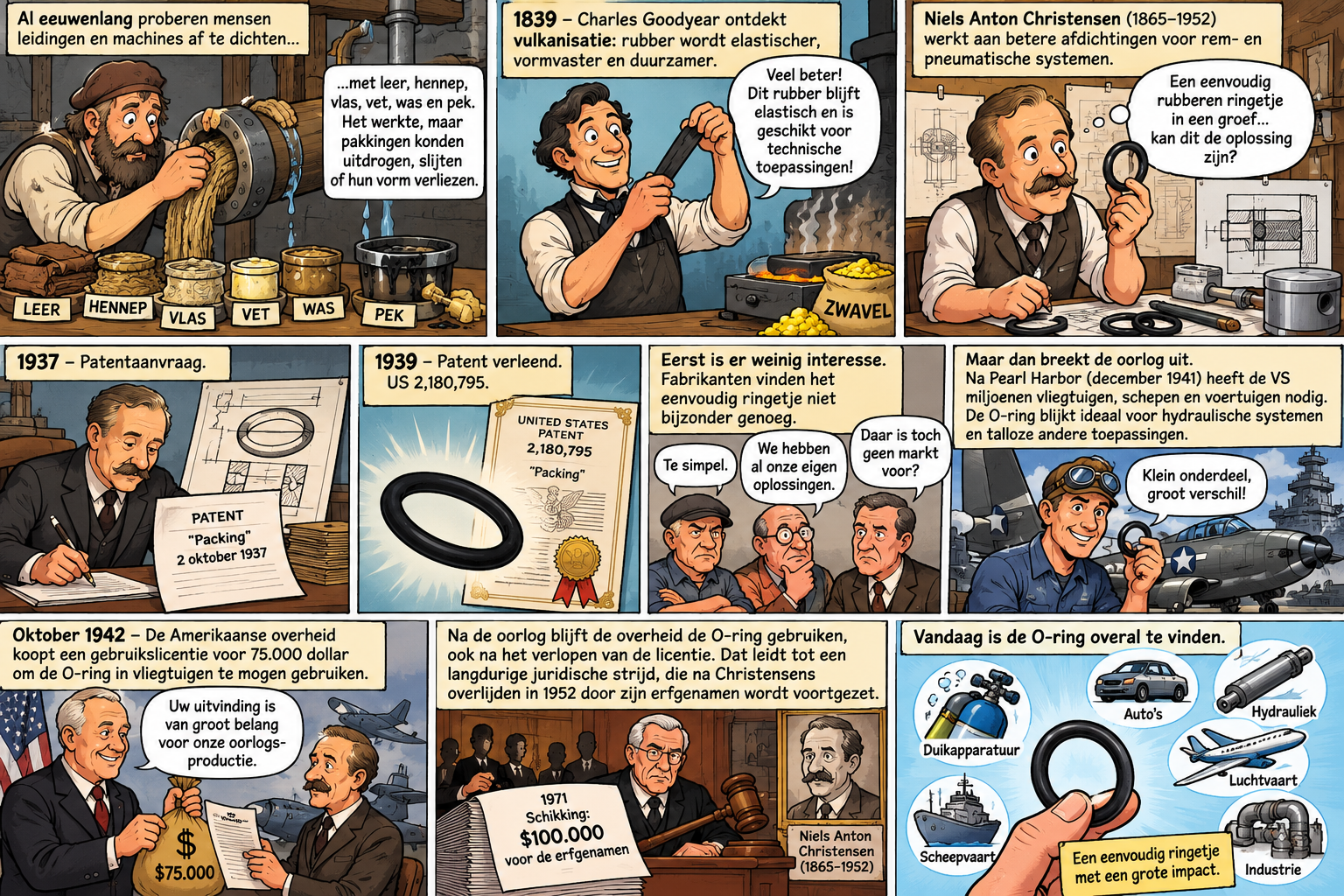
As rubber production spread around the world, so did its uses. A crucial breakthrough had come in 1839, when the American inventor Charles Goodyear discovered that heating rubber with sulfur greatly improved its resilience, dimensional stability and durability. The process, known as vulcanization, opened the door to countless engineering applications, including seals. Of course, the problem of stopping leaks is almost as old as engineering itself. Long before steam engines appeared, people needed to keep water inside pipes, pumps and containers. For this purpose, they used materials that easily deformed and could fill small irregularities: leather, hemp, flax, grease, wax, and tar. They worked, up to a point. Gaskets could dry out, wear down, harden, or lose their shape. Some had to be tightened or replaced regularly. As machines began operating at higher pressures, temperatures and speeds, those limitations became harder to ignore. One solution would prove remarkably simple: a rubber ring with a circular cross-section, placed in a precisely fitting groove. Yet decades passed before the modern O-ring became an engineering staple.
The development of the modern O-ring seal is usually credited to the Danish-American inventor Niels Anton Christensen (1865–1952). Christensen was born on a farm in Danish Jutland and emigrated to the United States in 1891. He worked on brake systems and other mechanical inventions in Chicago and Milwaukee. His experience with pneumatic and hydraulic installations eventually led him to the problem of reliable piston seals. In the 1930s, Christensen developed a particularly effective way to use rubber rings in grooves on moving pistons. O-shaped seals already existed, but his carefully specified groove geometry made them far more reliable in dynamic applications. The ring was slightly compressed during assembly so that it constantly maintained contact with the cylinder wall. During the piston's movement, the ring could also undergo slight deformation. On October 2, 1937, Christensen filed his patent application. On November 21, 1939, his U.S. patent, number US 2,180,795, was officially granted. Its modest title was simply “Packing”—the engineering term for a seal.
Like many deceptively simple inventions, Christensen’s design was not an overnight success. Christensen initially struggled to persuade manufacturers to adopt his particular sealing arrangement. Existing sealing techniques were familiar, and a simple rubber ring might not have seemed special enough to change an established industry. World War II changed the picture. After the Japanese attack on Pearl Harbor in December 1941, the United States rapidly converted its industry to wartime production. Aircraft, ships and military vehicles had to be produced on an enormous scale, and the government sought access to technologies essential to that effort. It secured rights to use a range of militarily important inventions. Manufacturers could then apply these technologies for war production without having to negotiate license fees with each inventor separately.
Christensen’s seal was among them. In October 1942, he granted the U.S. government a license for $75,000 to use his patented seal in aircraft. The O-ring meanwhile found widespread application in hydraulic systems and other technical installations. What had been a relatively unknown invention for years grew into an indispensable industrial component during the war. However, the success had a bitter aftermath for Christensen. The wartime license lasted until 1952, leaving just four years before the patent expired. Moreover, the government continued to use the invention even after the license had expired. This led to a long legal battle, continued by his heirs after Christensen's death in 1952. The dispute continued for decades, with litigation over compensation reaching the courts long after Christensen’s death. Accounts of the case describe an additional award of approximately $100,000 to his heirs. By that time, the O-ring was already inseparable from modern technology.
3. Why did the O-ring become so successful?
The O-ring owes its success to a rare combination of simplicity and effectiveness. A traditional flat gasket often needs to be compressed over a relatively large surface area to form a good seal. An O-ring, on the other hand, requires only a small, precisely designed groove. When two parts are joined, the ring is slightly deformed and an initial seal forms. As soon as pressure is applied to the system, the O-ring is pushed toward the low-pressure side of its groove. This increases the contact pressure against the sealing surfaces. The pressure of the gas or liquid trying to escape simultaneously helps to better seal the connection.
That is what makes the O-ring such an elegant piece of engineering. It has no complicated mechanism, consists of a single component and is inexpensive to manufacture. Moreover, the same basic principle can be applied in very different conditions. An O-ring can therefore function in a simple water tap but also in high-pressure systems. In some applications, it seals a fixed connection and can remain in the same spot for years. In other applications, it must accommodate movement between two parts, making it subject to wear and possibly needing more frequent replacement.
After World War II, the O-ring spread across virtually all branches of industry. At the same time, modern recreational scuba diving was also developing. Regulators, high-pressure connections, cylinder valves, and other parts of diving gear all needed compact, reliable seals. The O-ring was an excellent fit. It takes up little space, can be relatively easily replaced, and allows metal parts to be sealed gas- or watertight without large gaskets or complicated constructions.
A modern scuba setup contains dozens of O-rings. Some are clearly visible, such as the sealing ring in a DIN cylinder valve. Others are deeply hidden in a first stage, a pressure gauge, an inflator, or an underwater camera. And although materials, production methods, and quality standards have greatly improved since the 1930s, the basic principle has hardly changed. A small ring of elastic material, in the right place and compressed the right way, resists a pressure difference that can be hundreds of times greater than atmospheric pressure. So how does such a small piece of rubber manage it? The answer lies in the physics of sealing.
4. How does an O-ring actually work?
At first glance, an O-ring seems almost too simple to deserve an explanation. A rubber ring is clamped between two parts and prevents air or liquid from escaping along the joint. Yet there is some clever physics behind that modest ring. An O-ring does not seal only because it is compressed. The pressure of the gas or liquid trying to escape simultaneously helps to strengthen the seal.
The initial seal: compression
An O-ring is usually placed in a specially designed groove. This groove is slightly shallower than the thickness of the O-ring itself. When the two parts are assembled, the ring is thereby somewhat compressed. Its originally round cross-section changes into a flattened shape, making contact with both sealing surfaces. Seal designers call this initial deformation squeeze. Because rubber is elastic, the O-ring tries to return to its original shape. As a result, it continuously exerts pressure on the surfaces between which it is locked. This contact pressure forms the initial seal, even when there is no pressure in the system yet.
The amount of squeeze depends on the application. For static seals, where the parts do not move relative to each other, a compression of about 15 to 30 percent of the cross-sectional thickness is often applied. For dynamic seals, this is generally lower, since too much compression causes additional friction and wear. The exact values depend on material, dimensions, and construction.
The second seal: pressure energization
Once pressure builds, the seal gets some help from the very fluid it is supposed to contain. The gas or liquid exerts pressure on the O-ring and pushes it toward the low-pressure side of the groove. There, the ring is pressed against the groove wall while at the same time being pushed more firmly against the other sealing surface. As a result, the contact pressure increases as the system pressure rises. This is known as pressure energization: the seal is reinforced by the pressure itself. This explains why a relatively soft rubber ring in a well-designed connection can still withstand a pressure difference of hundreds of bars. The O-ring does not have to resist that pressure solely through its own elasticity. The pressure of the medium helps maintain contact between the ring and the sealing surfaces.
There is one important catch: the O-ring must be sufficiently supported by the surrounding metal parts. Otherwise, the same pressure that strengthens the seal can also damage the ring.
When pressure becomes a problem
An O-ring is elastic and can thus accommodate small irregularities and deformations. But rubber is not infinitely deformable. When the pressure becomes high enough, part of the O-ring can be pressed into the small gap between two metal parts. This is known as extrusion. The rubber ring is essentially pressed through the gap to the outside. When the pressure then drops or fluctuates, the protruding rubber can become damaged or torn off. Over time, characteristic frayed edges or missing pieces of material develop. The risk of extrusion depends not only on the pressure but also on the gap width, the hardness of the rubber, and the temperature. Therefore, harder O-rings are often used for high-pressure applications, for example with a hardness of 90 Shore A instead of 70 Shore A. In some constructions, special support rings are also applied, called back-up rings, which prevent the O-ring from being pressed into the gap.
But harder is not necessarily better. Hard rubber can less easily adapt to small irregularities and generally requires more force to be sufficiently compressed. The proper material hardness is therefore always a compromise between sealing ability, deformability, and resistance to extrusion.
Static and dynamic seals
Not all O-rings have the same job. The key distinction is between static and dynamic seals. In a static seal, the two parts do not move relative to each other. Think, for example, of the connection between a scuba cylinder and the cylinder valve, or an O-ring between two parts of a diving regulator. The ring is compressed during assembly and then remains in place. As long as the material remains in good condition and the connection is not disturbed, such a seal can function for years. In a dynamic seal, however, the parts do move relative to each other. This can be a back-and-forth motion, as with a piston, or a rotating motion, as with some swivels. The O-ring then must not only seal but also withstand friction and wear. The choice of material, compression, and lubrication thus becomes more important.
An O-ring that works perfectly in a static joint may be entirely unsuitable for a moving one.
A simple principle, demanding design
An O-ring combines two useful properties in one small component: the elasticity of rubber ensures the initial seal, while system pressure can help energize the seal. That principle is simple, but a reliable application requires precise coordination between the O-ring, the groove, and the conditions in which it is used. An incorrect size, insufficient compression, a too-large gap, or an unsuitable material hardness can cause even a new O-ring not to seal properly. And precisely for that reason, so many different sizes, materials, and hardnesses are available.
5. Materials: not all rubber is created equal
The earliest O-rings were made from natural rubber. Synthetic elastomers later expanded the range of conditions in which these seals could operate. Today, most O-rings are made from synthetic rubbers, whose raw materials mainly come from the petrochemical industry. Their story begins not in tropical forests but in refineries and chemical plants. By changing the composition of the polymers and the added substances, manufacturers can tailor the properties of the rubber to specific applications.
In everyday language, we usually just talk about rubber. But rubber is not a single substance. It is a collective name for a large group of elastic materials, each with their own chemical composition and properties. Some resist oils and grease; others perform better in hot water, ozone, harsh chemicals or high temperatures. A material that is ideal for one application can deteriorate quickly in another. In regulators, cylinder valves, and compressed air systems, we mainly encounter three types of synthetic rubber: NBR, EPDM, and FKM. Additionally, silicone O-rings are also used, for example, to seal underwater camera housings.
NBR: the everyday workhorse
NBR stands for nitrile butadiene rubber, usually called nitrile rubber. It is a synthetic rubber produced from two chemical building blocks: acrylonitrile (C₃H₃N) and butadiene (C₄H₆). The ratio between these substances partly determines the properties of the final material, including elasticity and resistance to oil and grease. NBR is one of the most widely used O-ring materials, both in industry and in diving gear. It is relatively inexpensive, has good mechanical properties, and is resistant to many mineral oils, lubricants, and fuels. Moreover, it is suitable for a wide range of compressed air and water applications.
A significant disadvantage is the limited resistance to ozone, ultraviolet light, and prolonged exposure to weather conditions. Under such influences, NBR can harden and develop small cracks. However, in diving gear most O-rings are protected inside metal parts, so exposure to sunlight and ozone usually remains limited. For regulators, cylinder valves, and compressed air systems, NBR is therefore a widely used and reliable choice. NBR can also be used with ordinary nitrox mixtures, provided the respective parts are suitable for it and comply with the required maintenance and cleanliness standards.
EPDM: built to resist weathering and oxidation
EPDM stands for ethylene propylene diene monomer. It is made using three types of chemical building block: ethylene (C₂H₄), propylene (C₃H₆), and a small amount of a specific diene, a molecule with two double bonds between carbon atoms. These small molecules, also called monomers, are chemically bonded to each other into long chains that together form a polymer. Its chemical structure gives EPDM excellent resistance to water, ozone and weathering. On the other hand, the material responds poorly to mineral oils and certain lubricants, causing it to swell and lose its properties.
In diving technology, EPDM is primarily mentioned as an alternative to NBR for applications involving oxygen-rich breathing gases. Its resistance to weathering and oxidation can be useful, but oxygen service requires more than a generic material label: the specific compound, lubricant, pressure, temperature and cleanliness all matter. EPDM is also incompatible with many petroleum-based lubricants.
FKM: Viton and the fluoroelastomers
FKM is a family of synthetic rubbers known as fluoroelastomers. Unlike NBR and EPDM, these materials contain fluorine in their chemical structure. FKM can, for example, be made from vinylidene fluoride (VDF; C₂H₂F₂) and hexafluoropropylene (HFP; C₃F₆), but also from other fluorine-containing monomers. The strength of the carbon–fluorine bond helps give many FKM compounds excellent resistance to heat, oils, fuels and chemicals. A well-known trade name is Viton, a fluoro rubber developed in the 1950s by the American chemical company DuPont. Although Viton is often used as a synonym for FKM, not every FKM O-ring is actually from the Viton brand.
In diving technology, FKM, like EPDM, is used as an alternative to NBR for applications involving oxygen-rich breathing gases. This includes systems that work with pure oxygen or nitrox mixtures with more than 40% oxygen, but sometimes also for equipment used with ordinary nitrox. FKM is often selected for its chemical and temperature resistance, but oxygen compatibility cannot be inferred from the letters FKM alone. A widespread misconception is that choosing FKM or EPDM automatically makes an oxygen system fire-safe. It does not. Different compounds behave differently, and any elastomer can contribute to a fire under unfavorable conditions. Oxygen service requires a qualified material in a properly designed, cleaned and maintained system.
Of these three materials, FKM is generally the most expensive. The higher price can be justified when conditions demand it, but for many common applications in diving equipment, NBR remains the standard choice.
Which material do you choose for which application?
The properties of the different rubbers can broadly be summarized as follows.
Material | Typical applications in diving technology | Main advantages | Points of attention |
|---|---|---|---|
NBR | Regulators, cylinder valves, pressure gauges, hose connections, and compressed air installations | Reliable, wear-resistant, affordable, and widely available | Suitability for oxygen-rich service depends on the specific compound and application |
EPDM | Specific seals in oxygen and nitrox installations | Good weathering and oxidation resistance; some compounds are suitable for specified oxygen applications | Not resistant to many mineral oils and lubricants; requires compatible lubricants |
FKM (Viton) | Seals in oxygen and nitrox installations, including filling equipment and certain cylinder valves | Good heat and chemical resistance; selected compounds are used in oxygen service | Relatively expensive |
6. Shore A: why harder is not always better
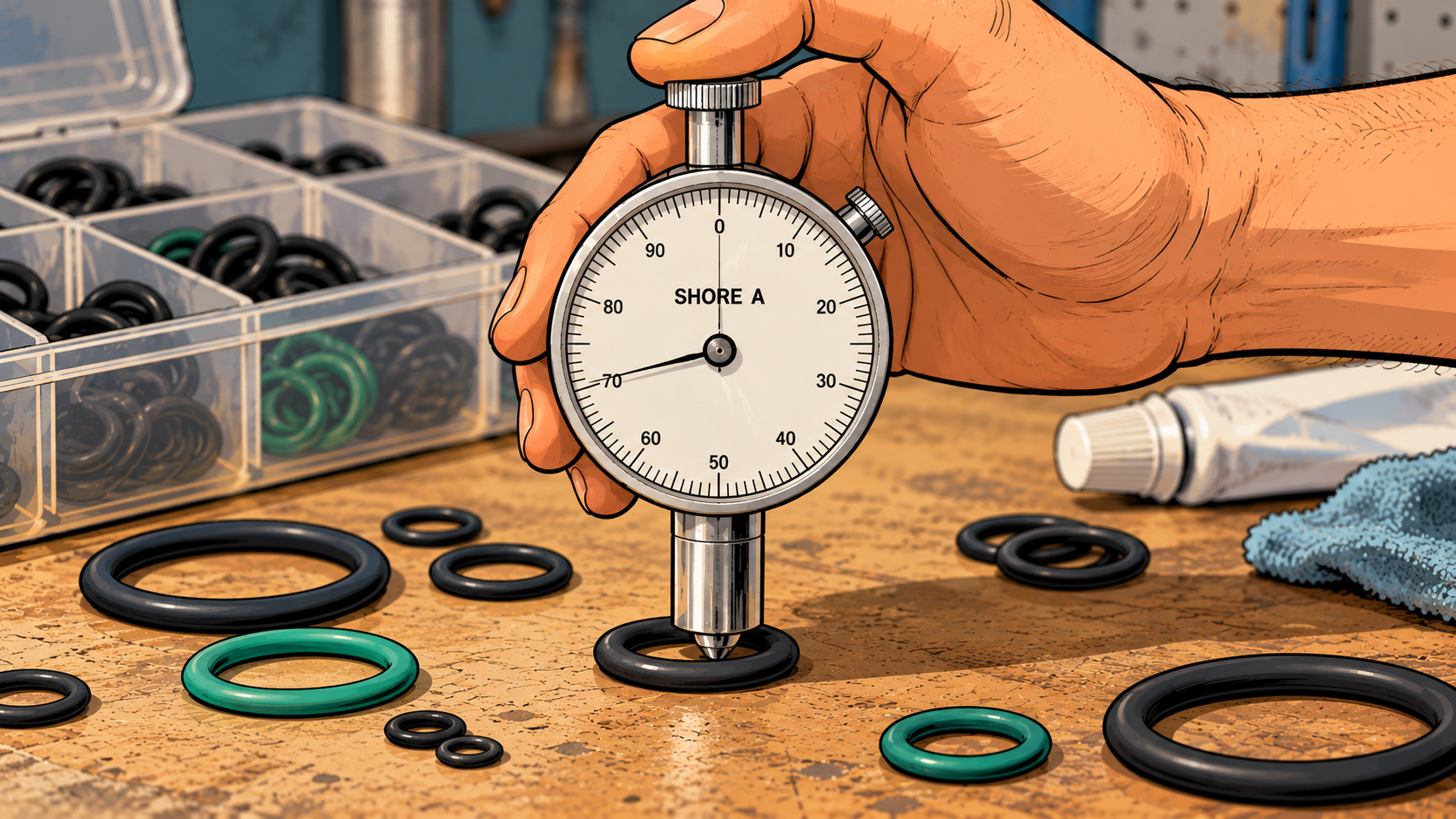
The material matters, but it is only part of the story. Two O-rings of the same material and exactly the same dimensions can behave quite differently under pressure. Chemical composition matters, but so does hardness. That hardness is usually expressed in Shore A. This scale is named after the American engineer Albert Ferdinand Shore (1876–1936), who in 1915 developed an instrument to measure the hardness of rubber: the durometer. There are also Shore B, C, and D scales, each intended for different material properties and hardness ranges. Shore A is the most familiar scale for ordinary elastomer O-rings, although other scales may be appropriate for specialized materials.
During the measurement, a small, blunt test body is pressed against the material with a prescribed force. The less deeply the test body penetrates, the higher the Shore A value. An O-ring of 90 Shore A (also called 90 durometer) is therefore harder than an O-ring of 70 Shore A. The Shore A scale runs from 0 to 100: lower values indicate softer materials, while higher values indicate greater resistance to indentation.
An O-ring must be able to deform sufficiently to seal small imperfections between two metal surfaces. A relatively soft O-ring accomplishes this more easily. It adapts well to the surface and can form a reliable seal even with limited preloading. That makes 70 durometer a suitable choice for many applications. However, at higher pressures, a harder O-ring can offer advantages. As we saw earlier, the rubber can be pressed under pressure into the small gap between two metal parts, a phenomenon called extrusion. A harder O-ring, for example 90 durometer, provides more resistance to this deformation. Therefore, harder O-rings are regularly used in high-pressure connections, such as certain connections of diving cylinders, cylinder valves, and filling installations.
But harder is not automatically better. A harder O-ring deforms less easily and generally requires more force to sit properly against the sealing surfaces. In a connection designed for a softer O-ring, a harder one can actually seal less well. In moving parts, hardness, friction, and wear also play important roles. Moreover, resistance to extrusion depends not only on hardness but also on pressure, O-ring dimensions, and seal construction.
For diving equipment, the distinction between 70 and 90 Shore A is mainly a matter of using the right O-ring in the right place. A softer O-ring is not automatically worse, and a harder O-ring is not automatically safer. The manufacturer selects the hardness based on the conditions under which the seal must function. As a general rule, O-rings of 70 durometer are often used for low-pressure applications, while 90 durometer is regularly chosen for high-pressure applications. However, there are important exceptions: the right hardness depends not only on pressure but also on the seal design. When replacing an O-ring, one must therefore pay attention not only to the correct dimensions and material but also to the specified hardness. An O-ring that looks exactly the same does not necessarily have the same technical properties.
7. Those mysterious numbers: why 003 or 214?
We now know that O-rings are made from different materials and that their hardness can vary as well. But that’s not all. If you want to replace an O-ring, you of course need to choose the right size. And that is where things can get confusing. In diving technology, we often encounter designations such as 003, 014, 112, and 214. Why give tiny rubber rings such peculiar numbers? And why do they measure, for example, 24.99 × 3.53 millimeters instead of simply 25 × 3.5 millimeters?
The explanation lies in the American AS568 standard, which was published in 1971 by the Society of Automotive Engineers (SAE). The letters AS stand for Aerospace Standard. The number 568 is the number of this specific norm within a much larger series of technical standards managed by SAE. AS568 defines the dimensions and corresponding tolerances of hundreds of different O-ring sizes. Although the standard was originally developed for aviation, it is now used worldwide, including in the diving industry.
An O-ring is defined by two key dimensions: the inside diameter (ID) and the thickness of the rubber, also called the cross-section (CS). Its outside diameter is the inside diameter plus twice the cross-section. In the AS568 system, each combination of these dimensions receives its own three-digit code. The full designations are AS568-003 and AS568-214, but in practice, these numbers are usually shortened to 003 and 214. The dash numbers fall into series, with the leading digit indicating the broad cross-section family. Within each series, most O-rings have the same cross-section while the inside diameter increases.
Series | Cross-section | Cross-section in inches | Nominal inch size |
|---|---|---|---|
000 | 1.78 mm | 0.070" | 1/16" |
100 | 2.62 mm | 0.103" | 3/32" |
200 | 3.53 mm | 0.139" | 1/8" |
300 | 5.33 mm | 0.210" | 3/16" |
400 | 6.99 mm | 0.275" | 1/4" |
The first three sizes from the 000 series are an exception. Sizes -001, -002, and -003 have cross-sections of 1.02, 1.27, and 1.52 millimeters respectively. From size -004 on, this is 1.78 millimeters. In the original American measurement system, these dimensions are much more straightforward: 0.040, 0.050, 0.060, and 0.070 inches. Those four specified thicknesses increase by one hundredth of an inch each time. O-rings 010, 011, 012, 013, 014, and 015 — all found in diving equipment — have the same thickness (1.78 mm / 1/16") but the diameter gets increasingly larger.
AS568 size | Inside diameter (ID) | Cross-section (CS) | Examples in diving equipment (verify against manufacturer specifications) |
|---|---|---|---|
-003 | 1.42 mm | 1.52 mm | In the air spool of a pressure gauge |
-006 | 2.90 mm | 1.78 mm | In some BCD power inflators |
-010 | 6.07 mm | 1.78 mm | At the low-pressure hose connection on the second stage regulator |
-011 | 7.65 mm | 1.78 mm | In the quick coupler of the BCD inflator hose and at the 3/8" low-pressure hose connection on the first stage |
-012 | 9.25 mm | 1.78 mm | At the 7/16" high-pressure hose connection on the first stage |
-013 | 10.82 mm | 1.78 mm | At the larger 1/2" low-pressure hose connection; sometimes used in practice as an alternative to the -014 in older INT cylinder valves |
-014 | 12.42 mm | 1.78 mm | As a seal between the INT cylinder valve and the yoke connection of the regulator |
-015 | 14.00 mm | 1.78 mm | Seal for the spindle holder of a cylinder valve |
-111 | 10.77 mm | 2.62 mm | Smaller DIN connection |
-112 | 12.37 mm | 2.62 mm | Standard DIN connection |
-214 | 24.99 mm | 3.53 mm | Between the cylinder valve and the neck of the diving cylinder |
From tiny gauge seals to cylinder valves
Two familiar sizes show just how wide the range is. A 003 has an inner diameter of only 1.42 millimeters and a cross-sectional diameter of 1.52 millimeters. It is a particularly small O-ring, used among other places on both sides of the air spool of a pressure gauge. A 214 is significantly larger. It has an inner diameter of 24.99 millimeters and a cross-sectional diameter of 3.53 millimeters. This size is used, among other things, in certain seals between diving cylinders and cylinder valves. The size number, by the way, says nothing about the material or hardness. An O-ring of size 214 can, for example, be made of NBR or FKM, with a hardness of 70, 75, or 90 Shore A. The AS568 code describes only the dimensions.
Why such odd dimensions?
To anyone used to the metric system, these dimensions can seem almost deliberately awkward. Why would someone design an O-ring with an inner diameter of precisely 24.99 millimeters? Why not simply 25 millimeters? And why 3.53 instead of just 3.5 mm thick? You might suspect that these peculiar dimensions are simply the result of converting inches to millimeters. And that is correct. The cross-sections derive from inch-based dimensions commonly described by approximate fractional names such as 1/16", 3/32", 1/8", 3/16" and 1/4"; the specified decimal-inch dimensions are the ones that count. The inner diameters also follow a clear systematic pattern: they typically increase in steps of first 1/32", then 1/16", 1/8", and finally 1/4". As the O-rings become larger, so do the increments between consecutive sizes.
What about metric O-rings?
In addition to the American AS568 standard, there are also metric sizing systems. In these, O-rings are usually directly identified by their inner diameter and cross-sectional diameter, for example 25 × 3.5 mm. Comparing this size with the American AS568-214, we see how small the difference actually is:
Size | Inner Diameter | Cross-Sectional Diameter |
|---|---|---|
AS568-214 | 24.99 mm | 3.53 mm |
Metric 25 × 3.5 | 25.00 mm | 3.50 mm |
Difference | 0.01 mm | 0.03 mm |
So the difference is only one-hundredth of a millimeter in inner diameter and three hundredths in cross-sectional diameter. That is very little. Moreover, O-rings are not manufactured with an absolutely exact size: the AS568 standard also allows certain size tolerances. In many noncritical applications, those small dimensional differences may be insignificant. But nominal similarity does not establish interchangeability: tolerances, groove dimensions, compound properties and the manufacturer’s specification must all be checked. For high-pressure diving equipment, never assume that a metric 25 × 3.5 ring is an approved substitute for AS568-214.
The diving industry does not follow a neat American-versus-European division in O-ring sizing. It is not the case that American manufacturers, such as Oceanic and Scubapro, exclusively use O-rings according to the American AS568 standard, while European manufacturers, such as Mares and Cressi, exclusively apply metric sizes. In practice, both measurement systems are used interchangeably, sometimes even within the equipment of a single manufacturer. The origin of a manufacturer therefore says little about the sizing of its O-rings. Ultimately, the specifications for the particular component are what matter.
This is partly due to the way diving equipment is produced. Manufacturers do not design and produce all parts themselves but also source components from specialized suppliers, sometimes from different parts of the world. These parts often have their own historically grown sizing. In addition, manufacturers build on existing designs and use standardized parts where possible. This is how American and metric O-rings can end up side by side in one and the same regulator.
8. Why O-rings fail—and how to prevent it
An O-ring is a remarkably simple component. A small rubber ring, without moving parts, electronics, or complex construction. Yet the reliability of an entire regulator, cylinder valve, or filling station can depend on it. As long as the O-ring does its job, we don’t notice it. Only when air escapes, a connection starts to hiss, or a joint suddenly loses pressure, do we become aware of its presence. Fortunately, O-ring failures usually have an identifiable cause. Usually, there is an identifiable cause. Sometimes the rubber is aged, sometimes the ring is damaged during assembly, and sometimes it is simply not suitable for the conditions in which it is used. Understanding the different failure modes makes many of those problems preventable.
Aging: rubber does not last forever
Rubber may look unchanged for years, but its chemistry does not stand still. The long polymer chains that make up the material can gradually change under the influence of oxygen, heat, light, and certain chemicals. Some bonds break down, while in other places additional cross-links between the chains form. The result is that rubber can lose its original properties over time. An O-ring can become harder and less elastic, develop small cracks, or become softer and stickier. Which changes occur depends heavily on the elastomer used and the conditions in which it is stored or used.
An NBR O-ring exposed to the outside air in a warm environment for years, for example, will generally age faster than a similar ring kept in a cool, dark place protected from sunlight. The presence of ozone, certain oils, and other chemicals can also accelerate the aging process. This does not mean, however, that every old O-ring is automatically unusable. The lifespan depends on the material, quality, storage conditions, and load during use. Some O-rings function problem-free for many years, while others need to be replaced after a short time. For spare parts, a simple rule applies: store O-rings clean, dry, out of direct sunlight, and preferably in closed packaging. Avoid prolonged exposure to high temperatures and do not store them unnecessarily stretched. An O-ring that has been tightly hung on a hook for years is possibly not the same ring as when it came out of the package.
Compression set: when rubber stops springing back
One of the most common forms of aging in O-rings is compression set, meaning permanent deformation after prolonged compression. To understand what this means, we need to recall how an O-ring seals. When two parts are assembled against each other, the O-ring is somewhat compressed. Its round cross-section changes into a more oval shape. It is this deformation that causes the rubber to press against the sealing surfaces. Normally, the O-ring springs back when the connection is opened. But after prolonged compression, especially at elevated temperatures, part of that deformation can become permanent. The ring becomes flatter and no longer fully regains its original round shape. This is called compression set.
An O-ring with high compression set can still sit in its groove and at first glance look reasonably good. Yet its ability to exert pressure on the sealing surfaces is reduced. Especially when the connection is opened and reassembled, this can cause problems. This is one of the reasons why O-rings are generally replaced during maintenance work. Not because they are necessarily visibly damaged, but because we cannot always assess how much elasticity they have lost.
Damage during installation
Not all O-rings gradually deteriorate. Some are already damaged before the equipment is even put into use. A common problem occurs when an O-ring is pulled over a sharp edge, thread, or metal burr during assembly. The rubber can suffer a small cut. Sometimes this damage is hardly visible, but under pressure a leak can develop precisely at that spot. An O-ring can also become pinched between two parts. When a bottle valve, coupling, or other component is tightened while the ring is not properly seated in its groove, a piece of rubber may get caught between the metal surfaces. The ring is then locally flattened or even cut through.
Twisting is another potential problem. Especially with larger O-rings or those placed over a longer distance in a groove, the rubber can rotate around its own axis during assembly. This causes uneven stress. With repeated movement, this can lead to a spiral-shaped damage pattern, known as spiral failure. Preventing assembly damage starts with a clean, undamaged groove. Check that there are no grains of sand, salt crystals, metal particles, or remnants of old O-rings present. When removing a ring, preferably use tools that do not damage the metal surfaces. A deep scratch in a sealing surface can also cause leakage even with a new O-ring.
An appropriate amount of the prescribed lubricant can facilitate assembly, but we will return to that later.
Extrusion: when the rubber gets damaged under pressure
Another form of damage occurs due to extrusion, the phenomenon where rubber is pressed under high pressure into a small gap between two metal parts. We have previously seen how this arises and why the hardness of the O-ring plays an important role. But how do you recognize an O-ring damaged by extrusion? Characteristic are small notches, ragged edges or missing pieces of rubber, usually on one side of the O-ring. Sometimes it looks as if little bites were cut out of the rubber with a small knife. With repeated pressure changes, this pattern can further develop, as small pieces of rubber are torn off each time. In English, this type of damage is also called nibbling, literally 'nibbling'. A fitting name for an O-ring where pressure has gnawed bit by bit.
An O-ring with such damage must, of course, be replaced. But just replacing with a new ring is not always enough. If the cause lies in too large a gap, incorrect material hardness or insufficient support, the same damage can occur again. Therefore, it is important to check not only the O-ring but also the construction and the condition of the seal.
Chemical attack and wrong material choice
Not every rubber can withstand every liquid or gas. As we saw earlier, NBR, EPDM and FKM each have their own properties. When an O-ring comes into contact with a substance for which the material is unsuitable, various problems can arise. The rubber may swell because molecules of the fluid penetrate the material. It can also shrink, harden, soften or lose its mechanical strength. A classic example is EPDM in contact with certain mineral oils and greases. EPDM has excellent properties for various applications with water and certain oxygen-rich gases, but is generally not suitable for contact with mineral oil products. NBR and many FKM variants are better resistant to such oils.
Conversely, this does not mean that NBR or FKM is always the better choice under all conditions. The right material choice always depends on the combination of medium, pressure, temperature, lubricant and application. The quality of the rubber also plays a role. Two O-rings both sold as NBR 70 do not necessarily have exactly the same chemical composition or performance. NBR is after all a family of rubber compounds, not a single substance with identical properties everywhere. A wrong material choice is also not always immediately visible. An O-ring may look fine after installation and only develop problems after weeks or months. Precisely for this reason, it is wise during maintenance not to look solely at the size but also at the prescribed material.
To lubricate or not to lubricate?
Few O-ring topics attract quite as many confident opinions as lubrication. Some divers are convinced that every O-ring should be generously coated with silicone grease. Others prefer to use no lubricant at all. As usual, the answer is less straightforward. An O-ring does not always need lubrication to seal. With a static seal, where the parts do not move relative to each other after assembly, the sealing function is primarily determined by the correct sizing, compression and pressure. Still, a thin layer of suitable lubricant can be useful. It reduces friction during assembly, helps prevent the O-ring from twisting, and can make it easier to place the ring correctly in its groove.
With dynamic seals, where parts move along each other, lubrication can also be necessary to reduce wear. But more grease is not automatically better. Excessive amounts can attract dirt, get into unwanted parts of the equipment, or cause problems if the lubricant is not compatible with the rubber. The choice of lubricant is also important. Not all greases are compatible with all elastomers. And a lubricant that works well in a typical compressed air regulator is not necessarily suitable for equipment exposed to high oxygen concentrations. Therefore, here too: use only a lubricant that is suitable for the specific seal and approved by the manufacturer. When an O-ring must be installed dry, extra lubrication offers no advantage.
Oxygen compatibility: more than choosing the right rubber
For equipment used with nitrox and pure oxygen, the requirements for materials and maintenance become even more important. Oxygen itself is not flammable, but it supports combustion. As oxygen concentration and pressure increase, certain materials can ignite more easily and a fire that has started can burn much more intensely. Therefore, components that come into contact with oxygen-rich gases must be suitable for the specific application. This applies to metal parts, O-rings, and the lubricants used. But oxygen compatibility is more than just the choice between NBR, EPDM, and FKM. Even an O-ring made from a suitable material can become part of a dangerous situation if the installation is contaminated with oil, grease, or other combustible residues.
Conversely, the designation FKM or Viton does not automatically mean that every O-ring made of that material is safe for every oxygen application. The exact composition, operating pressure, temperature, and other conditions remain important. In oxygen service, oxygen cleaning also plays an important role: the careful cleaning and inspection of parts to remove unwanted contaminants. An O-ring installed with dirty hands or that comes into contact with an unsuitable lubricant can negate the cleanliness of an otherwise properly prepared connection.
This is especially not a trivial matter at filling stations where oxygen is used under high pressure. Here, material choice, cleaning, assembly, and operating procedures must be considered as a whole.
When should an O-ring be replaced?
An O-ring does not have to be visibly damaged before replacement is advisable. During periodic maintenance of diving regulators and cylinder valves, certain O-rings are routinely replaced according to the manufacturer's instructions. This makes sense: the part is relatively inexpensive, while the consequences of a leaking or failing seal can be significant. However, sometimes there are clear signs indicating damage or aging. Think of cracks, notches, a flattened cross-section, discoloration combined with material change, swelling, hardening or a sticky surface. Also, if an O-ring is damaged during disassembly, it should be replaced. The same applies when its origin, compound or correct dimensions cannot be established with confidence.
In diving technology, O-rings are considered consumables. They are designed to reliably seal throughout their service life, but not to be reused at every maintenance session. During a complete overhaul of a regulator or cylinder valve, the relevant O-rings are therefore generally replaced as standard, even if they still look good. The cost of a new O-ring is negligible compared to the time and effort of dismantling and reassembling the equipment, let alone the possible consequences of a failing seal.
Why not use an O-ring from a bargain assortment?
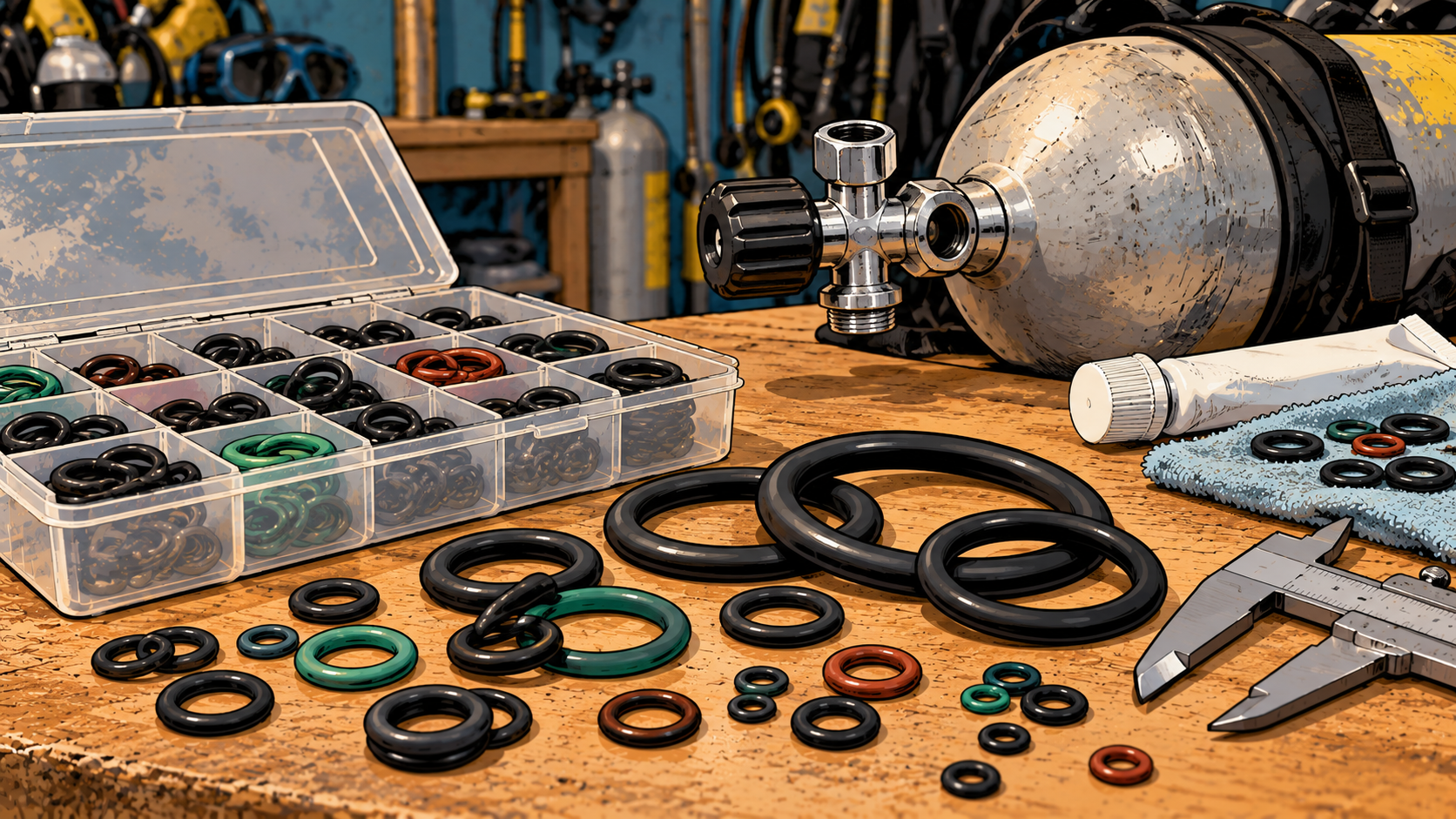
Anyone who has ever bought an assortment of O-rings knows the temptation. A box with hundreds of black rubber rings, neatly sorted by size, for a fraction of the price of an official service kit. Why not just pick the right ring from there? Because dimensions tell only part of the story. An O-ring that looks exactly the same may be made of a different elastomer. It may have a different Shore A hardness, different tolerances, or be made from a rubber compound that is not suitable for the specific application. Also, with cheap, no-name assortments, we do not always know how the rings were produced, how long they have been in stock, or under what conditions they have been stored.
That does not mean that only O-rings bearing a diving manufacturer's logo are reliable. Many seals in diving equipment are ordinary, standardized industrial parts. An O-ring from a specialized industrial supplier can be technically entirely equivalent to one from an official service kit. But then we must know what we are buying. Not only the size, but also the material, hardness, tolerances, and any additional requirements must match the specifications for the application. For critical components of regulators, cylinder valves, and high-pressure systems, the prescribed maintenance procedure remains decisive. A ring that appears technically suitable is not necessarily an approved replacement.
A small component with a big responsibility
We have covered quite some ground: from the rubber forests of Brazil and Congo, through the plantations of Southeast Asia and the development of synthetic rubber and World War II, all the way to the workbench of the service technician. Along the way, we have become acquainted with the history, chemistry, and physics behind one of the simplest parts of our diving equipment, and with the engineers Niels Christensen and Albert Shore. We have discovered why one rubber is not like another, what Shore A hardness means, and why the dimensions of such a simple ring are sometimes specified down to a hundredth of a millimeter. A whole world of knowledge, gathered in a piece of rubber that may only cost a few dimes, but on which the reliability of an entire regulator can depend.
There is one last detail worth looking at: the name O-ring itself. At first glance, it seems almost tautological: a ring is round, and so is the letter O. But those two kinds of roundness describe different things. The O refers to the round cross-section of the rubber, while the ring describes the shape of the whole. For example, there are also X-rings, which are just as round from above but have an X-shaped cross-section. An O-ring is, quite literally, a ring with an O-shaped cross-section. Round in two different ways—and not a tautology after all.