Who Is Actually Writing This? On Authorship, Artificial Intelligence, and the Making of Air Insights
Who actually writes the articles for Air Insights? The obvious answer is: I do. Who I am and what my background is, I'll explain in this personal essay. But whether I'm really the one writing all those articles turns out to be a more complicated question. And the more I think about it, the less obvious the answer becomes. A critical reflection on writing in the age of AI.
1. Who’s Actually Writing This?
Perhaps it's time to come clean. Who actually writes all those articles for Air Insights? Who is behind the stories about diving cylinders, compressors, breathing gases, and O-rings? And why are these stories written in the first place?
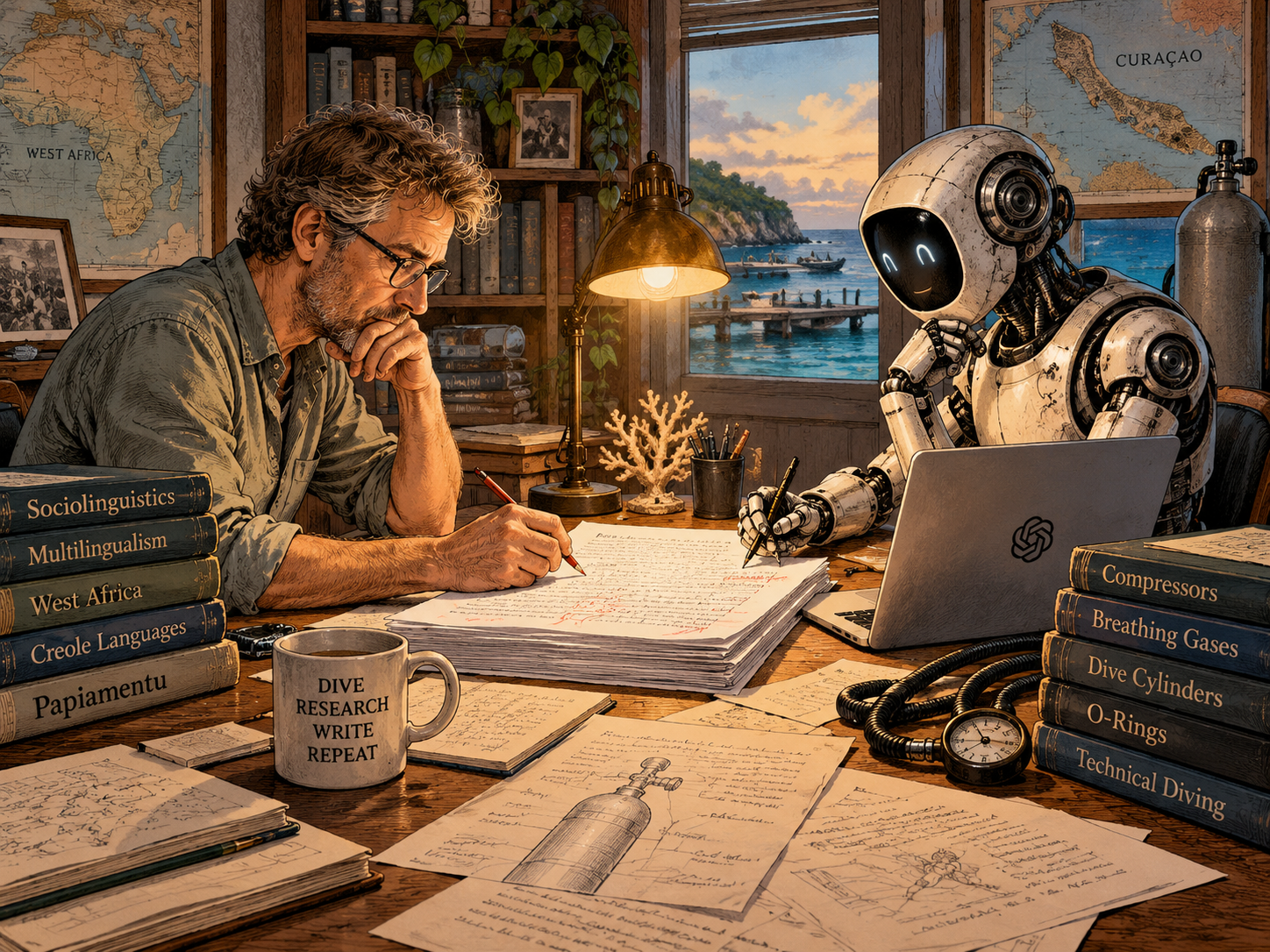
Let me start by introducing myself. My name is Kasper Juffermans, and I'm one of the founders of Air & Dive Supply here on Curaçao. I also own Porto Mari Dive Center, a dive center on what may well be the most beautiful beach on the island, and I'm still an active diving instructor.
In a previous life, I was a sociolinguist, or linguistic anthropologist. I spent about sixteen years studying and working at various universities, across the three Benelux countries as well as in Hong Kong and Germany. My main interests were multilingualism, literacy and the social significance of language. Throughout my academic career, I spent considerable time in West Africa, particularly in The Gambia and later Guinea-Bissau, where I investigated how people in highly multilingual societies use spoken and written language. My earlier research in The Gambia eventually resulted in a doctoral dissertation and a book, Local Languaging, Literacy and Multilingualism in a West African Society.
After completing my PhD, I worked on several postdoctoral research projects and briefly held a visiting professorship. But academic life, with its temporary contracts and international relocations, became increasingly difficult to reconcile with family life. Eventually, I decided to leave academia behind and move to Curaçao with my family. There, I turned my hobby into my profession: diving.
For many years, writing, researching, and publishing were central to my work. I wrote academic articles, published books, and edited collections of essays. The subjects were quite different from the compressors, diving cylinders and O-rings I work with (and write about) today, but my curiosity and the pleasure I take in finding things out and explaining them never really disappeared.
Early in my career, I was primarily a writer who discovered the pleasures of diving along the way. Now the roles have been reversed. Somewhere on the margins of my work as a diving instructor and business owner, I’ve gradually rediscovered the pleasure of writing. Air Insights is, in a sense, my hobby project. A hobby that may have gotten a little out of hand, but one that serves several purposes.
For one thing, there is a commercial purpose. Air & Dive Supply is a business, and naturally we hope these articles will attract more visitors to our website. Someone searching online for information about breathing air, Nitrox, diving cylinders or O-rings might eventually find their way to us. That would be good for our visibility and, perhaps, ultimately for our revenue. There’s no need to be coy about that.
But that is certainly not the only reason I write these articles. I also simply want to tell interesting, accessible stories about the technical side of diving. Stories that our own staff can learn from, as well as colleagues at other dive centers, our customers, and anyone else interested in these subjects, on Curaçao and elsewhere. In our industry, we work with fairly sophisticated technology every day, without necessarily understanding exactly how it works. Why do we use particular materials? How is breathing air actually produced? What happens inside a compressor? And why can such a tiny rubber ring sometimes be so important?
These are questions I'm curious about myself. And writing has always been a way for me to understand things better. After all, if you want to explain something properly, you first have to understand it yourself. So while researching and writing, I regularly discover things I didn't know before.
The project also gives me an opportunity to do something I spent many years enjoying: writing, researching, drawing connections, and making knowledge accessible. Only this time, I don't have to turn it into an academic paper, complete with footnotes, bibliographies and complicated theoretical debates. I can simply write about subjects that interest me, for people who might find them useful. And if nobody else gets anything out of it, at least I will.
2. How AI Got Me Writing Again
That brings me to something rather unusual about this project. Although I've always enjoyed writing, it largely disappeared from my life after I left academia. I simply no longer had the time or opportunity. I still enjoyed taking my time to write detailed replies to customers' emails, but that was about it. Running a dive center is, after all, a fairly labor-intensive business, with most of your day spent outdoors – by, in, and under the water. Only a small part of the job takes place on dry land, sitting behind a computer screen.
The fact that I'm writing so much again has everything to do with the rise of generative artificial intelligence, or AI for short. Not because I suddenly developed an urge to write about AI, but because AI made it possible for me to start writing again.
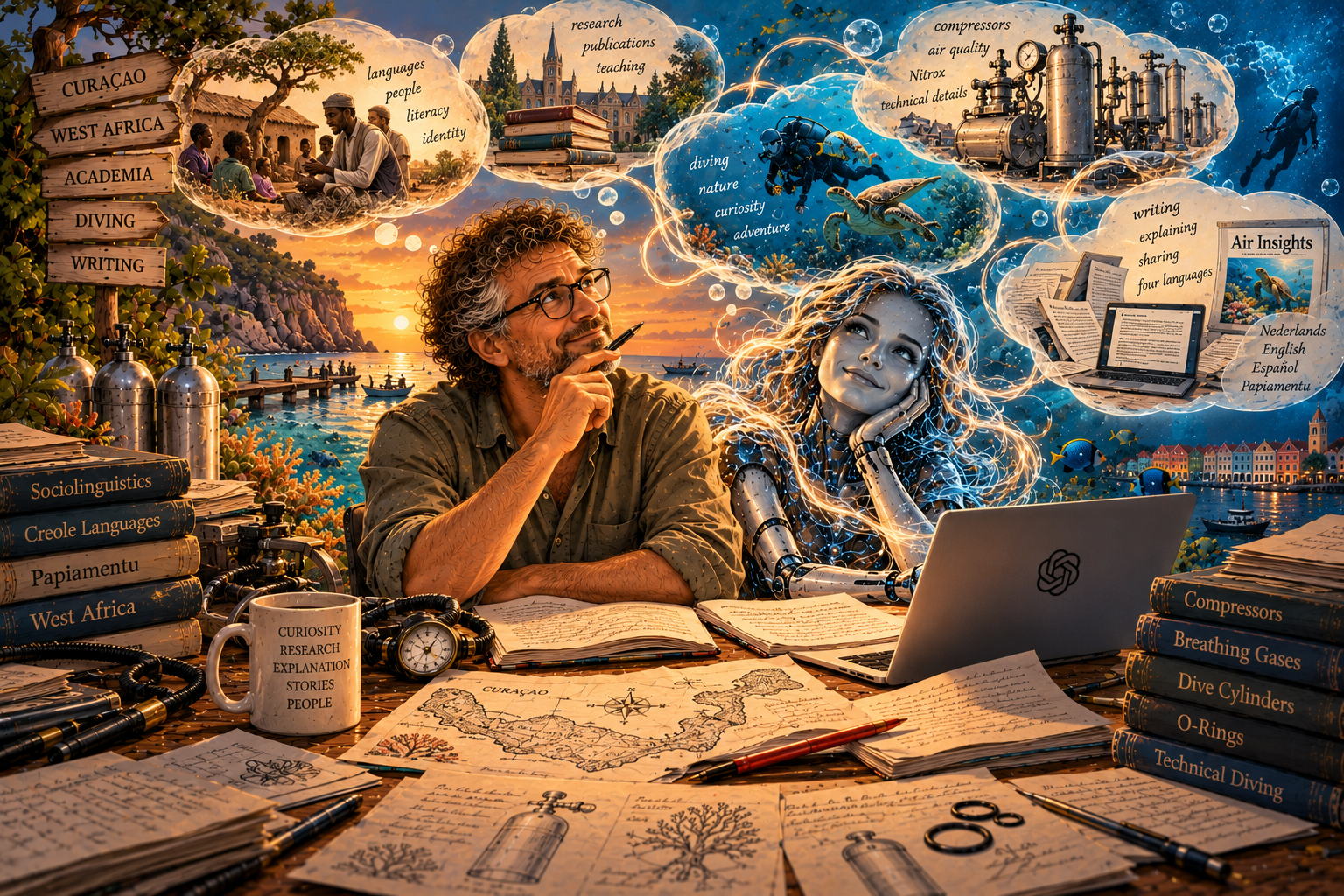 Wie schrijft hier? • Who's writing this? • ¿Quién escribe esto? • Ken ta skirbi esaki?
When we set about improving our dive school's website, I discovered what AI could do as a writing assistant. My teenage daughter had also discovered how useful it could be for homework. That sparked my curiosity. I started exploring it myself and gradually discovered just how much this new technology could offer me.
I began by thoroughly rewriting the existing course descriptions on our website and adding numerous new courses and dive trips. Once the old texts had been given a fresh coat of paint, our divemaster/webmaster Wouter, now a fellow diving instructor (among many other things), suggested that I start writing landing pages. These are pages people find through search engines, hopefully encouraging them to explore the rest of our website and eventually book a dive or a course with us.
He only had to suggest it once. Within a few days, with the help of AI, I had produced a whole series of these pages. I organized them into a digital snorkeling and diving guide, with the idea of perhaps turning it into a little book one day. The subjects ranged from Curaçao's best diving and snorkeling spots to boat diving versus shore diving, learning to dive and the various paths to becoming a dive professional.
Gradually, I ventured into more complicated subjects, such as diving theory, and came up with the idea of creating a guide for aspiring and established diving professionals as well. Along the way, I also discovered that AI could help me not only with words and language, but with generating illustrations.
What I discovered, then, was not just what AI could do, but how dramatically the writing process had changed by 2025 and 2026 compared with the time when I left university and moved to Curaçao, almost a decade earlier. Things that once took me weeks or even months could sometimes now be accomplished in a matter of hours. What began as a practical way to improve our website gradually developed into a renewed interest in writing, researching and publishing. In a sense, AI helped me rediscover the pleasure of writing.
And I certainly don’t use AI merely as a glorified spellchecker. I use it to brainstorm ideas, research subjects, discuss technical questions, develop chapter outlines, draft and revise passages, create illustrations and translate articles into other languages. Sometimes we go through three, four or even more rounds of editing before I'm satisfied.
The curious thing is that I've started writing much more while actually formulating fewer of the words myself. AI has helped me rediscover the pleasure of writing, but it now also does a substantial part of the writing itself.
Which brings me to a question I find myself asking more and more often: if I use AI for so many parts of the writing process, to what extent am I still the writer?
That's the question I want to explore in this essay. Not to defend the way I work or to sing the praises of AI, but because I genuinely find it interesting. Especially as someone who spent so many years working professionally with language, writing and authorship. And perhaps also simply to explain how all those articles for Air Insights actually come into being.
3. I Used to Write Everything Myself. Or Did I?
When I was still working at university, I wrote most of my texts myself. That may sound obvious, but these days it seems to be a distinction worth making. I collected my research data, read books and articles, took notes, developed arguments, and then tried to put them into words as clearly as possible. Sometimes that came easily, but more often than not, writing was a fairly time-consuming process. A single paragraph could take me hours, and I sometimes spent weeks or months working on a text.
Even then, though, I didn't do it entirely on my own. I constantly drew on the work of others. I read what other researchers had written, borrowed concepts and ideas, consulted dictionaries and reference works, and discussed my writing with colleagues. Drafts were sent to supervisors, editors, and anonymous reviewers, who provided feedback and sometimes suggested substantial revisions. Academic writing is, after all, largely a conversation with other scholars, even when your name is the only one on the title page.
And of course, there were the technical tools. I wasn't writing with a quill pen, but on a computer, using a word processor, spellchecker, search engines, digital libraries, and software to manage my references. We considered all of that perfectly normal. Nobody questioned whether I had really written an article simply because I'd used Google Scholar to find sources or Microsoft Word's spellchecker to correct typos.
But there was one important difference compared to today. All those tools helped me with writing, without producing large passages of text themselves. A dictionary could tell me what a word meant, but not what thought I wanted to express with it. A search engine could lead me to an interesting article, but it didn’t write my own argument. And a colleague could suggest structuring a paragraph differently, but usually I still had to figure out how to do it myself.
With the advent of generative AI, that boundary has shifted. Nowadays, I can ask a question, provide a few ideas, and within seconds receive a fairly coherent text. Not just a collection of facts or suggestions, but complete sentences, paragraphs, and sometimes even entire chapters. I can ask it to further develop an argument, make a passage more accessible, or rewrite a text in another language.
That is more than a new version of the spellchecker. The machine does not just help with writing; it actually writes along with me. And that changes my own role as well. Where I used to be mainly busy finding the right words to express my thoughts, these days I spend much more time evaluating, redirecting, and improving words already on the screen. But does that also mean that I think less for myself? Or that I am less the author of what eventually gets published? I am not so sure about that yet.
4. How We Make Air Insights
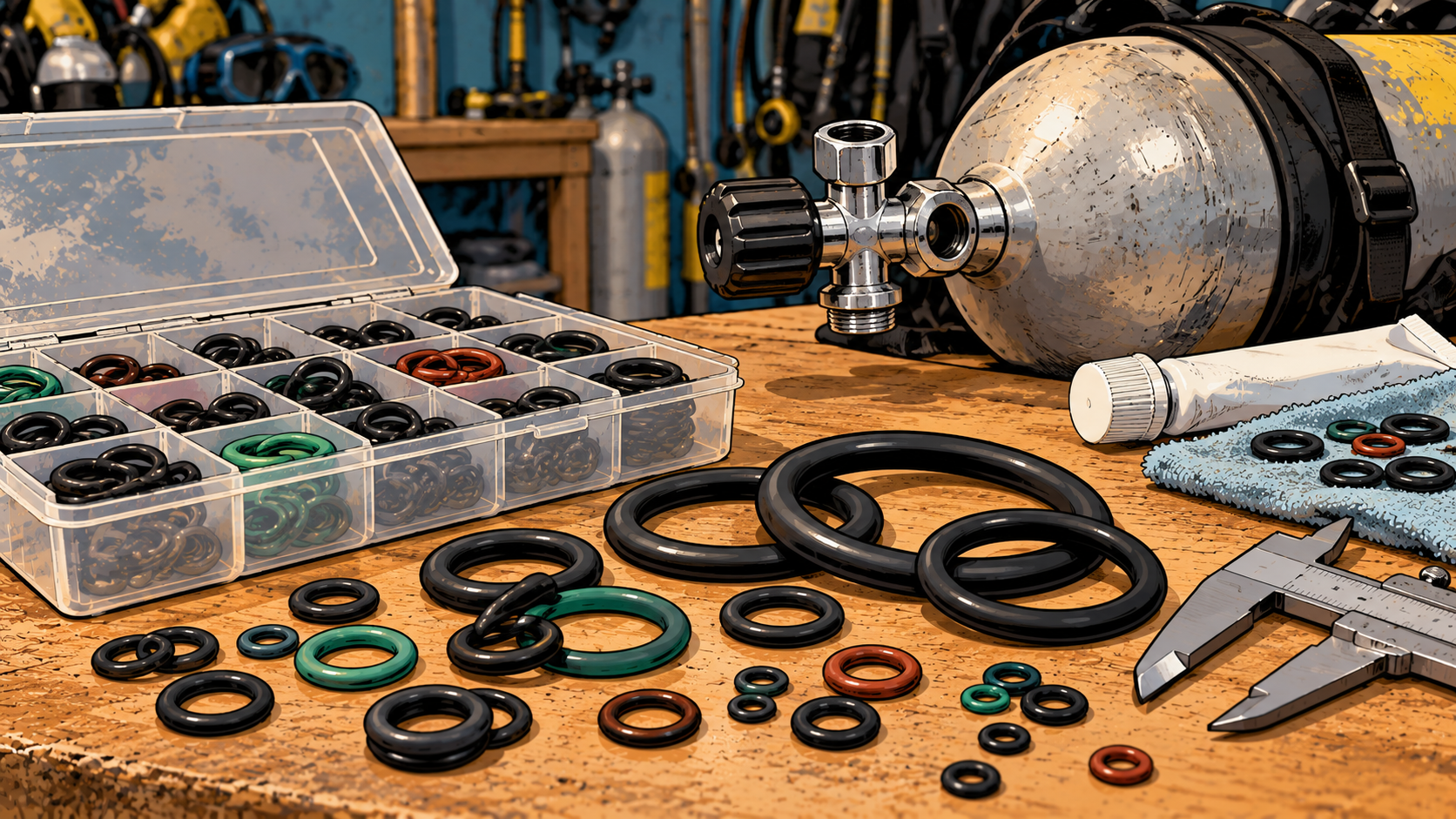
How does writing with AI actually work? To explain that, I can best describe how a typical article comes about. Although I should immediately add that there is no fixed recipe. Some articles begin with a technical question, others with a practical incident, an interesting historical fact, or simply something I have become curious about. Take, for instance, the article about O-rings. We use those small rubber rings daily in our dive school and fill station. They are found in scuba cylinders, valves, regulators, and all kinds of components in our compressors and filling systems. Everyone who works with diving equipment knows them. But how much do we actually know about them? Why are they mostly black? Why are some harder than others? What is the difference between NBR, EPDM, and FKM? And who actually invented the O-ring?
Questions like these usually start a conversation with ChatGPT, the AI program I use for most of my writing. I explain what I want to investigate and for which audience I’m writing. Then we brainstorm. Which topics are interesting? Which belong together? Which technical details deserve more explanation? And how can we turn all of this into a story that’s not only informative but also enjoyable to read?
Often, it doesn’t even begin with the intention to write, but from interest, curiosity, or the practical need to figure something out. And during the conversation with the AI, I often realize there might be a story in it. AI regularly suggests things I hadn’t thought of myself. Some are interesting, others less so. I make choices, ask follow-up questions, and try to develop a structure along the way. Sometimes that structure is set quite quickly, but often it changes several times during writing. Take the article about O-rings, for example. We use those small rubber rings daily at our dive center and filling station. They’re found in scuba cylinders, valves, regulators, and all sorts of components in our compressors and filling systems. Anyone who works with diving equipment is familiar with them. But how much do we really know about them? Why are they mostly black? Why are some harder than others? What is the difference between NBR, EPDM and FKM? And who actually invented the O-ring? (Note: This passage overlaps with node_0_36_0 in source and current translation, so no change needed here)
Take the article about O-rings, for example. We use those small rubber rings daily at our dive center and filling station. They’re found in scuba cylinders, valves, regulators, and all sorts of components in our compressors and filling systems. Anyone who works with diving equipment is familiar with them. But how much do we really know about them? Why are they mostly black? Why are some harder than others? What is the difference between NBR, EPDM and FKM? And who actually invented the O-ring?
Questions like these usually start my conversations with ChatGPT. This is the AI program I use for most of my writing. I explain what I want to investigate and who I’m writing for. Then we brainstorm. Which subjects are interesting? Which ones belong together? Which technical details deserve more explanation? And how can we turn all this into a story that is not only informative but enjoyable to read?
Often, I don’t set out to write anything at all. I’m simply curious about something or trying to solve a practical problem. Then, somewhere in the conversation with AI, I realize there might be a story in it. AI often suggests things that hadn’t occurred to me. Some are interesting, others less so. I make choices, ask follow-up questions, and gradually work out a structure. Sometimes that structure takes shape quickly, but often it changes several times as the article develops.
Then comes the research. I ask technical questions, seek explanations, and compare possible answers. Sometimes I ask AI to look for additional sources. But I also bring my own knowledge and experience into the conversation. I weigh what AI tells me against what I know from practical experience. But I am equally willing to let AI teach me things I don’t yet know.
AI also offers something that is otherwise hard to find: an accessible way into complicated technical subjects. There simply aren’t many books about compressors, cylinders, and filling systems. Perhaps the people who work with this equipment aren’t usually the ones who write books. And when an explanation goes a little over my head, I ask AI to try again in simpler terms.
I work daily with compressors, cylinders, breathing gases, and filling equipment, and that hands-on experience raises questions that general technical descriptions rarely address. I can sometimes also tell when an answer sounds convincing but isn’t technically quite correct. That happens more often than you might think.
Then comes the actual writing. And here I must be honest: a substantial share of the sentences in Air Insights are initially written by AI. Sometimes I provide a rough draft, which AI rewrites extensively before I edit it again. Sometimes I merely explain what a passage should cover, and AI produces a first draft. And sometimes a passage grows out of a long exchange of questions and answers that we eventually shape into a coherent story.
But that first draft is almost never the end of the process. I read, cut, add, ask questions, and request new versions of passages. Sometimes a text feels too much like a lesson, too technical, or simply too superficial. Sometimes the information is incorrect or an important distinction is missing. And sometimes a passage is perfectly sound in substance but simply doesn’t sound like something I would write. So we try again. Sometimes the result is too long or too short, and I ask for more depth or have it cut back.
What makes this interesting is that the process changes not just the text but my understanding of the subject as well. While writing, I discover new connections, come up with additional questions, and must sometimes revise earlier assumptions. For example, the article about O-rings started as a technical explanation of seals but grew into a story that also included the history of rubber, materials science, and even the origin of the word O-ring. I deliberately chose an anthropological and historical angle, in keeping with my background in the humanities. Because let’s face it: writing about technology is far more interesting when you put it in its social context.
When the Dutch text is more or less finished, we start with the illustrations. These are also largely created with AI. I describe what an image should show, and the machine generates a first version. Then, more often than not, another round of corrections begins. A cylinder has the wrong dimensions, a part isn’t in the right place, or a technical cross-section is inaccurate. Sometimes we get it right on the first try; sometimes we’re still not satisfied after six attempts. And sometimes, after ten attempts, I give up in mild frustration and conclude that AI simply doesn’t understand what I want—or can’t do it. AI can make beautiful images, but a beautiful image is not necessarily a technically correct image.
Next come the translations. The articles appear in Dutch, English, Spanish, and Papiamentu. I use AI for this too. The first translation is usually quick, but that’s when the real editing begins. Technical terms must be translated consistently, sentences must sound natural, and the style and tone of the original article must be preserved as much as possible. Papiamentu, in particular, presents an interesting challenge because the available language models do not yet fully master that language. But the English and Spanish translations also improve noticeably after one or more editing rounds. It isn’t just about correcting mistakes. It’s mainly about improving readability, rhythm, and the natural flow of the language. A translation can be grammatically flawless and still read unmistakably like a translation. The goal is for each version to read as though the article had originally been written in that language. As a former linguist who uses several languages, I may be a bit more particular about this than the average web designer or content creator.
Finally, I read through the whole article once more. I check that everything hangs together, refine the wording, add captions, and decide which images we will use. Sometimes that final round still leads to new questions or adjustments in the original Dutch text. A translation can, for example, reveal an ambiguity I had previously overlooked.
So an article doesn’t emerge all at once. It takes shape through an ongoing conversation between the machine and me. I provide ideas, questions, practical experience, and criticism. AI supplies information, suggestions, formulations, translations, and images. We keep going back and forth until we have something I’m happy with.
And that brings us back to the central question of this article. Because if AI does so much of the actual writing work, what, exactly, is my own contribution? Am I the writer, the editor, the person commissioning the work—or a little of each?
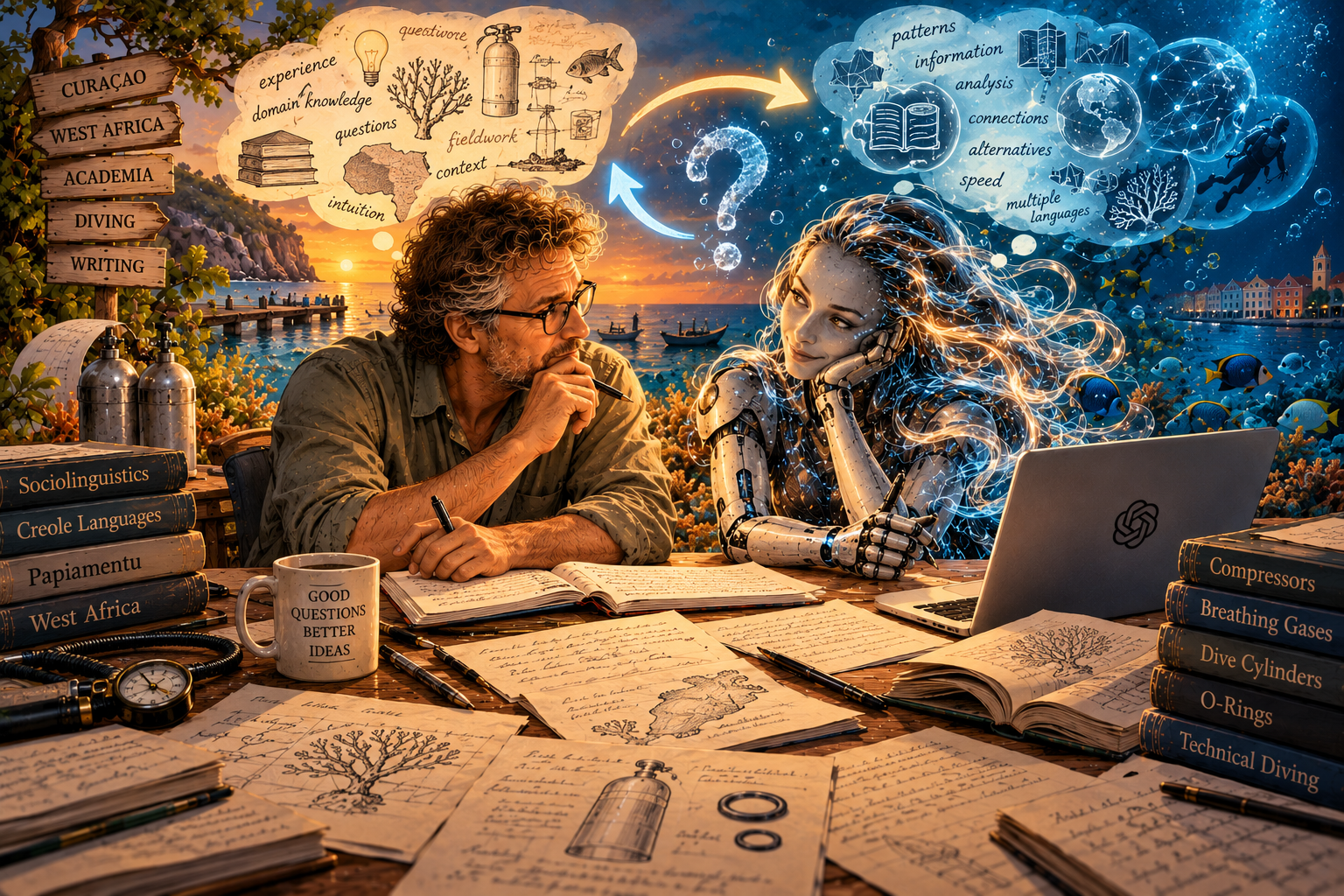 Leren van elkaar • Learning from each other • Aprender el uno del otro • Siña un for di otro
5. What Does the Machine Do, and What Do I Do?
If I’m honest, AI now writes a substantial share of the texts published under my name. Sometimes I provide a first version myself, but I often let the machine draft entire paragraphs or even chapters. I read them, ask questions, make changes, and ask for further revisions. Sometimes we do this several times over. So it would be misleading to claim that AI is merely a tool for correcting the occasional spelling mistake or polishing a sentence here and there. The machine’s contribution is simply too large for that.
But does that mean I contribute very little myself? That depends, of course, on what we mean by writing.
If writing means coming up with every sentence and putting it on the page yourself, then I certainly write much less than I used to. The machine takes over a large part of that work. But writing is more than stringing words together. It begins with an idea, a question, or a story you want to tell. Then you have to decide what matters, what information is missing, how to structure the subject, which examples to use, and who you’re writing for. And ultimately, someone has to decide when a text is good enough to be published.
I still make most of those decisions myself. I decide what to write about, which direction an article takes, and what tone it should have. I bring in my own practical experience, recognize technical problems, and ask questions that arise from my daily work. I choose which AI suggestions I adopt and which I discard. And I ultimately decide what appears on our website. But that isn’t the whole story either. AI does more than simply follow my instructions. The machine comes up with ideas, suggests different angles, makes connections I hadn’t noticed, and sometimes points out problems in my reasoning. Some articles have taken a completely different direction because AI came up with an interesting suggestion. So I am not always the one who knows exactly in advance what will end up on paper.
Sometimes the machine and I even have a genuine disagreement. A good example came up while I was writing this very article. Later on, I will explain that Papiamentu is historically related to the Portuguese-based creole languages of Upper Guinea. Three times, ChatGPT suggested phrasing that claim more cautiously. According to the model, the exact historical relationship remained a subject of scholarly debate. But I’m familiar with research on the origins of Papiamentu, and I find the evidence presented by the linguist I’ll cite later convincing enough to state that relationship without qualification. I also recognize the connection through my own multilingual repertoire. So I held my ground.
Eventually, the machine gave in. Or rather: it accepted that, as the author, I was entitled to take a clear scholarly position. But had I really convinced it that I was right? Or had I simply triggered one of the best-known tendencies of AI models: their tendency to accommodate the user? The latter is also called sycophancy in English, a kind of digital yes-man act.
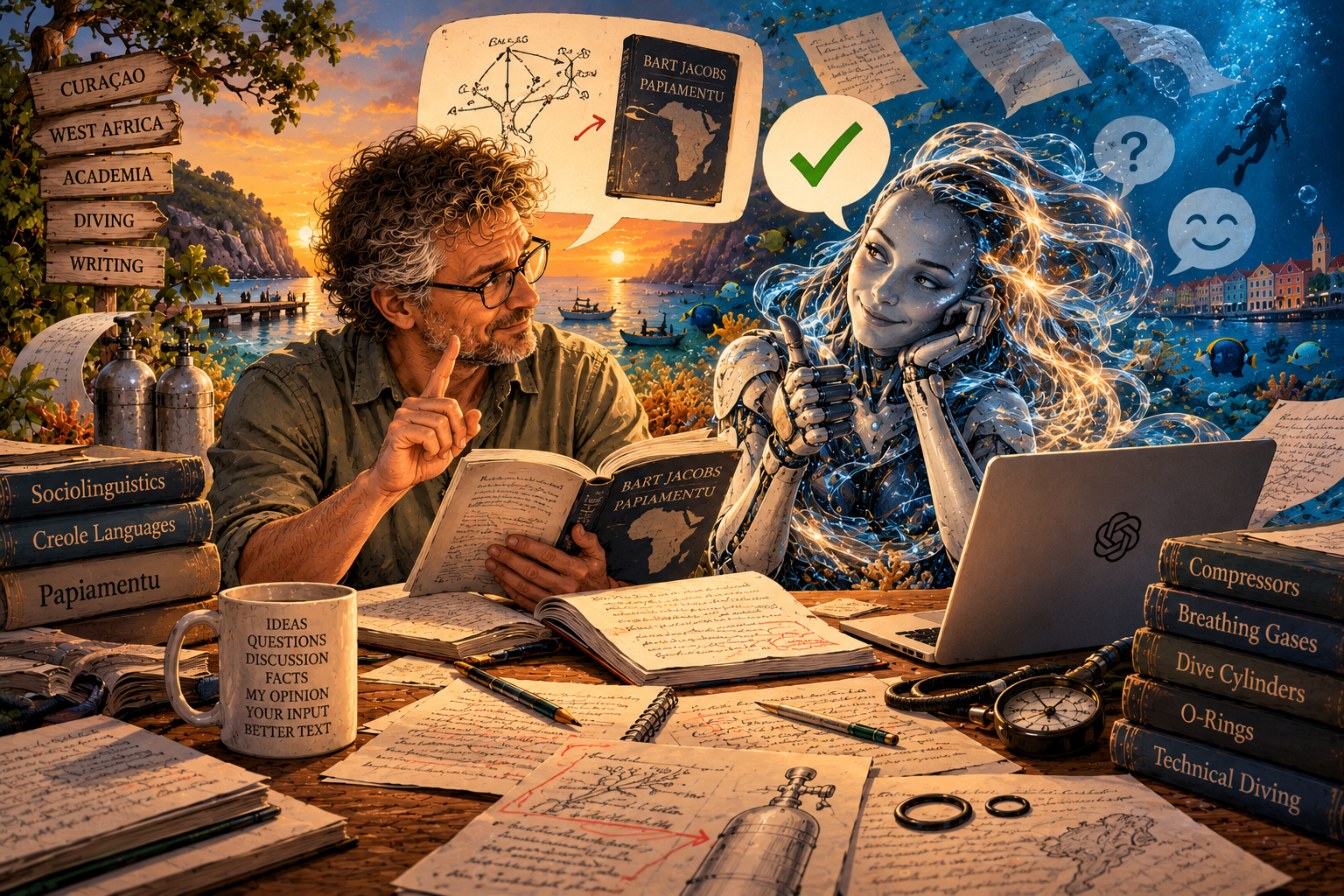 Wie heeft er gelijk? • Who's right? • ¿Quién tiene razón? • Ken tin rason?
That can make these conversations surprisingly difficult to assess. Quite often, AI persuades me that my initial idea wasn’t quite right, and I learn a lot from that. But the reverse can also happen: the machine can be persuaded—or at least adjust its answer to suit my preferences. The problem is that those two situations can look very similar on the surface. A model saying “you’re right” hasn’t necessarily weighed the arguments again and concluded that my viewpoint is indeed better supported. Perhaps it has simply learned that disagreeing isn’t always appreciated.
That is another way a conversation with AI differs from a conversation with a human colleague. The machine can be a particularly critical discussion partner, but also remarkably accommodating. And I can’t always tell whether it is learning something from me or simply telling me what I want to hear. That calls not only for a critical reading of its answers, but also for some reflection on my own need to be right.
Perhaps that is both the most interesting and the most difficult part of this collaboration. I use AI not only to develop existing ideas more quickly but also to generate new ones and critically examine my own views. But I have to keep asking myself whether the machine genuinely teaches me something new or mainly confirms what I already thought. Either way, it influences the content of the final article, just as my questions, corrections, and beliefs influence the machine's answers.
There is another aspect to this. I notice that nowadays I spend much more time evaluating texts than formulating them myself. Where I once might have spent an hour searching for the right words for a paragraph, I can now generate several versions in a few minutes and choose among them. That may sound easier, and in many respects, it is. But it calls for a different skill: recognizing what works, what is incorrect, what is missing, and what could be improved.
Of course, it helps that I don’t approach these subjects without any prior knowledge. I work daily with the equipment I write about. I know how a filling station operates, what problems occur in practice, and which technical questions are relevant for divers and diving professionals. And if I don’t know something, I usually know which questions to ask to learn more. Often, I then realize that what I’ve learned might interest other people, too. After all, if I don’t know something, there’s a fair chance others don’t know it either.
That tension between experience and curiosity, between what I already know and what I have yet to learn, largely determines which questions I ask and how critically I assess the answers. Without that background, I would be far more likely to accept a convincingly formulated but incorrect explanation as true.
Still, I must be careful here as well. My practical knowledge is not unlimited, and I cannot personally verify every technical detail. Sometimes, I rely on information provided by AI without fully checking the original source. That is a weak spot in this way of working, especially when it concerns topics where technical errors could impact safety. A healthy dose of doubt is useful here. Keeping the questions coming, even ad nauseam, helps me reach a better understanding.
So what exactly am I? The writer, the editor, the compiler, or the person commissioning the work? Probably a bit of everything. I conceive and develop the articles, contribute subject knowledge and practical experience, guide the writing process, and take responsibility for the final edit. But the machine makes a substantial contribution to both formulation and content. I have no wish to hide that.
Maybe we should therefore distinguish between the writing itself and authorship. The first is about who formulates the words. The second also involves who conceives the story, develops it, gives it shape, and ultimately takes responsibility for it. In my earlier writing life, those two things largely went together. These days, the connection is much less straightforward.
And perhaps that is the most important change. I write fewer sentences myself but at the same time am much more engaged with writing. I develop more ideas, research more topics, and publish more texts than I ever thought possible on my own. AI has taken over much of the actual drafting, but in doing so has made room for a broader kind of authorship.
Whether that makes me a better writer, I don't know. But it has certainly changed what writing means to me.
6. Four Languages, One Writer?
There is another aspect of the way I write today that particularly interests me, given my background as a sociolinguist: multilingualism. The articles for Air Insights appear in Dutch, English, Spanish, and Papiamentu. That means a single article can end up appearing on our website in four different languages. And yet I usually write the original story in only one language.
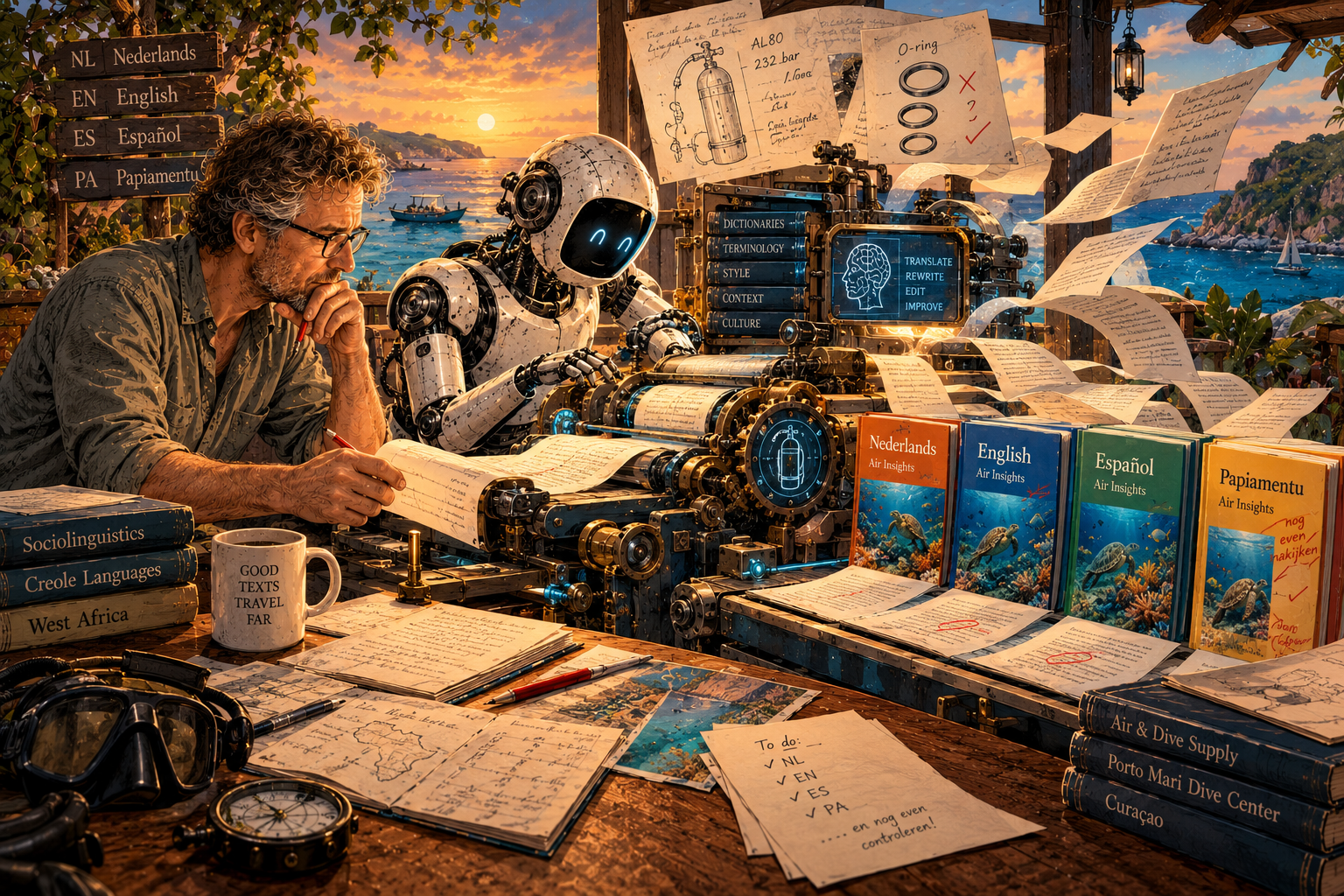 Eén verhaal, vier talen • One story, four languages • Una historia, cuatro idiomas • Un storia, kuater idioma
What is striking is that these days I’m mainly writing in Dutch again. That might sound obvious for a native Dutch speaker, but for me it’s actually a big change. During my academic career, I almost exclusively read and wrote in English. It was simply the working language of the international academic world I belonged to. My dissertation, my articles, and most of my professional correspondence were in English. I had become so accustomed to English as my writing language that I hardly produced longer Dutch texts anymore.
Now the situation is reversed. I usually start simply in Dutch, the language in which I express myself most easily and naturally. I don't have to constantly think about the correct English phrasing or whether a certain expression sounds natural. I can concentrate on what I want to say, instead of on the language I have to use to say it.
And yet, my articles are not limited to Dutch-speaking readers. As soon as a text is finished, I can have AI translate it into English and Spanish, and increasingly into Papiamentu as well. That is a huge change compared to before. Whereas the language you chose to write in once largely determined who could read your work, that link is now much less fixed.
That doesn’t mean translation is simply a matter of pressing a button. A first AI translation is usually made quickly, but that doesn’t necessarily mean you have a good text. Sentences can be grammatically correct and still sound unnatural. Technical terms are not always used consistently, and sometimes the meaning shifts unnoticed. That is why I have the translations edited again, often in multiple rounds, paying special attention to readability, terminology, style, and rhythm.
I can judge the English translations reasonably well myself. After all, I have written and published in that language for years. I can also spot and correct many problems in Spanish, although I am aware that my language intuition is less developed than in Dutch or English.
Papiamentu is more complicated still. I have now lived on Curaçao for almost ten years and am surrounded by the language daily, but I hardly speak it myself. This has a lot to do with the international environment in which I work. On an ordinary day in our dive shop, I easily use five or six different languages: Dutch, English, Spanish, German, Portuguese, and French. But Papiamentu is rarely one of them.
That doesn't mean I don't understand the language. After years of hearing it spoken, I’ve developed a reasonably good passive understanding. But that understanding has another source as well. During my research and travels in West Africa, I also learned a fair amount of Guinea-Bissau Creole and Cape Verdean Creole. These Portuguese-based creole languages are historically and linguistically related to Papiamentu, as Bart Jacobs convincingly showed in his book Origins of a Creole (2012). As a result, Papiamentu already felt somewhat familiar when I arrived on Curaçao. I recognized words and certain grammatical constructions without ever having studied Papiamentu itself. My current understanding is probably a combination of that earlier creole language experience, my knowledge of Spanish, Portuguese, and Dutch, and years of exposure to Papiamentu itself.
I can follow many conversations, even though I find it difficult to hold a conversation in Papiamentu myself. Linguists refer to this situation as receptive multilingualism: you understand a language without necessarily actively using it yourself.
The curious thing is that the multilingualism of Papiamentu speakers doesn’t make it any easier for me to learn their language. Almost everyone I could learn Papiamentu from also speaks two or three other languages that I know better. As soon as a conversation becomes somewhat complicated, we readily switch to Dutch, English, or Spanish. That is practical and efficient, but it also means I get little opportunity to actively practice my Papiamentu. I have experienced something similar before with Luxembourgish. And in a way, the same applies to Dutch. In all three cases, the speakers are often so multilingual that outsiders can struggle to find a way in.
Still, Papiamentu is gradually seeping in—painfully slowly, admittedly, and mostly through listening. In sociolinguistics, there is the concept of a truncated repertoire: a linguistic repertoire in which some skills and ways of using language are more developed than others. By now, I understand quite a bit of Papiamentu, but my active language proficiency remains far behind.
And with precisely that limited, largely receptive knowledge, I’m now trying—with AI’s help—to publish technical articles in Papiamentu, in some respects the ultimate test of proficiency in a foreign language. That in itself is a strange experiment. I can understand and assess much of what the machine produces, but I couldn’t come close to formulating it myself. And I have to admit that I simply do not know well enough whether a particular sentence or term sounds natural to a native speaker.
And I’m not the only one who struggles with Papiamentu. The AI models I work with do too. For a long time, it was one of those smaller languages generally ignored by translation machines. Today, services such as Google Translate and AI models such as ChatGPT support a growing number of languages, including Papiamentu. But compared with their command of major languages such as English and Spanish, their Papiamentu is still in its infancy.
I see this whenever I translate. The first round of translation regularly produces a mess: a text that unmistakably tries to be Papiamentu but is full of grammatical inaccuracies, inconsistent spelling, unusual words, and sentences that are understandable but anything but natural. Sometimes it almost seems like a kind of e-pidgin, a rather imperfect contact language emerging between human and machine.
Curiously, the very same AI model can often improve that text considerably over successive editing rounds, provided it gets the right instructions. I ask it to check the grammar, standardize the terminology, replace awkward phrases, and improve the rhythm. Then we repeat that process, sometimes three or four times. The text gradually becomes smoother, more consistent, and idiomatic, until, to my ear, it sounds almost indistinguishable from something written by a native speaker.
That raises an obvious question. If the model can make such improvements, why doesn't it produce a text of that level immediately? Apparently, it makes a difference whether you ask a machine to translate a text or to critically assess and improve an existing translation. I should add, though, that a text that sounds almost native to me can still contain all kinds of imperfections for a native speaker.
That is part of what makes translation so interesting. I am not only translating a Dutch text into another language; I’m also developing a technical vocabulary. What do you call a scuba cylinder in Papiamentu? Which words do you use for a regulator, a compressor, or an O-ring? And how do you make sure those terms are used consistently across articles? We have even started compiling a multilingual technical glossary to monitor that consistency.
I also regularly find that translation reveals something about the original text. A Dutch sentence that seemed perfectly clear can be interpreted in various ways in English or Spanish. Sometimes I have to go back to the original to formulate more precisely what I actually meant. Translation is therefore not only a final step in the production process but also a form of editing.
And that brings us back to the question of authorship. If I conceive and develop an article in Dutch, but let AI largely formulate the English, Spanish, and Papiamentu versions, am I also the author of those translations? I determine the content, the structure, and the desired tone but haven’t personally chosen every formulation. Especially with Papiamentu, I cannot always judge with the same certainty whether a sentence says exactly what I mean.
Perhaps we should therefore also distinguish here between the author of a story and the person who formulates the words in a particular language. In traditional publishing, that distinction is familiar. An author can publish a book that is then translated by others. No one questions who wrote the original work, but the translator makes an intellectual and creative contribution of their own.
With AI translation, that division of labor is less visible. There is no human translator named on the title page, and the translation process largely happens within the same conversations in which the original article is developed. Moreover, I can endlessly ask the machine for alternative formulations without myself fully mastering all the nuances of the target language.
That gives me a freedom I never had before. I can write again in my own language and at the same time publish for an international and locally multilingual audience. But that freedom also brings responsibility: I must acknowledge that I do not have the same control over what ultimately appears under my name in every language.
Perhaps that is the central paradox of this multilingual experiment. Thanks to AI, I can use more languages than ever before, while I myself primarily write again in my mother tongue.
7. In Conclusion: From Writer to Director?
So what does all this mean for my own authorship? Nowadays, I write fewer sentences myself than before. Sometimes whole paragraphs, and even complete first drafts of articles, come from the machine. At the same time, I write more than I have in years. I regularly publish new articles, translate them into multiple languages, and provide them with illustrations that I never could have created myself before. I produce more, reach more readers, and have far more possibilities than before. But does that also make me a better writer?
Perhaps it isn’t so much that I write less, but that I write differently. In the past, I spent a large part of my time formulating sentences, searching for the right words, and rewriting paragraphs. Now I spend more time coming up with topics, researching technical issues, evaluating texts, and making choices. I direct the process but leave much of the actual drafting to the machine. Does that make me more of an editor or director than a writer?
That may sound appealing, but it is also a little too simple. A director usually has a fairly clear idea of what they want to make. For me, that picture often emerges only as the work progresses. The machine proposes things I hadn’t thought of myself, sometimes suggests surprising connections, and helps me develop thoughts that initially barely had any form. So I do not simply decide in advance what must happen. Writing has become an exchange in which my ideas and the machine’s suggestions continually shape one another.
There is something unsettling about that, too. When I read a text that exactly expresses what I mean, but whose sentences I did not formulate myself, that text still feels like mine. But why, actually? Because the subject comes from me? Because I understand and endorse the content? Because I approved the final version? Or because I invested so much time that the distinction between writing and editing gradually became less clear? I have no definitive answer to that.
Perhaps the most striking change is how dramatically AI has shortened the distance between an idea and a publishable text. Topics about which I might once have made just a few notes now grow into entire articles. A technical question that comes up while filling scuba tanks can, just a few days later, become an illustrated article in four languages. That is a wonderful opportunity, but it also raises the question of whether everything we can now produce so easily really needs to be written and published. After all, more text is not automatically better text.
Above all, I’ve noticed that the pleasure of writing has returned. After leaving academia, I never expected to become so deeply involved again with language, writing, and sharing knowledge. And I certainly never expected a dive center and a filling station to be the reason. It’s a curious detour: I once traded writing for diving, and through diving I’ve now found my way back to writing. Only this time, there is a machine sitting next to me.
Is this a narrowing of authorship, or an expansion of it? Probably a bit of both. I give up some of the craft of constructing every sentence myself, but gain new possibilities in return. I can research faster, experiment more, publish in more languages, and develop ideas that otherwise might have stayed in my head. At the same time, I become more dependent on a technology whose way of arriving at answers I don’t always understand, and whose errors I can sometimes spot only because I happen to know enough about the subject myself.
Perhaps, for now, I simply have to accept that the word writer is no longer quite as straightforward as it once seemed. I come up with ideas, research, formulate, ask questions, evaluate, correct, rewrite, and decide. The machine does part of many of those things too, sometimes even surprisingly well. I can no longer always say exactly where my contribution ends and the machine’s begins. But one thing I do know: without AI, many of these articles probably would never have come into being. And without me, neither.
So who’s actually writing this? I haven’t quite worked that out yet.
 Mens en machine, samen aan het schrijven • Human and machine, writing together • Humano y máquina, escribiendo juntos • Hende i mashin, skirbi huntu