The Diving Cylinder – From French Invention to Modern High-Pressure Cylinder
Every diver knows the diving cylinder. It is perhaps the most familiar part of our equipment: a sturdy metal cylinder filled with breathing gas, carried on our back and connected to our regulator. We know how much air it holds and roughly how long we can dive with it. But how much do we actually know about the cylinder itself? How did the modern diving cylinder come about? Who conceived the idea of taking compressed air underwater, and how did the first pressure vessels evolve into the cylinders we use today? Why are some diving cylinders made of steel and others of aluminum, and how is such a strong, seamless metal cylinder actually produced? In this first part, we follow the history of the diving cylinder, from the first French inventions to modern production processes and materials. This is the first part of a four-part series about the diving cylinder. Welcome to the first lesson in cylinderology.

1. From Coal Mine to Underwater World
Surprisingly, the history of modern compressed air diving did not begin underwater, but deep underground in the French coal mines. Although humans have been diving underwater for thousands of years and various countries experimented with breathing apparatuses, some of the most important breakthroughs came from France. And the first of these was not intended for divers, but for miners who had to operate in dangerous, gas-filled mine tunnels.
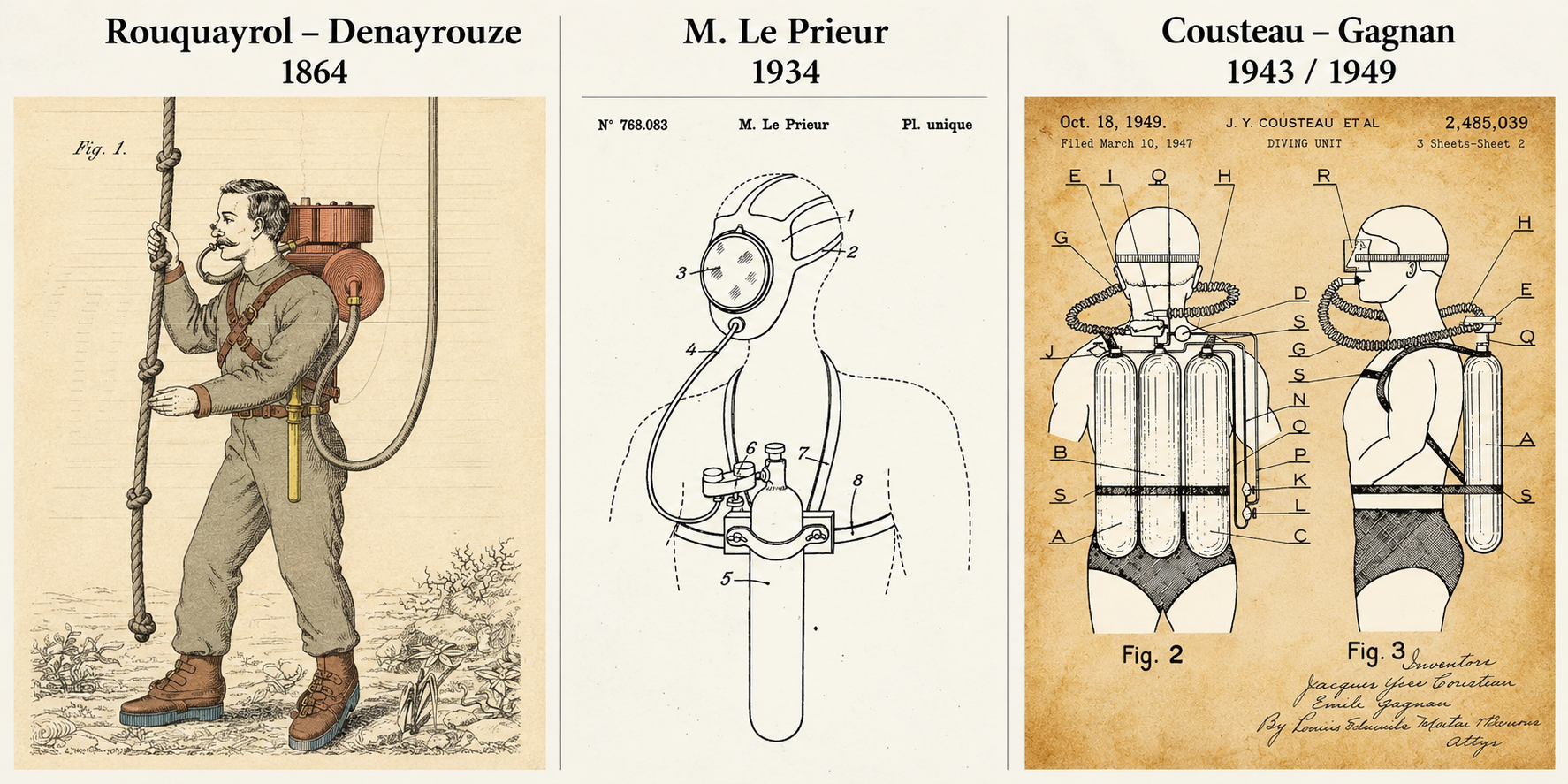
The French mining engineer Benoît Rouquayrol developed in 1860 a breathing apparatus that allowed rescue workers to operate in such conditions. A few years later, he met Auguste Denayrouze, a naval officer who had to interrupt his sea career due to illness. Denayrouze immediately saw that Rouquayrol's invention could also be used underwater. Together, in 1864, they developed a diving apparatus with a compressed air reservoir and a demand regulator that supplied air when the diver inhaled. With this, a mining engineer and a naval officer, each from their own field, laid an important foundation for modern compressed air diving.
The amount of available air was still very limited. For longer dives, people remained dependent on air supplied from the surface. Still, the device was revolutionary: for the first time, a diver had a system that automatically regulated the supply of breathing air based on their breathing. Moreover, this invention inspired Jules Verne for the diving equipment of Captain Nemo and his crew in the famous novel Twenty Thousand Leagues Under the Sea (1870). When Nemo and his men walk on the ocean floor, they are therefore not wearing entirely fictional science fiction devices but equipment based on an existing French invention from 1864.
An important next step came in 1926, when the French naval officer and inventor Yves Le Prieur, in cooperation with Maurice Fernez, demonstrated a self-contained diving apparatus that allowed a diver to move underwater without air supply from the surface. Le Prieur used industrial steel gas cylinders for this, such as those produced by the well-known tire manufacturer Michelin. The cylinders had a capacity of approximately three liters and contained compressed air at a pressure of about 150 atmospheres. They were worn on the back, so the equipment already began to resemble what we today recognize as a self-contained compressed air diving system. However, the air supply still had to be manually regulated, making the system less efficient and comfortable than modern regulators.
The major breakthrough followed in 1943, when the French naval officer and explorer Jacques-Yves Cousteau (1910–1997), together with engineer Émile Gagnan (1900–1979), developed the famous Aqua-Lung. Gagnan had worked during World War II on pressure regulators for gas engines, a technique he and Cousteau adapted for underwater use. Their main innovation was a reliable demand regulator that supplied air only when the diver inhaled and automatically adjusted for ambient pressure. This greatly reduced air wastage compared to systems with continuous air flow.
The first Aqua-Lung devices used multiple steel compressed air cylinders on the back, allowing divers to stay underwater significantly longer and move more freely. After the war, the system was further developed and commercially produced, among others by the French company La Spirotechnique. This made self-contained compressed air diving accessible to a much larger group of people and created the technical foundation for modern recreational diving.
Although regulators have been continuously improved since the time of Cousteau and Gagnan, the basic principle of the diving cylinder has remained remarkably simple: a sturdy pressure vessel in which a large amount of breathing gas is compressed, sealed with a valve. Yet, the cylinder itself has also undergone an impressive development. The first heavy steel reservoirs gave way to increasingly stronger, more reliable, and versatile diving cylinders. To understand how this was possible, we must not only look at the history of diving but also at the development of the materials from which these cylinders are made. And that history begins with the metal that forever changed nineteenth-century industry: steel.
2. Two Metals, Two Histories
The first diving cylinders were made of steel. That was no surprise: iron and steel were among the main materials of the European industrial revolution. They formed the basis for the construction of railways and bridges, the building of ships and machines, and the development of ever stronger industrial pressure vessels. Especially in the second half of the nineteenth century, large-scale steel production enabled enormous technological developments, from which the first diving devices eventually benefited.
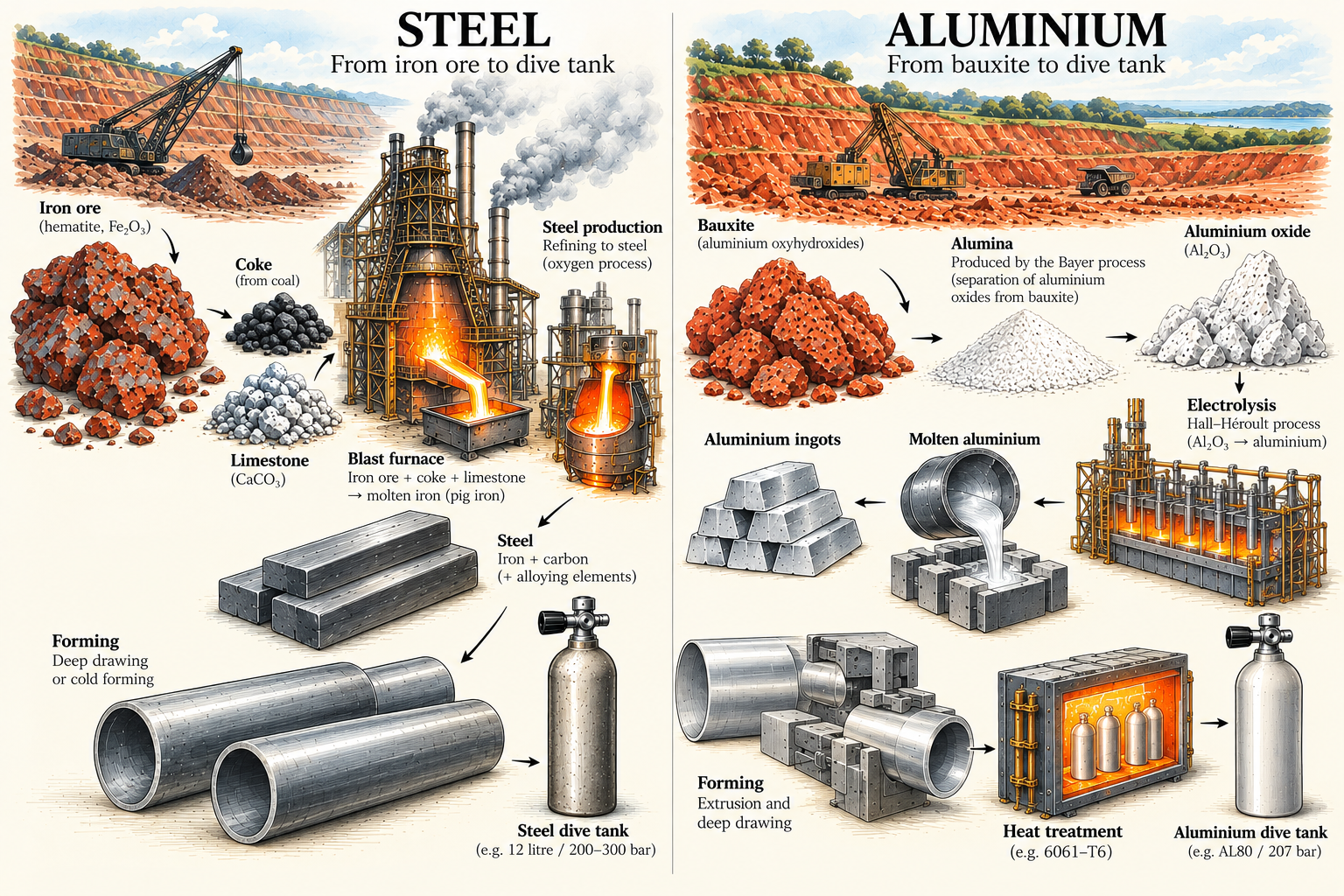
Steel is an alloy of iron and a small amount of carbon. The iron was extracted from iron ore, which in the nineteenth century was mined extensively in European mining regions such as Wallonia and the Ruhr area. Together with coal, iron ore was one of the most important raw materials of the industrial revolution. In blast furnaces, the ore was converted into pig iron using coke—a fuel made from coal—and then further processed into steel. New production methods made it possible to produce steel increasingly cheaply and on a larger scale. This made it an indispensable material for railways, bridges, ships, machines, and eventually also high-pressure cylinders. The first steel diving cylinders were thus, in a way, a direct product of the European industrial revolution.
Steel was strong, relatively inexpensive, and able to withstand large mechanical stresses. As the steel industry further developed, it became possible to manufacture increasingly stronger and more reliable cylinders that could endure higher pressures. The first independent diving devices thus used steel compressed air reservoirs. However, although steel remained for a long time the material of choice for diving cylinders, an important alternative emerged in the second half of the twentieth century: aluminum.
The history of aluminum began quite differently. In 1855, the French chemist Henri Sainte-Claire Deville presented the metal at the World Exhibition in Paris. At that time, aluminum was still a costly curiosity, even able to compete with gold in value. Today we make soda cans from it that we throw away after a few minutes. Nineteenth-century metallurgists would probably scratch their heads at that. That aluminum could become such an everyday material is mainly due to the development of new production methods.
The main raw material for aluminum is bauxite, a rock named after the southern French village Les Baux-de-Provence where it was discovered. It was only with the development of industrial electrolysis processes at the end of the nineteenth century that large-scale aluminum production became possible. In the twentieth century, aluminum grew into an important construction material, notably in aviation, the automobile industry, and machinery manufacturing. By combining aluminum with small amounts of other elements such as magnesium, silicon, and copper, alloys could be developed that were significantly stronger than pure aluminum.
From the 1960s onwards, aluminum cylinders were increasingly used for storing breathing air, but the big breakthrough in recreational diving came in the 1970s. In 1973, the aluminum 80-cubic-foot cylinder, better known as the AL80, with a working pressure of 3,000 psi (approximately 207 bar) was introduced. This model became one of the most widely used diving cylinders in the world. Aluminum cylinders were particularly popular in the United States and the Caribbean, while in Europe steel cylinders continued to make up a significant part of the market. Those geographic differences are still visible today.
Aluminum had several attractive characteristics. The material resists many forms of corrosion well, is excellently suitable for industrial processing, and has a much lower density than steel. However, this does not automatically mean that an aluminum diving cylinder is lighter. Because aluminum alloys used for diving cylinders generally have less strength than the steel types used, the walls must be made significantly thicker. As a result, an aluminum AL80 can actually be heavier dry than a comparable steel diving cylinder. Underwater, the differences become even more interesting since the external volume and thereby the amount of displaced water also play a role. We will come back to this in more detail later.
Steel and aluminum each have their own history and properties. One metal became prominent during the Industrial Revolution, the other started as an expensive rarity and grew into an everyday construction material. Both ultimately proved suitable for storing breathing gas under high pressure, but that required more than just choosing the right metal. After all, a diving cylinder must not only be strong but also manufactured in a particularly careful way. And it is precisely in this that the production of a modern high-pressure cylinder differs from that of a regular metal tube.
3. How do you make a cylinder that can withstand hundreds of bars?
A modern diving cylinder is not just a metal tube onto which a bottom and a neck are welded. Although that might seem the simplest way to make a cylinder, such a construction would pose several risks for a high-pressure cylinder. Weld seams can form weak spots, especially when a pressure vessel is filled and emptied thousands of times during its lifetime. Therefore, modern steel and aluminum diving cylinders are usually manufactured seamless: the entire pressure-bearing part consists of a single piece of metal, without welded joints.
Of course, you could also try to cast the entire cylinder in one go. With cast iron or cast aluminum, molten metal is poured into a mold, then cools and solidifies. This allows for complex shapes like an engine block or a cylinder head, but it is not a suitable manufacturing method for a diving cylinder. Cast metals generally have a less favorable combination of strength, toughness, and resistance to cyclic loading than specially developed, deformed metal alloys. During solidification, a crystalline grain structure forms, whose properties depend, among other things, on the cooling rate. Moreover, small gas bubbles, shrinkage cavities, and inclusions can remain in the casting. Such irregularities can form weak spots under high pressure and repeated loading. Especially cast iron is relatively brittle and therefore unsuitable for this kind of pressure vessel. The solution is not to cast the metal in its final shape but to deform it under great force in the solid state. With the right processing and heat treatments, a material with the desired mechanical properties arises.
That sounds simpler than it is. A manufacturer must reshape a piece of steel or aluminum into a hollow cylinder with a closed bottom, a precisely formed neck, and walls that are sufficiently strong everywhere. The material must be carefully handled throughout the production process so that the final cylinder meets all strength requirements. The shape of the cylinder is at least as important as the strength of the metal. A cylindrical wall distributes the forces from the internal pressure across the material, while the carefully shaped bottom and shoulder help prevent large local stress concentrations. Even the transition from the shoulder to the neck must be carefully designed because the valve is attached there and the structure locally changes shape.
In the production of steel diving cylinders, manufacturers often start with a steel tube or a solid piece of steel. Depending on the production process, the material is heated, pressed, drawn, or rolled until a cylindrical pressure vessel arises. In some methods, a solid piece of steel is pressed into a hollow shape, while in others, a seamless tube serves as the starting point. Next, the top is narrowed into a neck through heating and deformation, in which later the threading for the cylinder valve is made. The bottom also receives its final shape. The result is a cylinder whose wall, shoulder, and neck form one continuous whole.
However, the steel cylinder is not finished yet. During forming and processing, the internal structure of the metal changes, and this can also alter the mechanical properties. Therefore, a carefully controlled heat treatment usually follows, during which the steel is heated and cooled according to a prescribed temperature profile. Depending on the type of steel and production method used, this can, for example, consist of hardening and tempering. This gives the material the desired combination of strength and toughness. After all, a diving cylinder must not only withstand large forces but also remain sufficiently deformable so that it does not suddenly break under local overload.
Aluminum cylinders are made differently. A widely used method is cold extrusion. In this process, a solid aluminum block, also called a billet, is pressed under enormous pressure into a mold. A punch compresses the metal so forcefully that it is pushed upward along the punch, forming a hollow cylinder with a closed bottom. In this way, an almost complete cylinder is formed from a single piece of aluminum, without needing to weld a bottom. It is an impressive production process, where a relatively simple block of metal quickly transforms into a precisely shaped pressure vessel.
The term cold extrusion is somewhat misleading. It mainly means that the aluminum is not preheated to the high temperatures commonly used in hot extrusion. During pressing, the material can still become quite warm due to the enormous deformation and the heat released. After extrusion, the top of the cylinder is narrowed into a neck by means of a forming process. Subsequently, the cylinder and neck are further processed, and the aluminum undergoes a heat treatment to achieve the desired mechanical properties. Especially with aluminum alloys, this treatment is very important: the final strength depends not only on the chemical composition but also on how the material has been deformed, heated, and cooled.
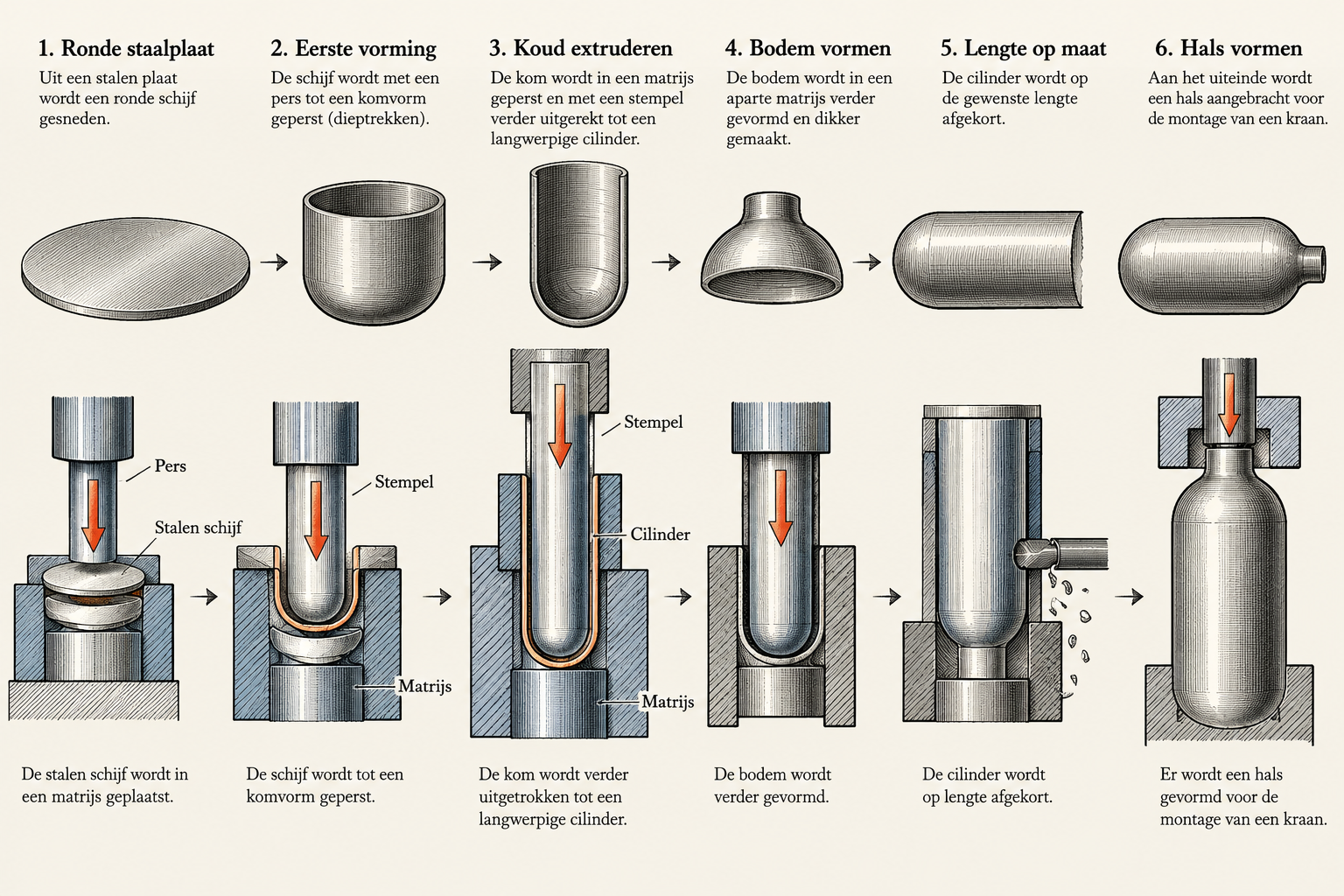
Both steel and aluminum diving cylinders then undergo extensive quality control. The manufacturer checks dimensions, wall thickness, finishing, and material properties. The threading in the neck must also be precisely manufactured so that the cylinder valve fits correctly and the connection remains reliable under high pressure. Additionally, the cylinders are pressure tested according to applicable production standards. In a hydrostatic test, the cylinder is filled with water and exposed to pressure significantly higher than its normal operating pressure. This verifies whether the cylinder can safely withstand the load and, depending on the prescribed test method, whether the deformation remains within allowed limits.
Only when a cylinder meets all requirements may it be delivered as an approved pressure vessel. The shoulder is marked with identification data, working pressure, inspection information, and other mandatory markings. This information serves as the technical passport of the cylinder. What seems a relatively simple piece of equipment to the diver is thus the end result of a carefully controlled industrial production process.
But even when two cylinders are manufactured in almost the same way, they need not have the same properties. Not all steel is equally strong, and there are significant differences between aluminum alloys as well. Furthermore, how a metal responds to stress determines whether a cylinder can safely withstand high pressure for years. To understand that, we need to look a bit deeper into the material science behind the modern diving cylinder.
4. Stronger Than It Appears – The Science Behind the Material
A diving cylinder must be strong enough to withstand hundreds of bars of pressure, but strength alone is not enough. The material must also have some elasticity, resist repeated loads, and behave as predictably as possible under extreme conditions. That may seem obvious, but metals can vary greatly in how they respond to pressure, deformation, and long-term loads. Even two cylinders both made of aluminum can have very different mechanical properties.
When we speak of a steel or aluminium diving cylinder, we are actually talking about different kinds of metal alloys. Pure iron, for example, is too soft for most technical applications. By adding small amounts of carbon and other elements and treating the material properly, steel is created with specific mechanical properties. For diving cylinders, high-quality steel types are used that combine high tensile strength with sufficient toughness. The latter is important: a pressure vessel must not only withstand high stresses, but also be resistant to slight deformations and variable loads without sudden breaking.
With aluminium, the choice of alloy is at least as important. Many modern aluminium diving cylinders are made from the 6061-T6 alloy. The designation 6061 refers to an aluminium alloy to which magnesium, silicon, manganese, copper, and chromium among others have been added. The addition T6 means that the material has undergone a specific heat treatment and artificial aging to increase its strength. The result is an alloy offering a good combination of strength, ductility, and corrosion resistance. So it is not just about aluminium, but about a carefully composed and treated material.
That has not always been the standard. In the past, diving cylinders were also made from the aluminium alloy 6351-T6. This differs in composition from 6061-T6 and proved more susceptible in certain cylinders to a phenomenon called sustained-load cracking: cracking that can occur when the material is under high stress for a long period. Especially at the neck and the thread, where the cylinder valve is attached, this could cause problems. Not every cylinder made of 6351-T6 developed such cracks, but the risk was serious enough to lead to additional inspection procedures and changes in material choice. Luxfer switched for its American aluminium diving cylinders in 1987–1988 to 6061-T6. This example shows that the safety of a diving cylinder does not depend solely on the pressure it is designed for, but also on the precise composition and treatment of the material.
To understand how such materials behave under pressure, we need to distinguish between elasticity and permanent deformation. When a diving cylinder is filled, the compressed air exerts a tremendous force on the inner wall. The metal stretches very slightly as a result. As long as the load remains within the elastic range, the cylinder almost completely returns to its original dimensions after the pressure is released. This is called elastic deformation. It is an essential characteristic of a well-designed pressure vessel: the cylinder must be able to expand and contract thousands of times without permanently changing shape.
If the load becomes too great, the material can exceed its elastic limit. Then plastic deformation occurs: a permanent change of shape. At even higher loads, breakage can occur. Therefore, diving cylinders are designed with significant safety margins and tested at pressures higher than their normal working pressure. A diving cylinder must therefore be able to flex a little throughout its life without sustaining lasting damage. A trait you might wish humans were also equipped with as standard.
But even when the load always remains within the elastic range, repeated use can have long-term effects. After all, a diving cylinder is not filled only once but potentially thousands of times over its service life. Each filling causes a new change in the material's stress. Such repeated loads can contribute to material fatigue, where microscopic cracks form or existing cracks slowly grow. How quickly this happens depends on the type of material, the construction, the size of the pressure changes, and any damage. A well-designed diving cylinder is calculated for a large number of pressure cycles, but that does not mean it can be used indefinitely or without inspection.
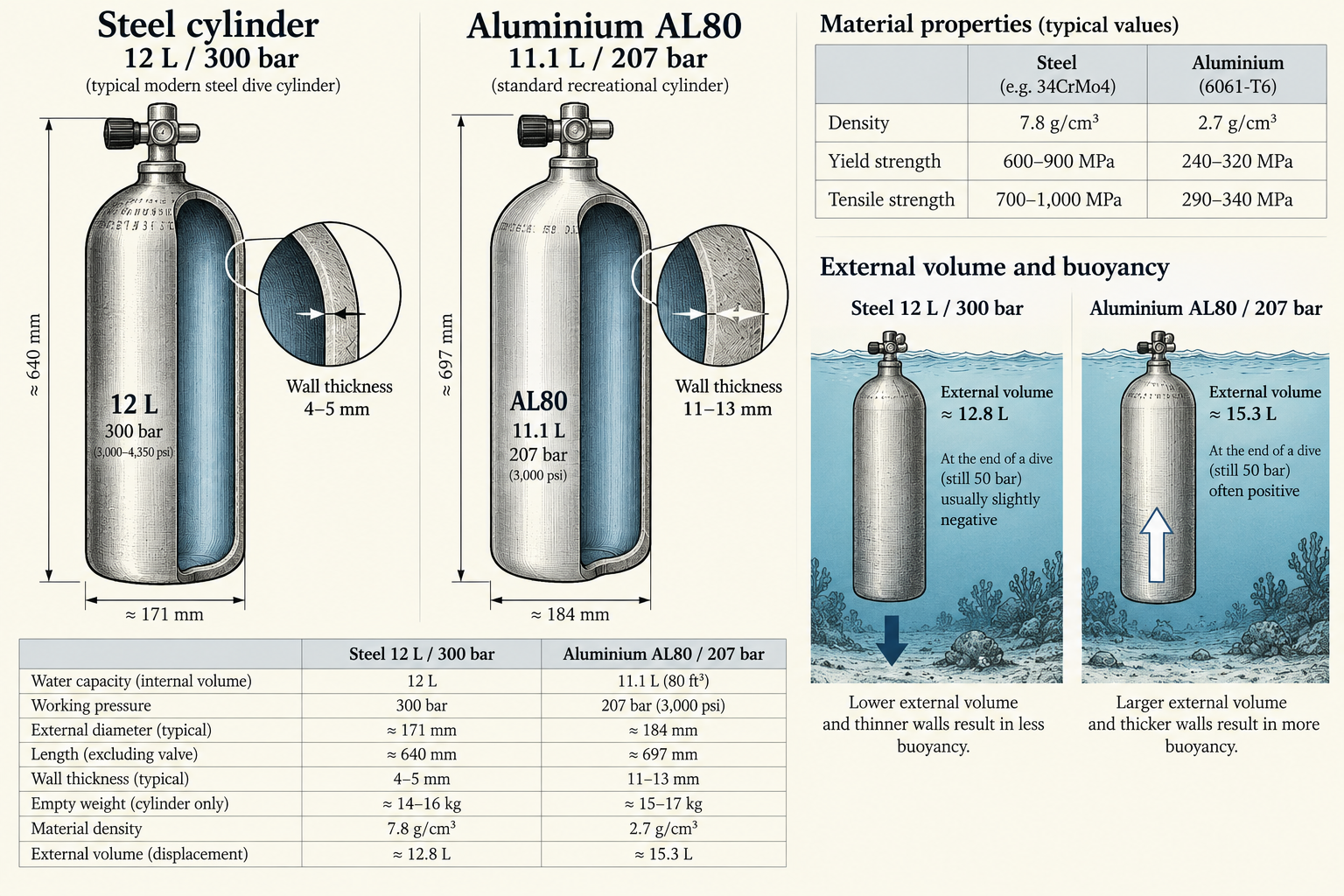
The differences in mechanical properties between steel and aluminium become particularly clear when we look at the wall thickness. Steel has a density of about 7.8 grams per cubic centimetre, while aluminium weighs only about 2.7 grams per cubic centimetre. A piece of aluminium with the same volume is therefore almost three times lighter than steel. You might expect, therefore, that an aluminium diving cylinder is considerably lighter than a steel one. In practice, however, this often disappoints, because the material's strength is at least as important as its density.
The high-quality steel types used for diving cylinders can generally withstand significantly higher mechanical stresses than aluminum alloys such as 6061-T6. To safely withstand the same internal pressure, an aluminum cylinder therefore usually requires thicker walls. For example, a common steel 12-liter cylinder has a wall thickness of about 4 to 5 millimeters, while the wall of an aluminum AL80 is typically 11 to 13 millimeters thick. This is about two and a half to three times as thick. Consequently, considerably more material is needed, which means much of the lightweight advantage of aluminum is lost. On dry land, an aluminum cylinder can even be heavier than a steel cylinder with a comparable gas capacity.
The greater strength of steel also makes it possible to design relatively compact diving cylinders for higher working pressures. Many aluminum cylinders have a working pressure of about 207 bar (3,000 psi), although there are also models for 228 bar (3,300 psi), such as the AL100. Steel diving cylinders, on the other hand, are available for 200, 232, and even 300 bar. A 12-liter steel cylinder at 300 bar can therefore hold significantly more breathing gas than an equally sized cylinder at 200 bar. This higher pressure does place more stringent demands on the construction, the cylinder valve, and the filling station. It should be noted, however, that this is not an absolute pressure limit of aluminum as a material, but rather a difference between typical designs and applications in diving.
The thicker walls of aluminum cylinders have another consequence: for the same water content, their external volume is usually larger. Underwater, this means they displace more water and therefore experience more buoyant force. According to Archimedes' principle, this buoyant force is equal to the weight of the displaced water. This partly explains why an aluminum AL80 can become positively buoyant at the end of a dive, while many steel cylinders remain negatively buoyant even at low cylinder pressures. The exact difference naturally depends on the cylinder model, the weight of the valve, and the amount of breathing gas still present. In the second part of Cylinderology, we will return extensively to these buoyancy differences.
The choice between steel and aluminum is thus much more complicated than the question of which metal is lightest or strongest. The composition of the alloy, the heat treatment, the wall thickness, and the shape of the cylinder together determine how a diving cylinder behaves under pressure. But a diving cylinder must not only withstand forces from within. It is also exposed to water, salt, oxygen, and sometimes years of intensive use. It is precisely these external influences where steel and aluminum again show very different properties.
5. Steel or aluminum: which cylinder is better?
After all the differences in composition, strength, and wall thickness, the question remains which diving cylinder is actually the best. There is no simple answer. Steel and aluminum each have their own advantages and limitations, and what is ideal for one diver may not be so for another. This is influenced not only by dimensions, weight, and working pressure but also by the conditions under which a cylinder is used and maintained. Especially the way both metals react to water and oxygen is of great importance.
Steel can rust in the presence of water and oxygen. This produces iron oxide, which usually forms as a porous, reddish-brown layer on the surface. Unlike some other metals, this layer generally does not sufficiently protect the underlying steel, allowing the corrosion process to continue. Especially in a moist, salty environment, this can become a serious problem. Therefore, steel diving cylinders are usually coated on the outside with a protective layer, while the inside must mainly prevent moisture ingress. A well-maintained steel cylinder can last for decades, but once serious corrosion develops, the strength of the pressure vessel can drop significantly.
Aluminum behaves differently. Once it comes into contact with oxygen, a very thin layer of aluminum oxide forms on the surface. This layer adheres firmly to the metal and protects it against further deterioration in many conditions. This makes aluminum relatively corrosion-resistant, which is an important advantage in the maritime environment in which diving cylinders are used. Nevertheless, this does not mean aluminum is immune to corrosion. Especially in the presence of chlorides, such as in seawater, localized attack can occur. Small pits form on the surface, a phenomenon called pitting corrosion. Galvanic corrosion can also occur when different metals make electrical contact in the presence of a conductive liquid.
For both materials, corrosion becomes particularly dangerous when it affects the thickness or strength of the cylinder wall. A cylinder that looks excellent on the outside can have severe internal damage, for example if moist breathing air has entered during filling. Conversely, damage to the paint on a steel cylinder does not automatically mean the cylinder is unsafe. Ultimately, it depends on the nature, depth, and extent of the damage. This is why periodic visual inspections and hydrostatic testing are so important. In the fourth part of Cylinderology, we will extensively revisit the different forms of damage and the criteria that determine whether a cylinder can still be used safely.
A common assumption is that aluminum cylinders last longer than steel ones simply because aluminum does not rust. However, it is not that simple. Both steel and aluminum diving cylinders can be safely used for decades, provided they are well maintained, filled according to regulations, and pass the required inspections and tests. There is no universal maximum lifespan that applies to every diving cylinder. Some cylinders have a service life set by the manufacturer or applicable standard, while others can in principle remain in use as long as they meet all inspection criteria.
In practice, the lifespan is mainly determined by the conditions of use. A steel cylinder that is always kept dry and carefully maintained can last very long. An aluminum cylinder that is regularly exposed to saltwater, mishandled, or develops damage to the neck can on the other hand be rejected prematurely. The quality of the breathing air also plays an important role. Moisture that enters a cylinder during filling can cause significant damage over time, regardless of the material of the cylinder. Proper maintenance and careful filling are therefore at least as important as the choice between steel and aluminum.
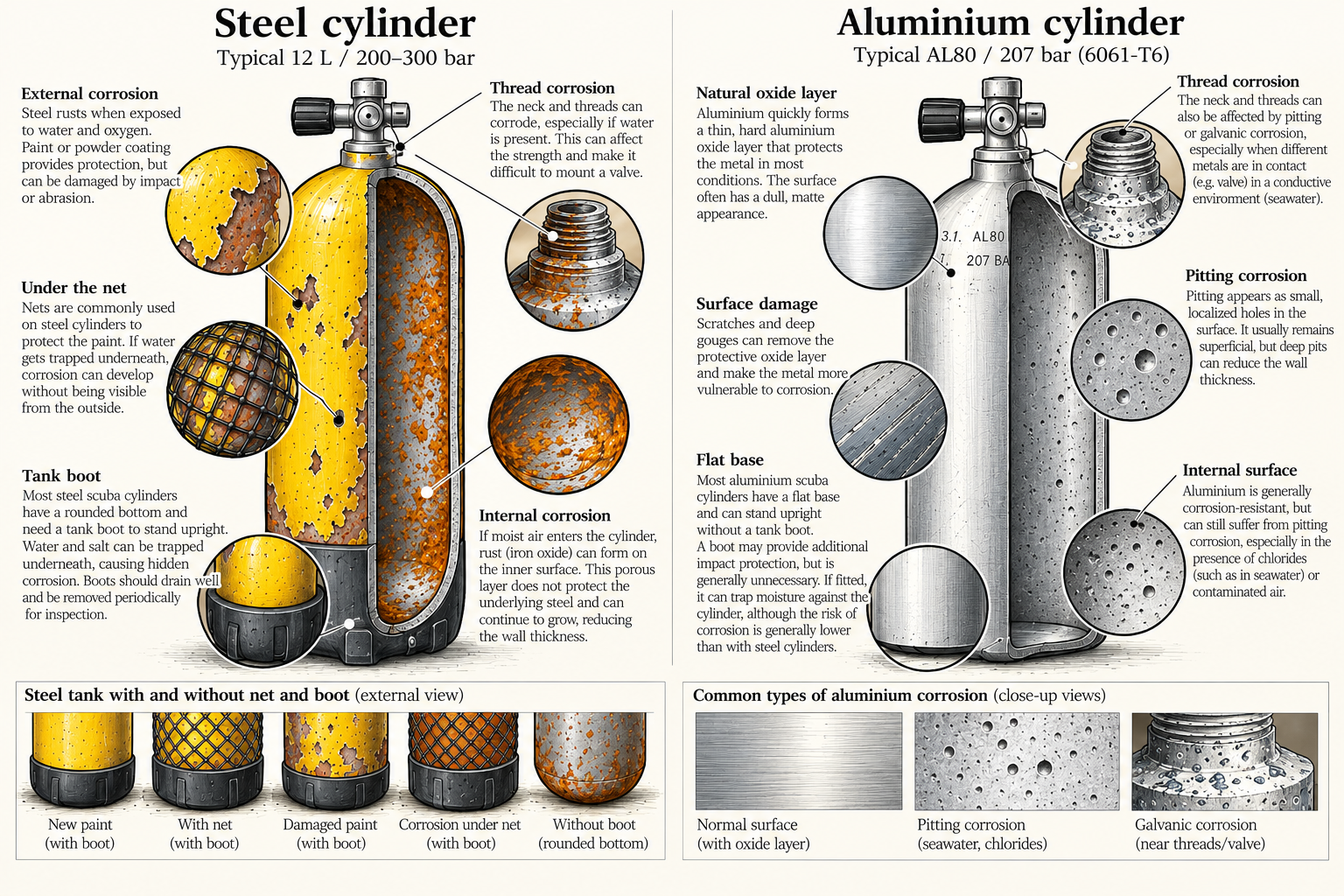
Besides corrosion resistance and lifespan, there are of course practical differences. Steel diving cylinders can be made compact thanks to their relatively thin walls and are available for high working pressures. Moreover, many steel cylinders remain negatively buoyant underwater, even when almost empty. This can be attractive for divers who want to limit their amount of lead. Aluminum cylinders, on the other hand, are particularly popular in recreational diving, especially in warm water destinations. They are well resistant to many forms of corrosion, are mass-produced, and usually have predictable buoyancy characteristics. An aluminum AL80, for example, often becomes less negatively and ultimately positively buoyant as the air supply decreases. This requires a different approach to weight distribution but is not a disadvantage as long as the diver takes it into account.
These properties also play an important role in technical diving. Aluminum cylinders are often used as stage and decompression cylinders because their buoyancy changes during the dive and they, depending on the model and configuration, can be relatively easily carried alongside the body. Steel cylinders are popular for larger gas supplies, for example in twin sets on the back. Their relatively compact size and high working pressure make it possible to carry a lot of breathing gas without the equipment becoming needlessly bulky. The best material choice therefore depends not only on the metal's properties but especially on how the cylinder is used.
Ultimately, steel and aluminum are not competitors where one must necessarily win. Both materials have proven themselves over decades as reliable bases for modern diving cylinders. Steel offers great strength and enables compact cylinders with high working pressures, while aluminum combines good corrosion resistance with properties attractive for many recreational and technical applications. Which cylinder is most suitable depends on the desired gas supply, diving conditions, buoyancy, maintenance, and of course the diver's personal preference.
6. Carbon Composite: The Third Path Besides Steel and Aluminum
Anyone who thinks diving cylinders are made exclusively of steel or aluminum has overlooked a third material type: carbon composite. These cylinders are significantly lighter than their metal counterparts and are usually designed for high working pressures, often 300 bar. In Europe, you occasionally encounter them, especially in specialized and professional diving applications. In the United States and the Caribbean, they are much less common in recreational diving. This is remarkable because on paper, a cylinder that weighs less and can hold more gas seems almost the ideal diving cylinder.
The origin of this technology does not lie in diving but in aerospace. From the 1950s and 1960s, engineers experimented with pressure vessels and rocket parts that were not entirely metal but reinforced with fibers wound under tension around an inner wall. Especially NASA invested extensively in this technique in the 1960s and 1970s. The first composite pressure vessels primarily used fiberglass, later followed by materials including Kevlar and carbon fibers. Consequently, there is no single inventor of the modern carbon cylinder. The technology emerged from decades of research into materials that had to be both light and exceptionally strong.
A surprising step towards the modern breathing air cylinder came from a collaboration between NASA and the U.S. fire department. In 1972, companies were tasked with developing lighter breathing air cylinders because the heavy steel cylinders represented a considerable burden for firefighters. One of the new composite cylinders weighed about 12 kilograms, compared to over 18 kilograms for a steel cylinder with the same gas capacity. The American company Structural Composites Industries, founded in 1971 by four former Aerojet engineers, played an important role in this. Luxfer also began producing fiberglass-reinforced cylinders in 1976 and introduced fully wrapped composite cylinders ten years later. In the 1990s, even more advanced versions using carbon fibers appeared. Thus, a technology originally developed for rockets and spacecraft found its way to diving via the fire department.
Remarkably, this technology, largely developed in America, saw only limited adoption in the American recreational diving scene. An important explanation lies in the different pressure standards and approval rules on either side of the Atlantic. In Europe, steel diving cylinders with a working pressure of 300 bar had been available for some time. Carbon composite was a logical addition: the same high working pressure but with significantly lower weight. In the United States, the situation was different. There, the common high-pressure diving cylinders do not exceed 3,442 psi, about 237 bar. Current DOT regulations do not allow the transport of metal diving cylinders with higher fill pressures on public roads. Separate approval options exist for composite cylinders, but these can impose special conditions on underwater use, inspection, and lifespan. Partly for this reason, the 300-bar diving cylinder has never become a self-evident alternative to the traditional steel and aluminum cylinders in the U.S.
The name carbon refers to carbon fibers, extremely thin fibers made mostly of carbon and having very high tensile strength. But a carbon cylinder does not consist of a single solid piece of carbon. It is a composite construction in which different materials work together to withstand the pressure of the stored gas. The word composite comes from the Latin compositus, meaning assembled. In this case, that is particularly fitting: the strength arises from the combination of materials with different properties.
In a conventional steel or aluminum diving cylinder, the metal wall bears almost all the mechanical load. In a composite cylinder, that task is wholly or partially taken over by a winding of strong fibers. Inside is a so-called liner, a thin inner wall that holds the gas. Around this, carbon fibers are applied, impregnated with a synthetic resin, usually epoxy. After curing, this forms a strong, relatively light structure.
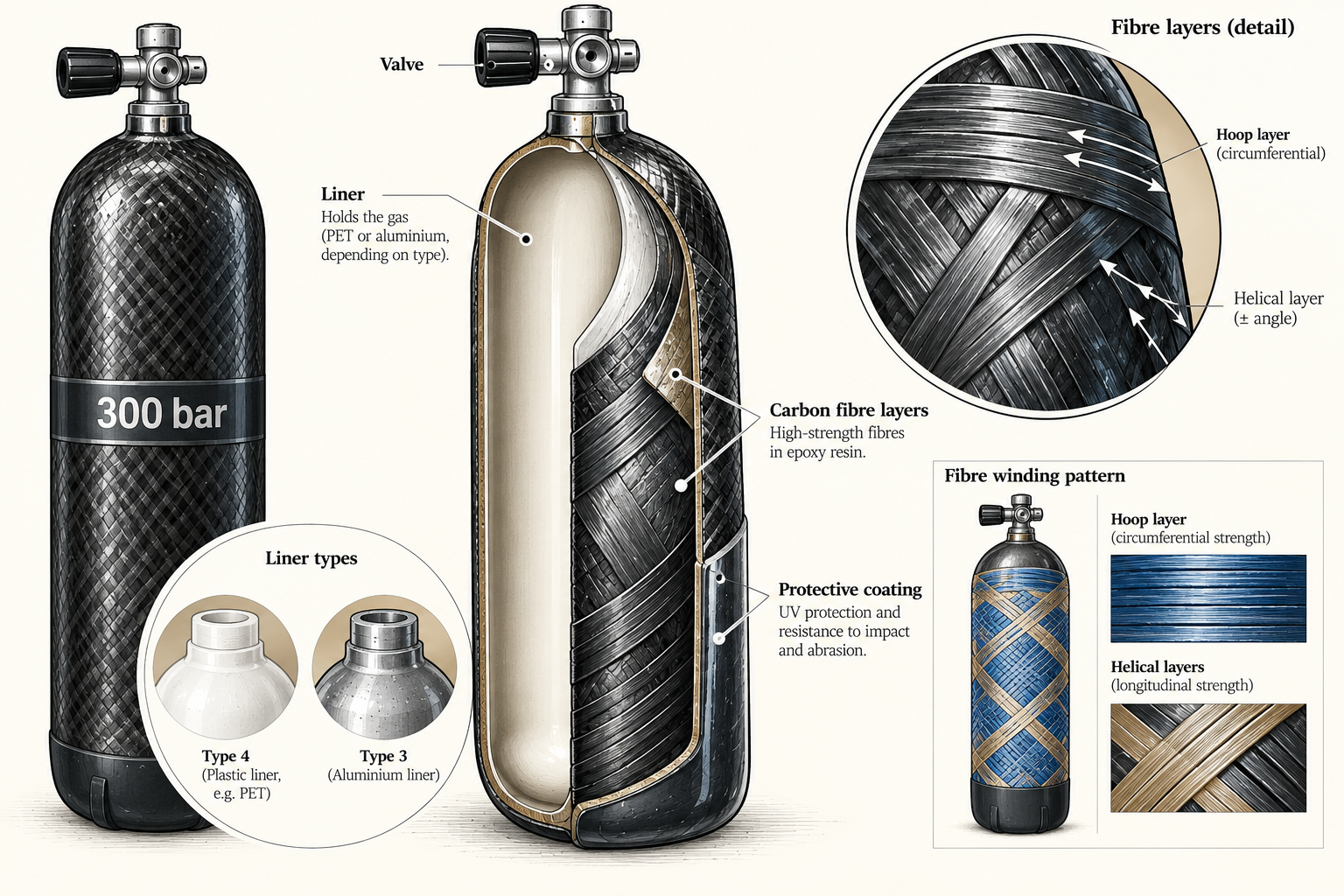
There are different types of composite pressure vessels. In some, a metal liner continues to bear a significant portion of the load. In others, the so-called Type 4 cylinders, the liner is made of plastic and the pressure is almost entirely absorbed by the fiber-reinforced outer wall. A manufacturer like CTS, for example, uses a liner made of PET, the same type of plastic we know from beverage bottles, although it obviously involves a specially developed composition. The carbon fibers provide the strength, while the liner prevents the gas from escaping through the construction.
The production method therefore differs greatly from that of a metal diving cylinder. Instead of deforming a metal tube or extruding an aluminum block, the liner is first made. Subsequently, fibers are wrapped under controlled tension around the cylinder, both in circumferential direction and at various angles. That orientation is important: the forces that load the cylinder longitudinally are not the same as the forces that try to push the wall outward. By applying the fibers precisely, the material can be reinforced exactly where it is needed. After winding, the resin is cured and the cylinder usually receives a protective outer layer or coating. The result is a pressure vessel that can achieve a considerably higher ratio of strength to weight than a conventional metal cylinder.
Many composite cylinders are designed for a working pressure of 300 bar, compared to the 200 bar we encounter in many conventional diving cylinders. As a result, a relatively small cylinder can store a significant amount of breathing gas. For example, a 7-liter cylinder at 300 bar has a nominal gas volume of 2,100 liters when simply multiplying the water volume by the filling pressure. A traditional 10-liter cylinder at 200 bar yields 2,000 liters according to the same calculation. In reality, these amounts are slightly lower, especially at 300 bar, because air under high pressure no longer behaves exactly according to the ideal gas law. We will cover this more thoroughly in the second part of Cylinderology.
However, anyone who wants to dive with a 300-bar cylinder should realize that there are some practical limitations. To begin with, the first stage of the regulator must be suitable for this higher working pressure. But at least as important is the availability of a filling station that can actually deliver 300 bar. That is not everywhere a given. Anyone who can only fill their 300-bar cylinder up to 200 bar each time loses a large part of the advantage they bought the cylinder for.
The greatest advantage of composite is the low weight. For firefighters, rescue workers, and other users of portable breathing apparatus, that is particularly attractive. They constantly carry their cylinders on their back, without the weight being compensated by water. Every kilogram less means less physical strain and more freedom of movement. It is therefore not surprising that composite cylinders have become much more common in these sectors than in recreational scuba diving.
Underwater it is more complicated. A diving cylinder not only has weight but also buoyancy. A steel cylinder usually contributes to the ballast needed by the diver. A much lighter composite cylinder can, depending on construction and the amount of remaining gas, have a significant positive buoyancy. That means the diver has to carry extra lead to compensate for the weight loss of the cylinder. The weight you save in the parking lot may need to be added underwater.
That does not automatically make composite unsuitable for diving. Some professional systems make use of separate, adjustable ballast weights. The diver can then carry the light cylinders comfortably to the dive site and only attach the needed ballast just before entering the water. For rescue divers, who sometimes have to cover long distances over land before reaching the water, this can be an important advantage. For a recreational diver taking the cylinder straight from the dive shop to the boat, this gain is generally smaller.
Composite cylinders also differ from metal cylinders in terms of maintenance and inspection. A steel cylinder can rust and an aluminum cylinder can develop corrosion or cracks, but with composite, other forms of damage play a role. Deep scratches, dents, damaged fibers, resin degradation, or delamination of various material layers can affect the strength of the construction. Such damage is not always assessed in the same way as with a metal cylinder.
Moreover, not every composite cylinder is suitable for underwater use. A cylinder approved for firefighter breathing air is not automatically allowed to be used as a diving cylinder. In some constructions, water can get between protective layers and the actual pressure wall. Therefore, both the certification and the manufacturer's instructions must explicitly permit underwater use.
The lifespan also deserves attention. Older composite cylinders often have a fixed maximum use period, for example fifteen years. Modern versions, on the other hand, may have a so-called Non-Limited Life approval, where no fixed end date is prescribed. Of course, this does not mean that such a cylinder can be used indefinitely without inspection. The prescribed inspections remain necessary, and a damaged cylinder can be rejected well before the end of its theoretical lifespan.
Composite cylinders demonstrate how far the development of pressure vessels has advanced by now. Where the first divers had to carry heavy metal reservoirs, modern manufacturers can build cylinders in which a thin plastic inner lining and carefully wound carbon fibers together withstand hundreds of bars of pressure. It is an impressive feat of materials science, but that does not automatically make it the best solution for every diver.
The higher purchase price, the specific inspection requirements, the availability of 300-bar filling stations, and especially the buoyancy underwater explain why steel and aluminum remain the standard for now. Composites offer interesting possibilities, especially when low weight above water is important, but the ideal diving cylinder still does not exist. Which material is most suitable ultimately depends on what you want to do with that cylinder.
In Conclusion
And with that, we have reached the end of the first part of Cylinderology. We have seen how the diving cylinder has developed over a century and a half, from the first experiments with compressed air to the modern high-pressure steel and aluminum cylinders. Behind that seemingly simple metal cylinder lies a long history of technical innovation, materials science, and ever-improving production methods.
Yet this does not tell us how a diving cylinder behaves underwater. How much breathing gas is really in a cylinder, why do Americans use different sizes than Europeans, and what happens to buoyancy when we slowly exhale the cylinder? In the second part of this series, we leave the history behind and dive into the physics of the diving cylinder.