Beyond Compressed Air: From Nitrox to Hydrogen, or Why Divers Use Different Breathing Gases
Ordinary compressed air is ideal for many dives, but for certain dives other breathing gases are used, such as Nitrox (air enriched with extra oxygen) and Trimix (a mixture of nitrogen, oxygen, and helium). In this article, we trace the development of diving through these breathing gases: from the rise of Nitrox to experiments with hydrogen-containing mixtures for extremely deep dives. We discuss applications of different gases, methods for mixing, analyzing, and identifying gases, and the related training. This is not a practical manual, but an accessible guide to the gas physics and chemistry behind every dive.
1. Air Is But One Breathing Gas
In the previous article, we looked in detail at compressed air: where the air we breathe underwater comes from, how a compressor compresses that air, and the requirements for good breathing air. For most recreational dives, ordinary compressed air is an excellent breathing gas. It is cheap, virtually everywhere available, and relatively easy to produce.
But air is not the only gas we can dive with. In fact, as soon as we want to dive longer or deeper, we encounter properties of ordinary air that become less favorable. Nitrogen becomes narcotic under increasing pressure and is absorbed by our body during the dive. Oxygen, which we obviously need to live, can become toxic at too high a partial pressure. And at great depths, air becomes so dense due to increasing pressure that breathing itself requires more effort.
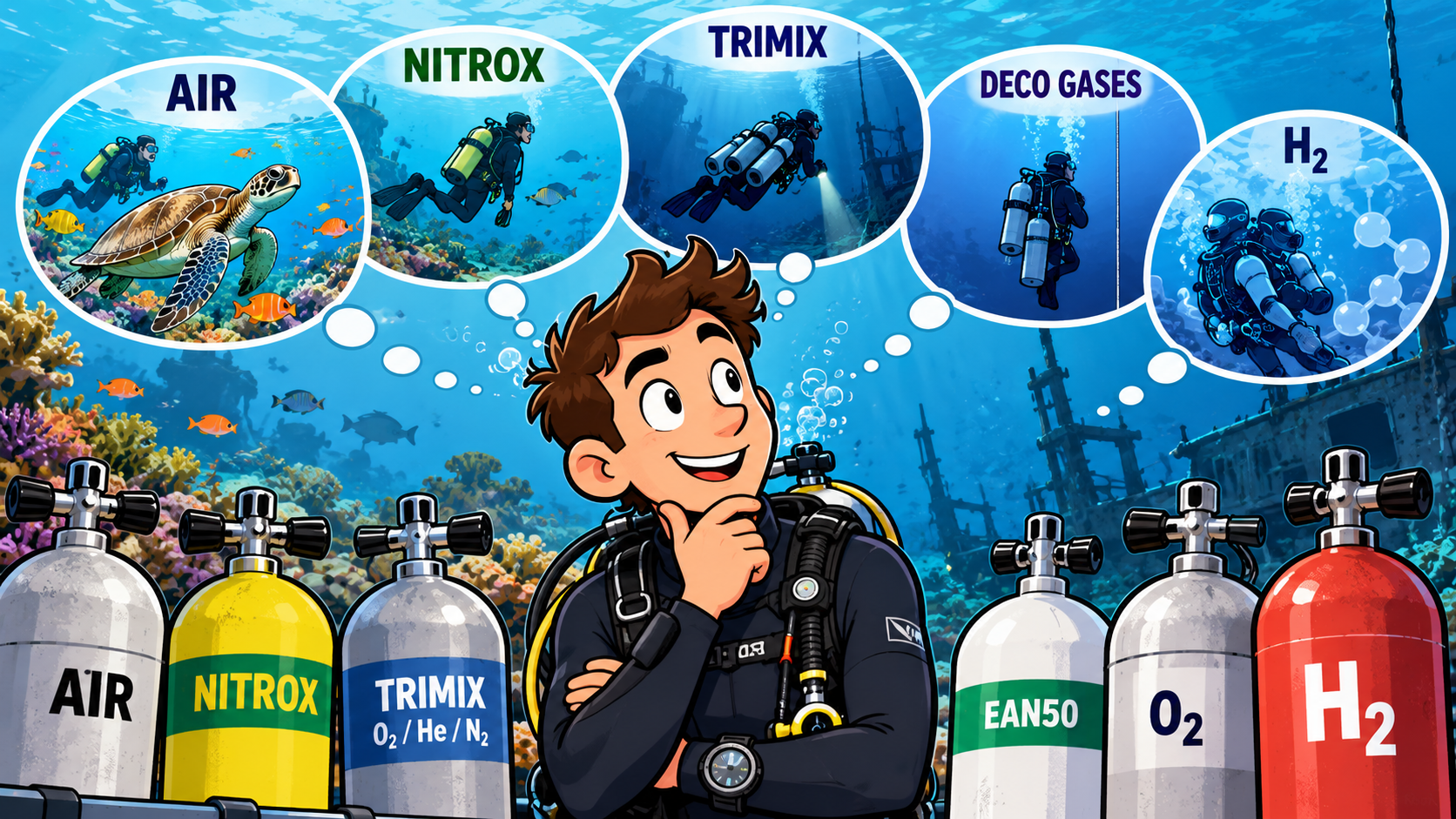
By changing the ratio between the different gases, we can better tailor a breathing gas to a particular dive. For example, we can replace some nitrogen with extra oxygen, as in Nitrox, or with helium, as in Trimix. For different phases of a technical dive, even different gas mixtures can be carried.
On the other hand, every breathing gas has its own possibilities and limitations. A mixture ideal at shallow depth can be dangerous deeper down. And a gas specially composed for a very deep dive can be unsuitable to breathe at the surface.
Even as a Divemaster, you don't need to be able to dive with all these gases or mix them yourself. Still, it is important to understand what they are and why they are used. In a professional dive center, you will quickly encounter Nitrox cylinders, gas analyses, MOD markings, and divers using different gas mixtures. And perhaps later you will guide technical divers or work at a dive center where Trimix and decompression gases are also filled. As a Dive Professional, you need to at least understand what you are dealing with and why different procedures and safety rules apply.
In this article, therefore, we look beyond ordinary compressed air. We start with Nitrox, which has become very common at many recreational dive centers, and then take steps further: to Trimix, decompression gases, and ultimately even experimental breathing gases with hydrogen. We look not only at what these gases are, but especially why we use them, how they are made and checked, and what extra knowledge, training, and equipment are needed.
2. Why Something Other Than Air?
Ordinary air consists of about 21% oxygen and 78% nitrogen, along with small amounts of other gases (< 1%). At the surface, this is a particularly practical mixture: we breathe it our whole life without thinking. But underwater, ambient pressure increases and with it the partial pressure of every gas we inhale. Because of this, oxygen and nitrogen behave differently at greater depths than we are used to at the surface.
Oxygen (O₂) is essential for life. More oxygen in a breathing gas can also be an advantage: if we replace some nitrogen with oxygen, we take up less nitrogen during the dive. But more is not indefinitely better. As the partial pressure of oxygen rises, so does the risk of oxygen toxicity. A mixture with a lot of oxygen can therefore be very suitable at shallow depths but dangerous deeper down.
Nitrogen (N₂) makes up the largest part of ordinary air. It is cheap and easily available, but under pressure it has some less favorable properties. Our body absorbs nitrogen during a dive, which plays an important role in decompression and the risk of decompression sickness. Additionally, nitrogen has a narcotic effect at greater depth. The deeper we go, the more noticeable nitrogen narcosis can become.
There is another problem that becomes especially important in deeper dives: gas density. The greater the ambient pressure, the denser the gas we breathe. At 30 meters, for example, the breathing gas is under about four times the surface pressure. Each breath therefore contains many more gas molecules and it requires more effort to move the gas back and forth through a regulator and our airways. At recreational dive depths (up to 40 meters) this usually causes little problem with normal exertion, but as we go deeper, the increased breathing workload can become an increasing limitation.
That is why, in deeper technical dives, helium (He) is often added to the breathing gas. Helium is much lighter than nitrogen and also has far less narcotic effect. By replacing part of the nitrogen with helium, we can create a gas mixture better suited for greater depths. However, helium also has disadvantages. It is expensive, scarce, and imposes other demands on dive planning and decompression.
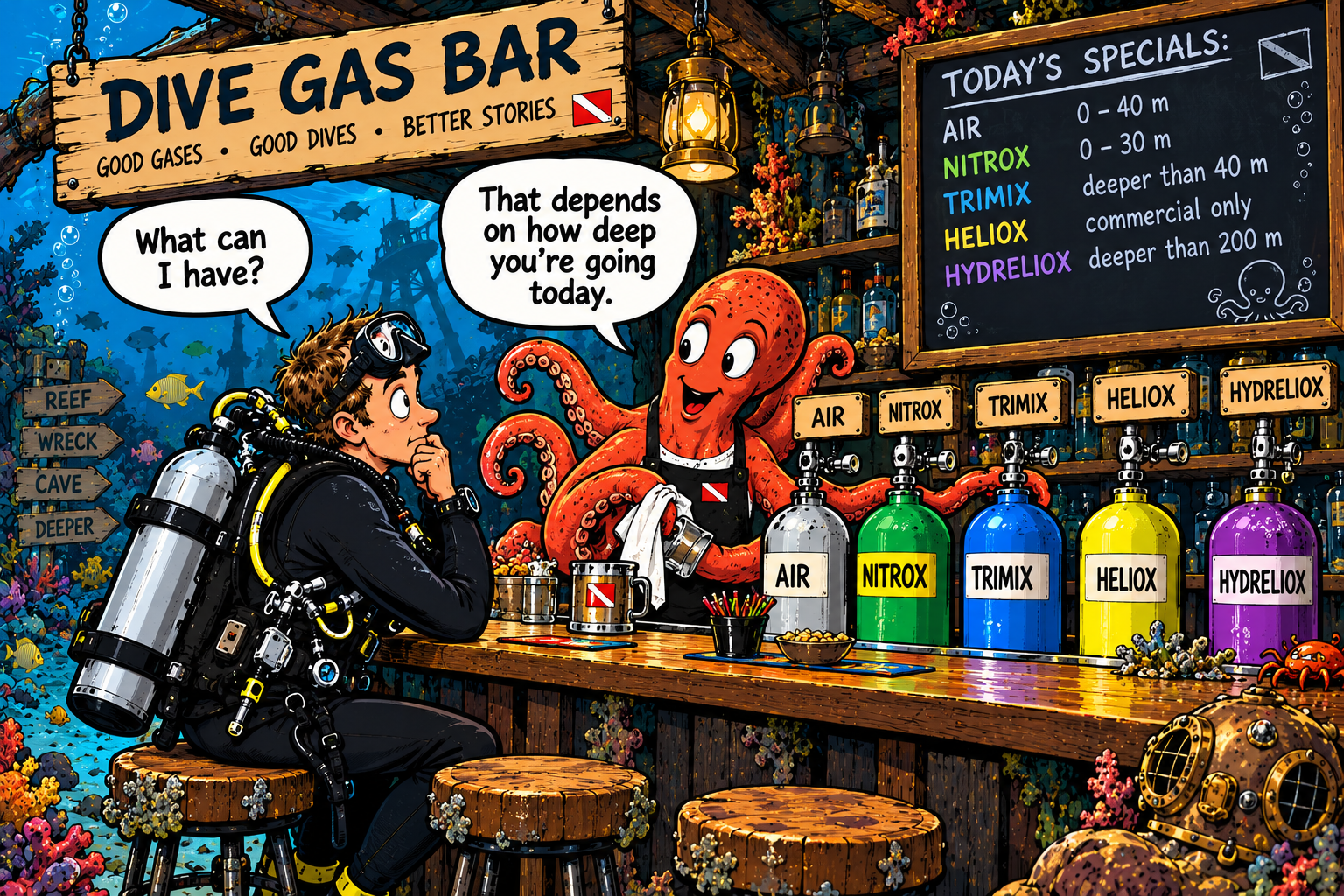
There is therefore no single perfect breathing gas for every dive. Regular air is a simple and practical choice for the majority of recreational diving. Nitrox can be interesting when we want to reduce nitrogen load, while helium-containing mixtures gain advantages primarily when we go significantly deeper. And during technical decompression, we sometimes want a gas with a very high oxygen content.
It is not so much about the question of which breathing gas is best, but which breathing gas is most suitable for a particular depth, dive time, and function. By changing the ratios of oxygen, nitrogen, and possibly helium, we can adjust the properties of the breathing gas to the dive we want to make.
3. From Devil’s Gas to Everyday Diving Practice
Diving with gas mixtures other than regular air may sound like a relatively modern development, but the idea is much older than recreational diving as we know it today. Already in the first half of the twentieth century, experiments were conducted with various mixtures of oxygen and nitrogen, and from the 1950s oxygen-enriched mixtures were used, among others, by the US Navy. The goal was the same as now: better tailoring the properties of the breathing gas to the depth and duration of a dive.
An important next step came from the scientific diving world. The American researcher and dive physiologist J. Morgan Wells worked in the 1970s at NOAA on practical procedures for the use of oxygen-enriched air. This led to mixtures known as NOAA Nitrox I (32% oxygen) and NOAA Nitrox II (36% oxygen). Procedures for Nitrox use were included in the 1979 NOAA Diving Manual. Nitrox was therefore certainly not a new or unproven gas when it started to find its way into recreational diving in the 1980s. Yet it was initially met with a lot of suspicion there.
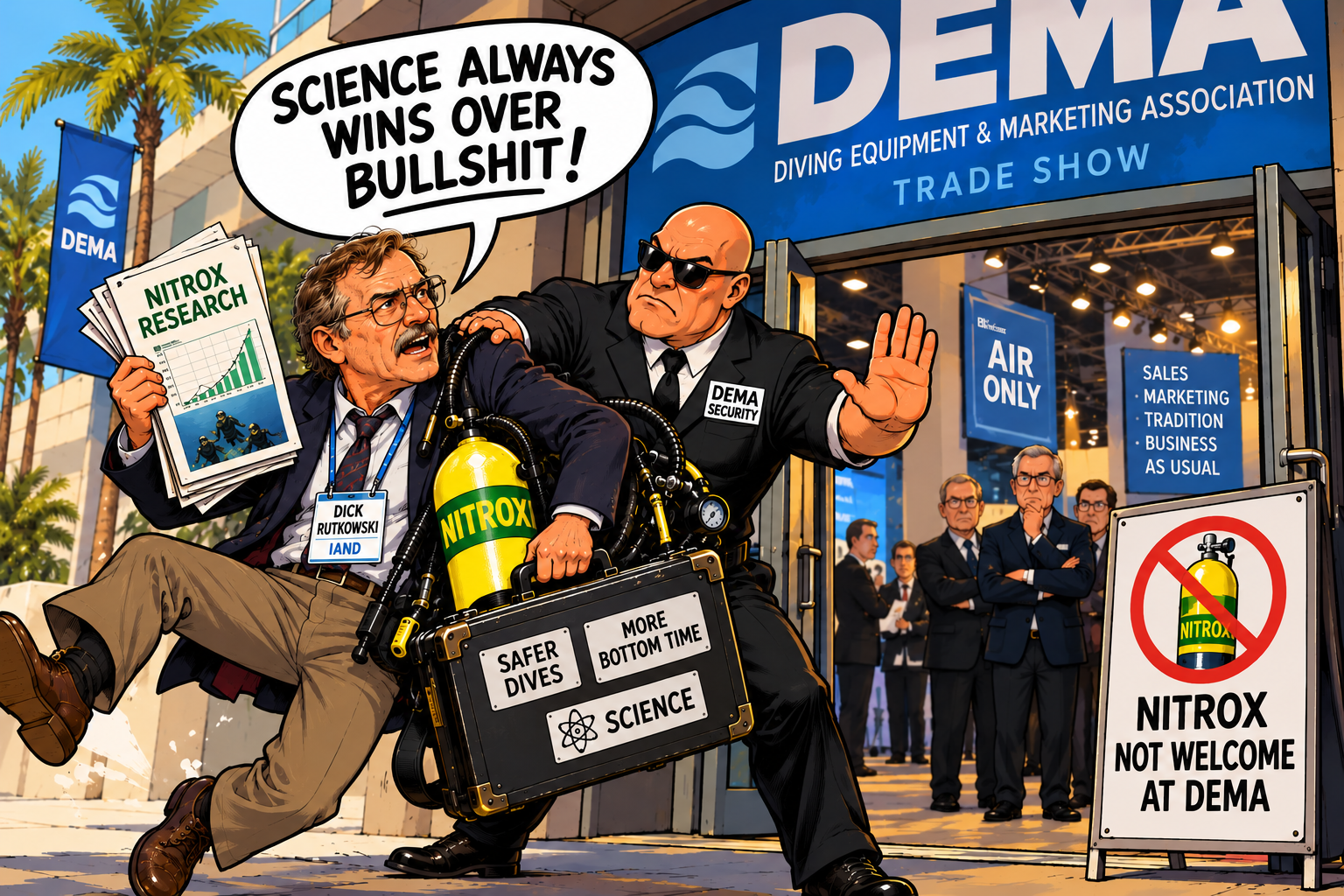
An important pioneer in that development was Dick Rutkowski, who had worked for many years at NOAA and was closely involved in dive training and the use of Nitrox there. After leaving NOAA, he began to promote Nitrox outside that scientific and professional world. In 1985, the International Association of Nitrox Divers (IAND, later IANTD) was founded, aimed at teaching ordinary sport divers to dive with oxygen-enriched air. That was quite revolutionary at the time. Nitrox itself was not new, but the idea that recreational divers could simply get it at a dive center and safely use it after a relatively short training was. For the established diving world, it felt like someone was suggesting fentanyl, which is used under strict hospital supervision, should be made available for independent use after a few hours of training. Despite resistance from the diving industry, IAND began offering Nitrox courses, training instructors, and making the gas available to an ever-larger group of sport divers.
Not everyone in the established diving world was happy about this. IAND faced fierce criticism and Nitrox was portrayed by opponents as unnecessarily complicated or even irresponsible for recreational divers. Manufacturers worried about using oxygen-richer mixtures with existing diving equipment, and several large training organizations initially wanted nothing to do with it. In 1991, resistance even went so far that Nitrox organizations like IAND and ANDI were not welcome at the annual DEMA trade show. Rutkowski was not deterred by the criticism. He summed up his attitude in a statement that would become famous: “Science always wins over bullshit.”
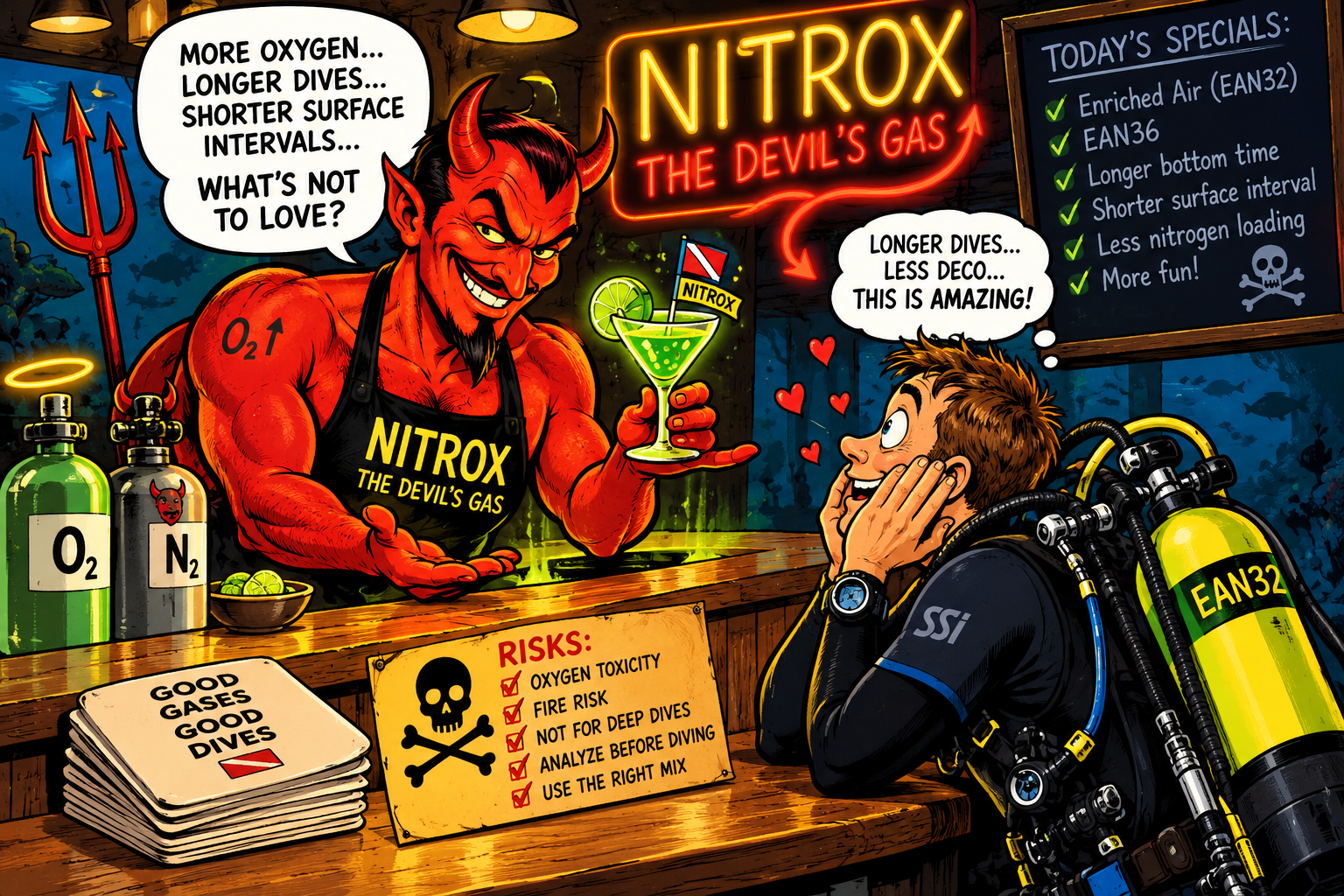
The controversy sometimes became quite fierce. During that period, Nitrox even earned the mocking nickname 'voodoo gas' and Bill Gleason, editor-in-chief of the influential American diving magazine Skin Diver, even called it 'The Devil's Gas'. And in 1991, DEMA director Robert Gray warned that recreational Nitrox use could pose a 'serious, unwarranted safety risk.' The resistance went beyond words: Nitrox organizations such as IAND were even banned from the 1992 DEMA trade show. In retrospect, that is remarkable, because it was not about a new or little-researched breathing gas, but primarily about whether a technique that had been applied for years in professional and scientific diving programs also belonged in recreational diving.
Established training organizations were initially hesitant as well. In the early 1990s, PADI felt there were still insufficient safety procedures, training, and technical provisions to introduce Nitrox on a large scale within recreational diving. The British British Sub-Aqua Club (BSAC) went even further. In 1993, the organization forbade its members to use Nitrox during club dives, even if they had received training elsewhere. But developments moved fast. More and more divers discovered the advantages of Nitrox and pressure on established organizations increased. In May 1995, BSAC lifted the ban and later that year even introduced its own Nitrox courses. PADI also launched an Enriched Air Diver program in 1995, which became widely available from 1996 onward. Thus, the main resistance within the established diving world disappeared within just a few years. What had recently been dismissed as 'voodoo gas' soon became a normal part of recreational diving. Science indeed won over the baseless concerns.
Today, that old discussion is almost hard to imagine. Nitrox is as commonplace at many dive centers as ordinary compressed air, and the Enriched Air Nitrox certification is one of the most followed specialties in various training organizations. What was considered exotic and even dangerous a few decades ago has meanwhile become everyday diving practice.
This historical development is interesting because it shows that new developments in diving are not always immediately accepted. New gas mixtures and techniques raise questions about safety, training, and equipment. Sometimes that caution is justified. Sometimes a technique, after years of research and experience, ultimately proves much less exotic than initially thought. As we will see later, exactly that discussion is now resurfacing around the use of hydrogen as a breathing gas for extremely deep dives.
4. Nitrox: more oxygen, less nitrogen
But what exactly is Nitrox, which sparked so much debate back then? The name is somewhat confusing, because any combination of nitrogen and oxygen could be called Nitrox – so regular air too. In the diving world, Nitrox usually means Enriched Air Nitrox (EAN): air with an oxygen content higher than the approximately 21% we normally breathe.
Common mixtures are, for example, EAN32 and EAN36, with respectively 32% and 36% oxygen. The remaining part consists mainly of nitrogen. EAN32 thus contains about 68% nitrogen instead of the roughly 79% found in regular air. That difference may not seem huge, but underwater it has important consequences.
Less nitrogen
The main advantage of Nitrox is actually not that there is MORE oxygen, but that there is LESS nitrogen. During a dive, our body tissues absorb nitrogen. How much and how fast this happens depends, among other things, on the depth and duration of the dive. When we breathe EAN32 at the same depth instead of regular air, we are exposed to a lower partial nitrogen pressure. So, for our decompression load, it appears as if we are diving at a shallower depth. This can be expressed as the Equivalent Air Depth (EAD): the depth at which normal air would produce the same partial nitrogen pressure as the Nitrox mixture used.
As a result, no-decompression limits (NDLs) with Nitrox can be considerably longer than with air. Especially during repetitive dives and dives where the NDL is actually the limiting factor, this can be a big advantage. However, Nitrox does not make a diver immune to decompression sickness. We still absorb nitrogen and must plan and perform our dive according to an appropriate dive table or dive computer.
More oxygen
But what on the one hand provides an advantage causes on the other hand a new limitation. If we reduce the percentage of nitrogen by adding more oxygen, the partial pressure of oxygen (ppO₂) increases at a given depth. At the surface, oxygen in regular air has a partial pressure of about 0.21 bar. At 10 meters, where the absolute ambient pressure is about 2 bar, that becomes approximately 0.42 bar. The deeper we go, the higher the partial oxygen pressure becomes. With Nitrox this happens faster. For example, EAN32 has a ppO₂ at the surface of about 0.32 bar. At 30 meters, at about 4 bar absolute pressure, it is already about 1.28 bar.
This brings us to one of the most important principles of diving with different breathing gases: for our body, not only the percentage of a gas is important, but especially the partial pressure to which we are exposed.
Fractions and partial pressures
The share of oxygen in a gas mixture is called the fraction of oxygen (FO₂). For regular air, the FO₂ is about 0.21; for EAN32 it is 0.32 and for EAN36 0.36. By multiplying the FO₂ by the absolute ambient pressure, we can determine the partial oxygen pressure:
ppO₂ = FO₂ × absolute pressure
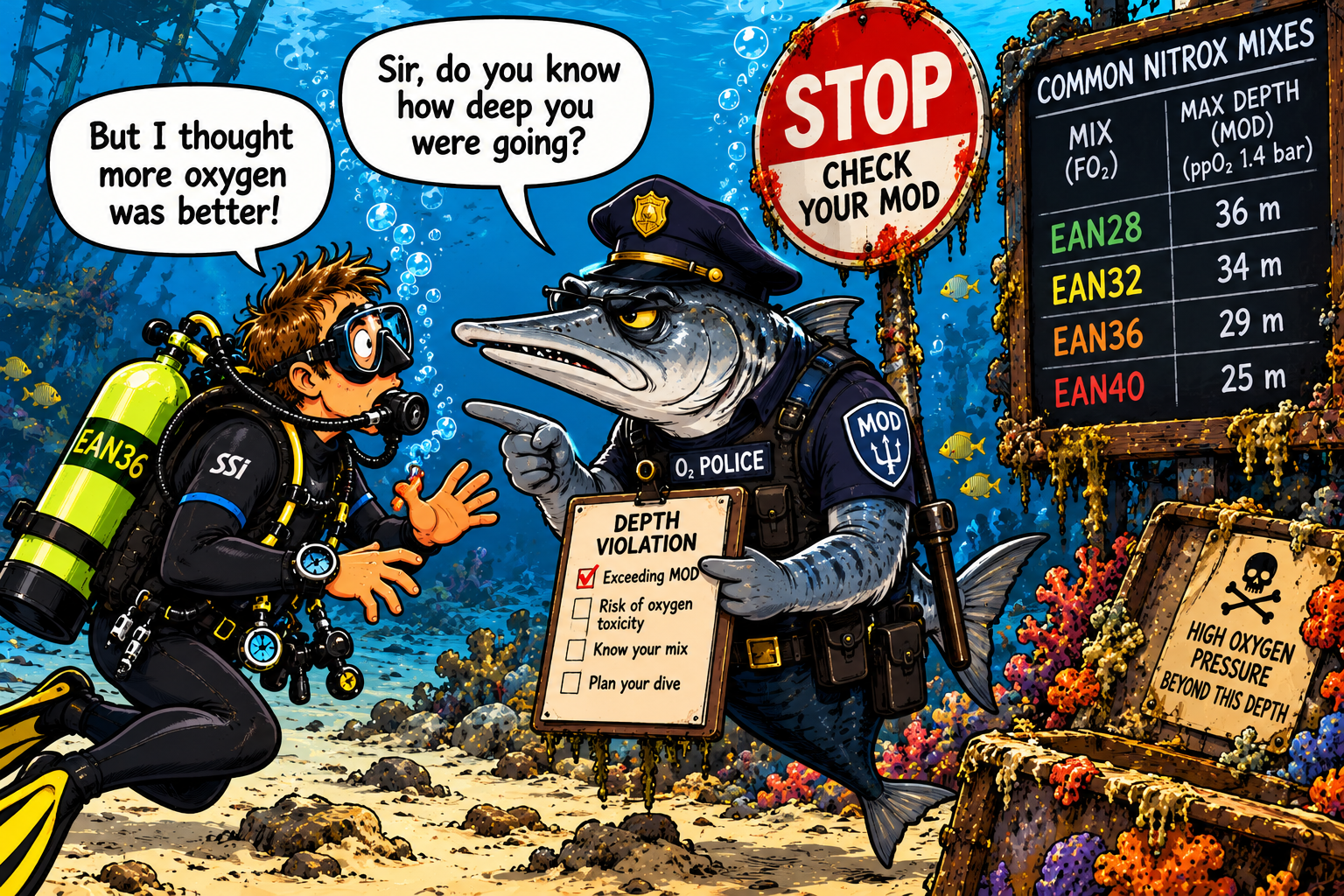
Because too high a ppO₂ increases the risk of oxygen toxicity, a Nitrox mixture cannot be used unlimitedly deep. Each mixture therefore has a Maximum Operating Depth (MOD): the maximum depth at which the gas may be used within the chosen maximum ppO₂.
For the active portion of a dive, planning is often done with a maximum ppO₂ of 1.4 bar. For example, EAN32 has a MOD of approximately 34 meters at that limit. EAN36 comes to about 29 meters. For certain decompression applications, a higher ppO₂ is sometimes accepted, often up to 1.6 bar, but that belongs to specific procedures and training. This also means that Nitrox is definitely not a gas you can simply use to dive deeper. The opposite is rather true: the higher the oxygen percentage, the shallower the maximum usage depth becomes.
Not only is the maximum ppO₂ important. The duration of exposure to increased oxygen pressure also plays a role. At high ppO₂, acute oxygen toxicity of the central nervous system can occur, often referred to as CNS oxygen toxicity. Underwater, the main risk is a convulsion, which is dangerous because it can lead to loss of the regulator and drowning. Additionally, prolonged exposure to elevated oxygen concentrations can cause damage to, among other things, the lungs. For technical and extended dives, not only the maximum ppO₂ but also the total oxygen exposure during the dive or over multiple dives is considered. For a regular recreational Nitrox dive, the dive computer keeps track of a large part of these calculations. But a computer can only calculate correctly when the correct oxygen percentage is set. Therefore, a Nitrox diver must always know what mixture they actually have in their tank.
Nitrox thus gives us a nice advantage, but not for free: less nitrogen gives us more possibilities in terms of dive time, while more oxygen imposes a new limitation regarding depth and exposure time. It is precisely this trade-off that makes Nitrox such a good first example of how we can adjust the composition of a breathing gas to the purpose of a dive.
5. How is Nitrox made?
That we can dive with Nitrox means of course that someone has to make that gas mixture first. A regular diving compressor sucks in outside air and does not change its composition: what goes in one side comes — after filtering and under high pressure — into the dive tank in virtually the same ratio. To produce Nitrox, we must either add extra oxygen or remove part of the nitrogen from the air.
There are different methods for this. Which method a filling station uses depends, among other things, on the amount of Nitrox produced, the desired mixtures, and the available installation.
Partial-pressure blending
One of the traditional ways to make Nitrox is partial-pressure blending. This involves first introducing a precisely calculated amount of pure oxygen into the diving cylinder. Then the cylinder is topped up with air to the desired final pressure. After mixing, the desired oxygen percentage is obtained. For example, suppose we want to make a cylinder with EAN32. The blender calculates how much oxygen is needed, accounts for any gas already present in the cylinder, adds the required amount of oxygen, and then fills the cylinder further with air. The big advantage of this method is its flexibility. Very diverse mixtures can be produced and the same principles are also used when mixing technical breathing gases. On the other hand, pure oxygen flows under high pressure directly into the cylinder and through parts of the filling system. This puts high demands on the equipment used and on the cleanliness of the cylinder, valve and other parts that come into contact with the oxygen.
Continuous-flow blending
In continuous-flow blending, the oxygen is added to the intake air before the high-pressure compressor. A controlled amount of oxygen is mixed with ordinary air, after which the complete mixture is compressed by the compressor. The advantage is that the diving cylinder does not first need to be filled separately with pure oxygen. Moreover, a filling station can relatively efficiently fill multiple cylinders with the same mixture this way. The downside is that the compressor itself works with oxygen-enriched air. Not every compressor or system is suitable for this without modification. The oxygen percentage of the mixture going into the compressor must be carefully monitored and the system must be designed and maintained for this method of operation.
Membrane systems
A very different method is the use of a membrane system. Here, no extra oxygen is added to the air. Instead, some of the nitrogen is removed from ordinary air. The air is first passed at relatively low pressure through a special membrane. Different gas molecules pass through such a membrane at different rates. This produces a gas stream that contains relatively more oxygen and less nitrogen. This oxygen-enriched air is then compressed by the high-pressure compressor to 200 or 300 bar. Membrane systems are especially interesting for filling stations that produce large quantities of Nitrox. They can continuously supply Nitrox without having to mix pure oxygen for each cylinder separately. On the other hand, the system is considerably more complex and expensive than a regular compressor and there are limits to the oxygen percentages that can be produced with it.
Which method is best?
There is no one method that is ideal for every filling station. A small filling station that occasionally makes different mixtures may have different needs than a large dive center that fills dozens of EAN32 cylinders daily. In practice, there are also variations and combinations of the above methods.
What all methods have in common is that the end result must be reliable. The gas must meet the requirements for breathing gas and the actual oxygen percentage must be known. The fact that extra oxygen is involved also means that certain parts of a filling system, diving cylinder or valve may be subject to additional requirements.
How we check the final mixture, why Nitrox cylinders are marked, and when equipment must be oxygen clean or oxygen compatible will be discussed later in this article.
6. Trimix: helium for greater depths
With Nitrox we replace part of the nitrogen with extra oxygen. That works well as long as we stay within the depth at which the higher oxygen concentration can be used safely. But when we want to dive deeper, we run into a problem. We want less nitrogen because of narcosis and gas density, but we cannot replace nitrogen unlimitedly with oxygen: the partial pressure of oxygen would then become too high, which exposes us to the danger of oxygen poisoning.
For deeper dives, we therefore need a third gas. In practice, this is usually helium (He).
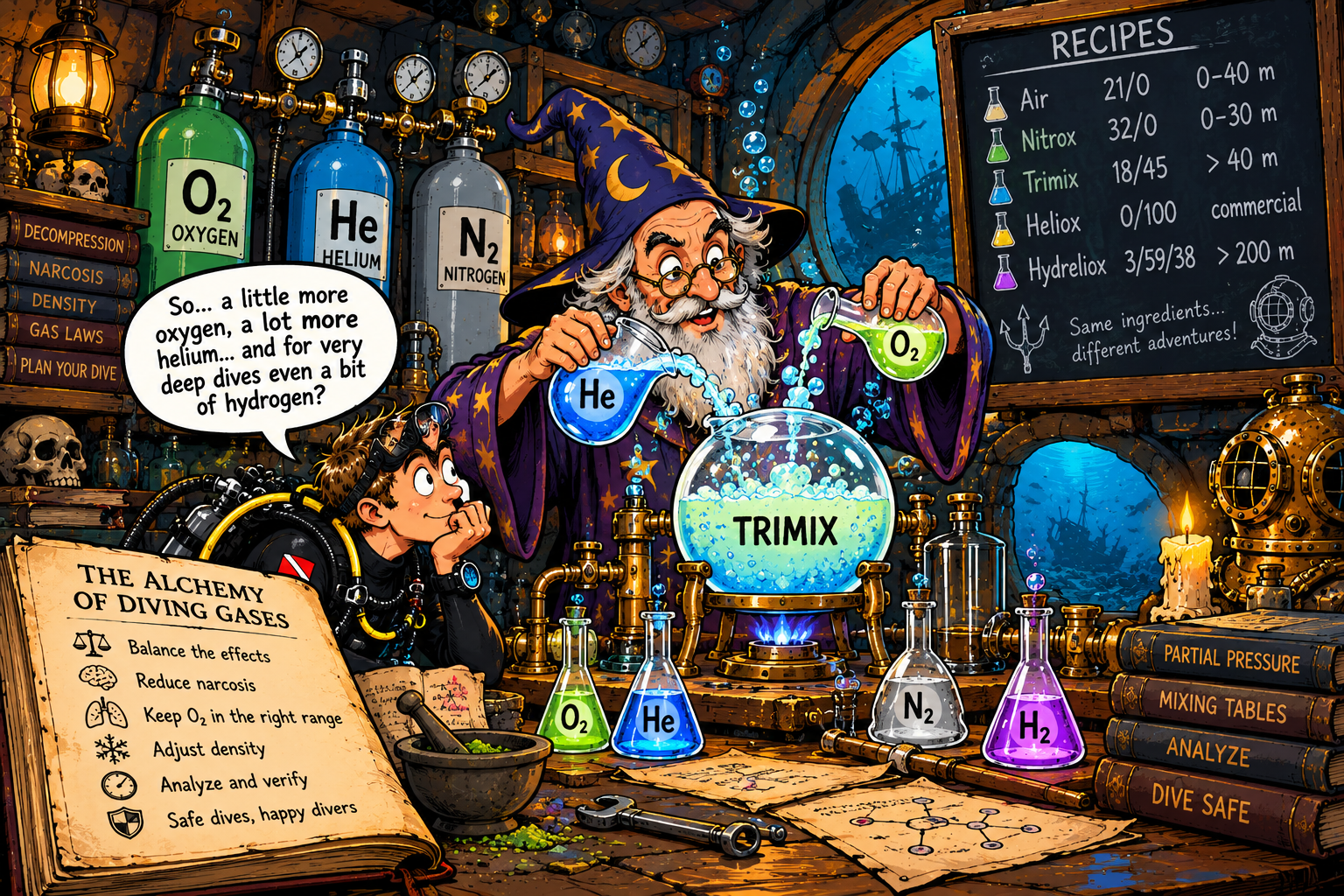
A mixture of oxygen, nitrogen, and helium is called Trimix. The name simply refers to the three gases in the mixture. For Trimix, typically two numbers are given. For example, Trimix 18/45 contains 18% oxygen and 45% helium. The remaining part, in this case about 37%, consists of nitrogen.
Adding helium has two major advantages. First, helium has much less narcotic effect than nitrogen. By replacing part of the nitrogen with helium, the narcotic load at greater depths can be reduced.
Second, helium is a much lighter gas than nitrogen. This becomes important as we go deeper. As we saw earlier, the density of a breathing gas increases with ambient pressure. A dense gas takes more effort to move through our regulator and airways. By partially replacing nitrogen with the much lighter helium, we can limit gas density and thus breathing effort.
Normoxic and Hypoxic Trimix
Not every Trimix mixture contains the same amount of oxygen. For less extreme technical dives, normoxic Trimix can be used. In this mixture, enough oxygen remains present to breathe the gas at or near the surface, while helium is added to reduce the amount of nitrogen. Trimix 21/35, for example, contains 21% oxygen (just like regular compressed air), 35% helium, and 44% nitrogen (significantly less than in regular compressed air).
For very deep dives, hypoxic Trimix is used. Here, not only is the nitrogen percentage lowered but also the oxygen percentage. This sounds strange at first: after all, we need oxygen to survive. At great depth, however, the high ambient pressure ensures that even a relatively small percentage of oxygen can provide a sufficiently high partial oxygen pressure.
A clear example of hypoxic Trimix is Trimix 10/70: 10% oxygen, 70% helium, and 20% nitrogen. At the surface, the partial oxygen pressure of this mixture is far too low to breathe safely. At greater depths, however, that oxygen pressure rises. With a minimum ppO₂ of 0.18 bar, that threshold is reached at about 8 meters, while with a maximum ppO₂ of 1.4 bar, the maximum operating depth is at 130 meters. This does not mean the gas is automatically suitable over this whole range: the actual operating depth and gas switches must be carefully planned.
Here again, we see why in technical diving not only the percentage of a gas is important but especially the partial pressure at the depth where it is used. The same Trimix mixture can be perfectly suitable at great depth, yet contain too little oxygen at the surface.
Heliox
If we remove nitrogen entirely from the mixture, we are left with a combination of only oxygen and helium. Such a mixture is called Heliox. Heliox is primarily associated with commercial and very deep diving operations and plays a much smaller role within ordinary recreational and technical sport diving than Trimix.
Helium is Not Only Better
It might be tempting to think that for deep dives we should simply replace as much nitrogen as possible with helium. It’s not that simple.
Helium has disadvantages as well, apart from the cost. Because helium conducts heat much better than air, it can also contribute to heat loss when used as a suit gas, for example. Helium also affects decompression planning: a Trimix dive therefore requires different gas calculations and decompression procedures than a comparable dive with air or Nitrox.
At extreme depths, another problem arises: High Pressure Nervous Syndrome (HPNS). This neurological phenomenon is primarily seen in deep helium dives from about 150 meters and deeper. Symptoms can include tremors, muscle twitches, and reduced motor and cognitive performance. Not only depth but also the rate at which a diver is compressed plays an important role. For normal technical sport diving, HPNS is hardly relevant; it mainly becomes a limitation in extremely deep and saturation dives.
Trimix thus again shifts the boundaries of what’s possible but does not remove those boundaries. By adding helium, we can reduce the narcotic effect and density of our breathing gas, enabling responsible deeper dives. In return, we get new complications: higher costs, more complex decompression and gas planning, and eventually new physiological limits.
And as soon as different gases are only usable within certain depth ranges, the next question naturally arises: how do you carry different breathing gases during a single dive and when do you use which gas?
7. One Dive, Multiple Breathing Gases
In an ordinary recreational dive, it’s simple: we start the dive with one tank of air or Nitrox and breathe the same gas throughout the dive. In technical diving, this does not have to be the case. A technical diver can carry several cylinders with different breathing gases and switch gases multiple times during the dive.
That has a simple reason: the ideal breathing gas changes with depth. A gas suitable to breathe at 70 meters is not necessarily the best gas at 20 or 6 meters. Conversely, a gas that is very effective at 6 meters can be life-threatening at 40 meters. The different breathing gases can therefore each serve their own function. Depending on the gas's role within a technical dive plan, we speak of bottom gas, travel gas, and deco gas.
Bottom gas
The bottom gas is the breathing gas used during the deep part of the dive. For shallower technical dives this can be air or Nitrox, but at greater depths Trimix is often used. The composition is chosen for the planned maximum depth. Considerations include partial oxygen pressure, narcotic load, and gas density. For very deep dives, the oxygen percentage of the bottom gas can be so low that the mixture cannot be safely breathed at the surface. Such a gas is called hypoxic trimix gas.
Travel gas
In that case, a travel gas might be necessary. The diver starts the dive with a gas that can be safely breathed at the surface and during the initial part of the descent. Only when enough depth is reached does the diver switch to the hypoxic bottom gas. During the ascent the same principle can be applied in reverse. As soon as the bottom gas is no longer the most suitable gas, the diver switches back to the travel gas. For very complex and extremely deep dives, two or more different travel gases can even be used.
Decompression gas
During decompression, we want to breathe in as little inert gas—nitrogen and helium—as possible. Therefore, Nitroxmixes with a high oxygen percentage are often used for decompression stops. A commonly used decompression gas is, for example, EAN50, with 50% oxygen. At shallow depth, 100% oxygen can also be used. Due to the higher oxygen concentration, the partial pressure of inert gases in the lungs drops, which promotes the elimination of nitrogen and helium from body tissues and can shorten the required decompression time. However, this does not mean that a gas richer in oxygen is always better. EAN50 has a maximum operating depth, and pure oxygen can safely be used only at shallow depths because of the high PO₂. The decompression gas must therefore fit the depth at which the gas switch is performed.
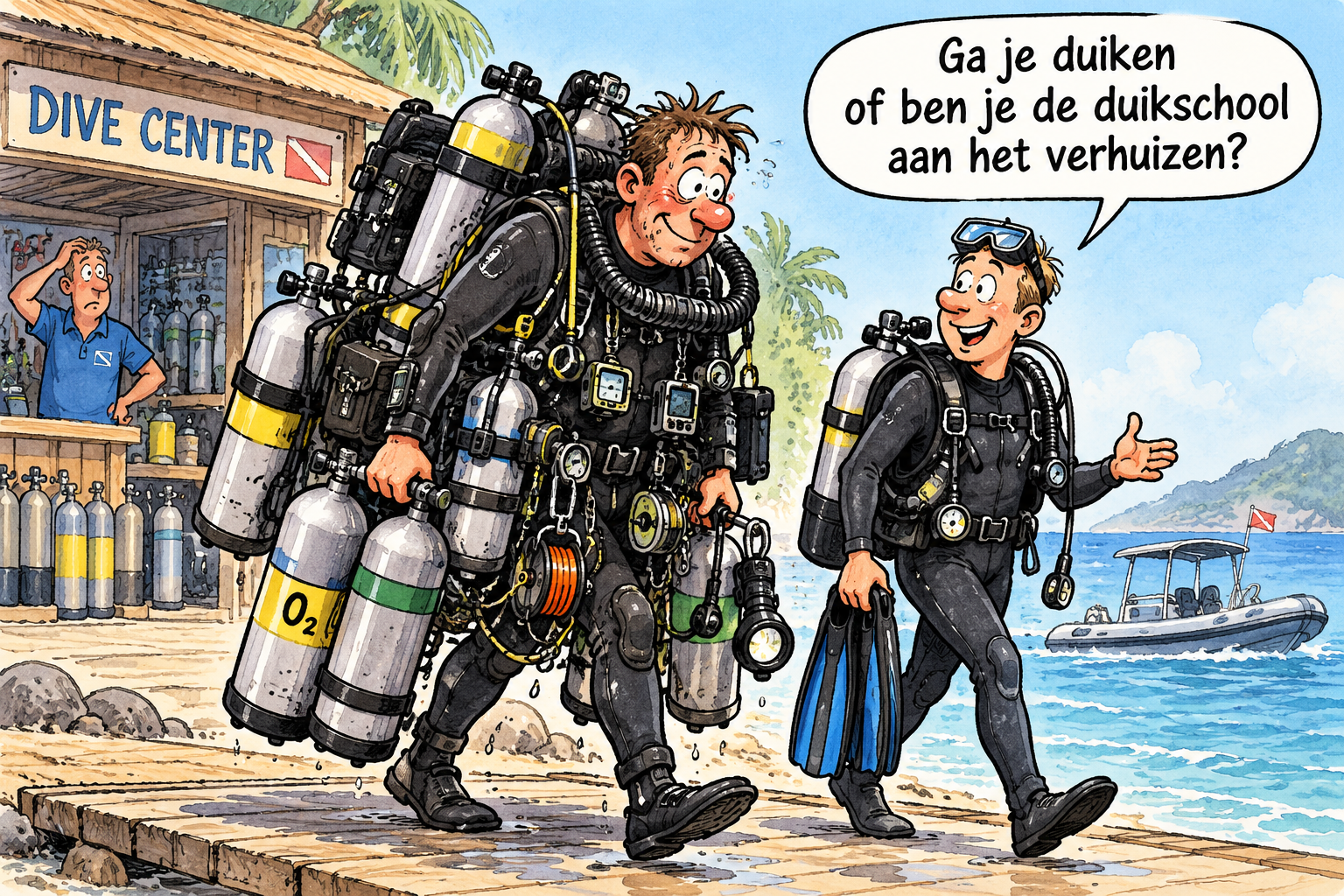
The right gas at the right depth
A technical diver can, for example, during one dive start with EAN32 as travel gas, then switch at greater depth to a Trimix mixture as bottom gas, and on the ascent switch back to EAN32. From 21 meters depth the diver can use EAN50 for decompression, switching to 100% oxygen at 6 meters for the last decompression stops. For more complex and deeper dives, even more different gas mixtures can be carried.
This makes gas switching a critical moment during a technical dive. Taking the wrong regulator and breathing from a cylinder with a high oxygen percentage at the wrong depth can have severe consequences within a short time. Conversely, switching to a hypoxic gas at too shallow depth can lead to unconsciousness due to oxygen deficiency.
Therefore, stage and decompression cylinders are clearly marked, and technical divers follow fixed procedures before switching gases. A diver checks not only which cylinder is in front of them but also what gas it contains and whether that gas can be safely breathed at the current depth.
Breathing regulators can also be visually distinguished. For oxygen-rich decompression gases, green hoses and other green parts are often used. Different color conventions exist for Trimix and other gases as well, but there is no universal color code that a diver can safely rely on. Actual identification therefore takes place based on cylinder markings, the analyzed gas mixture, and the maximum operating depth (MOD)—not just on the color of a hose.
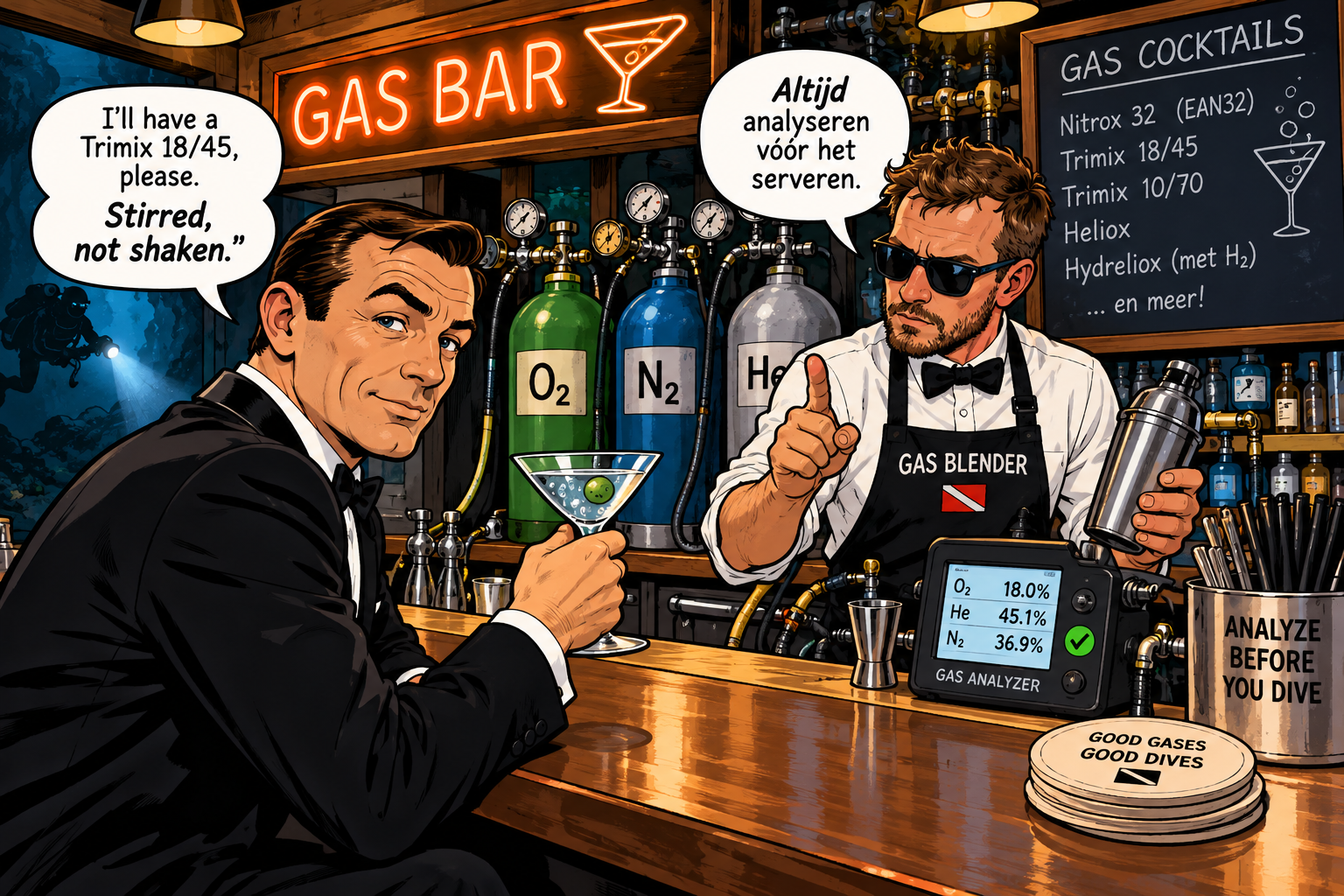
And that brings us to an important practical problem. From the outside, you cannot see if a cylinder contains air, EAN32, EAN50, or Trimix 18/45. Before we can use such a gas, we must reliably determine what is actually in the cylinder.
8. Measuring, Marking and Using Safely
You cannot see what is inside a breathing gas. You also cannot smell or taste it. Oxygen, nitrogen, and helium are all colorless, odorless, and tasteless. Because of this, mixtures of these gases cannot be distinguished from each other by our senses. Regular air, EAN32, EAN50 and Trimix 18/45 can look, smell and taste exactly the same, while their properties under pressure differ greatly. And as we saw in the previous chapter, breathing the wrong gas at the wrong depth can be life-threatening. Therefore, special breathing gases must be carefully analyzed, identified, and handled.
Measuring Oxygen
With Nitrox, we primarily want to know how much oxygen the gas actually contains. For this, we use an oxygen analyzer. Most portable analyzers in the diving world use an electrochemical oxygen sensor. When oxygen reaches the sensor, a chemical reaction takes place that produces a small electrical current. The size of this signal is related to the partial pressure of oxygen and can be converted by the device into an oxygen percentage.
Before a measurement is performed, the analyzer must be calibrated. This is often done with ordinary air, of which we know it contains approximately 20.9% oxygen. Then the diver lets a calm, controlled gas flow from the cylinder being analyzed pass over the sensor, and reads off the oxygen percentage. That measurement is more important than it may seem at first glance. The difference between, for example, EAN32 and EAN36 affects both decompression calculations and the maximum operating depth. An incorrectly set oxygen percentage in the dive computer means the computer calculates with incorrect data. Therefore, a Nitrox diver should analyze the gas they are going to use themselves. The fact that someone at the filling station has already written a percentage on the cylinder does not replace this personal check.
Furthermore, oxygen sensors do not last indefinitely. The chemical reaction in an electrochemical sensor slowly consumes the sensor material, even when the analyzer is hardly used. For many analyzers such a sensor has an expected lifespan of about one and a half to two years, depending on the type of sensor, usage, and storage conditions. Afterwards, the sensor must be replaced. An oxygen sensor is therefore a consumable, not a part that lasts indefinitely.
Measuring Helium
With Trimix, measuring oxygen alone is not sufficient. We also want to know how much helium the mixture contains. For this purpose, helium analyzers and combined O₂/He analyzers exist. A helium analyzer works on a different principle than a normal electrochemical oxygen sensor. There are several measurement methods. Some helium analyzers use the thermal conductivity of the gas. Helium conducts heat much better than nitrogen or oxygen. By measuring how quickly heat is conducted away by the gas, the analyzer can determine the helium content.
Another method is sonic or acoustic measurement. In this, the analyzer measures how fast sound propagates through the gas mixture. The speed of sound strongly depends on the composition of the gas and is much higher in helium than in normal air. By comparing the measured speed of sound with known values, the device can calculate how much helium the mixture contains.
Both methods thus indirectly determine the helium content based on a physical property of the gas. Combined O₂/He analyzers also contain a separate oxygen sensor, so both oxygen and helium percentages can be determined. The remaining part of a normal Trimix mixture can then be calculated as nitrogen.
For example, in a Trimix 18/45 we would measure roughly 18% oxygen and 45% helium. The remaining part – about 37% – then mainly consists of nitrogen. Just like with Nitrox, a correct analysis is essential for dive planning. An incorrect oxygen or helium percentage influences, among other things, the ppO₂, narcotic load, gas density, and decompression calculations.
Marking and Identification
After the analysis, it must be clear what is in the cylinder. Therefore, Nitrox, Trimix and decompression cylinders are marked with relevant information about the gas mixture. Depending on the procedures of the filling station and the training standard used, this may include the measured oxygen percentage, helium percentage, MOD, date of analysis, and the name or initials of the person who analyzed the gas.
For technical divers, the MOD (Maximum Operating Depth) marking is especially important. On stage and decompression cylinders, it is often applied large and clear, so the diver can quickly check underwater during a gas switch whether they have the correct gas for the given depth. Colors and colored regulators can be used as additional visual aids but should never replace gas analysis and clear cylinder marking.
Oxygen clean and oxygen compatible
A high oxygen percentage demands not only extra attention from the diver but also from the person filling the gas and the equipment used for that process. Oxygen itself is not flammable but strongly supports combustion. Materials that pose hardly any problem in ordinary air can ignite much more easily and burn very fiercely in an environment with a high oxygen concentration. Especially oil, grease, and certain other contaminants present a risk. Therefore, equipment that comes into contact with high concentrations of oxygen is specially selected, cleaned, and maintained.
The term oxygen clean means that a component has been cleaned according to a suitable procedure to remove contaminants that could pose an ignition hazard in an oxygen-rich environment. This is different from oxygen compatible. That term relates to whether the materials used themselves are suitable for the specific oxygen application. A component can thus be clean without all used materials automatically being appropriate for every oxygen application. Conversely, oxygen-compatible materials do little good if the system is contaminated with oil or grease. For safe use, material choice, cleanliness, pressure, oxygen concentration, and how the equipment is used all must fit together.
Exactly which equipment must be oxygen clean and from which oxygen percentage additional requirements apply depend on the filling method, equipment, standards, and procedures used. For example, with partial-pressure blending, pure oxygen under high pressure enters the dive cylinder directly. This imposes different requirements than a system where only a premixed gas with a much lower oxygen percentage flows through certain components.
This is also why filling and mixing Nitrox and Trimix is not simply a matter of adding some oxygen or helium to a cylinder. Behind a correctly marked cylinder of breathing gas lies an entire chain of suitable equipment, correct procedures, accurate analysis, and control by the diver themselves.
9. The Right Training for Every Gas
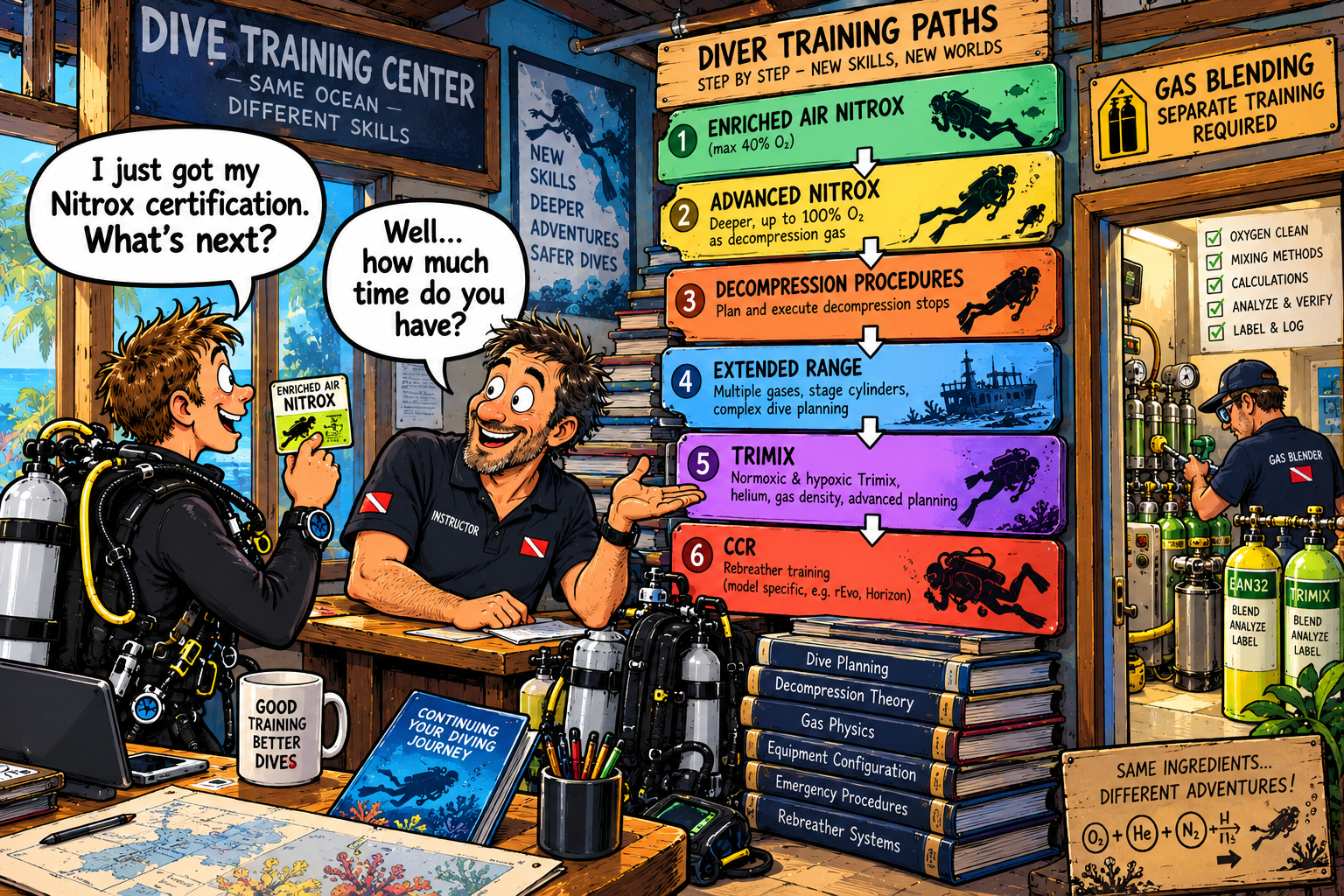
The fact that so many different breathing gases exist does not mean that every certified diver may use them just like that. Separate courses exist for the use of Nitrox, decompression gases, Trimix, and rebreathers, as well as for producing and mixing special breathing gases. As dives become more complex, the focus shifts from the breathing gas itself to dive planning, decompression, equipment configuration, and handling problems underwater.
For recreational divers, this usually starts with an Enriched Air Nitrox course. Here, the diver learns among other things the advantages and limitations of Nitrox, how oxygen exposure and MOD are calculated, how to analyze and mark a Nitrox cylinder, and how to correctly set the measured oxygen percentage in the dive computer. Recreational Nitrox courses typically assume mixtures with a maximum of 40% oxygen. However, this does not make someone a technical diver. A recreational Nitrox dive is usually still planned within no-decompression limits: the diver can in principle ascend directly to the surface at any time without mandatory decompression stops.
In technical courses, this changes. Divers learn to plan dives where decompression stops are deliberately made during ascent and where different breathing gases can be carried. Courses are often named Advanced Nitrox, Decompression Procedures, Extended Range, or Technical Diving, depending on the training agency. Topics include gas planning, staged decompression, oxygen exposure, multiple cylinders and gas switches, redundant equipment, and procedures for handling failures and other problems.
For deeper technical dives, training in the use of Trimix follows. Often, a distinction is made between courses for normoxic and hypoxic Trimix, although exact names, limits, and course structures vary by training organization. Divers learn not only to handle oxygen and nitrogen but also helium, gas density, narcotic load, and the consequences of these factors for decompression planning.
In addition to training courses for the use of special breathing gases, there are also separate courses for mixing them. In a Nitrox Gas Blender course, you learn how oxygen-enriched air is produced, the existing mixing methods, and which safety measures are necessary when working with high oxygen concentrations. This includes topics such as oxygen compatibility, oxygen cleaning, calculating mixing ratios, analyzing gas mixtures, and safely operating filling stations. A Trimix Gas Blender course goes a step further. Here, you learn to prepare mixtures of oxygen, nitrogen, and helium, taking into account the desired final pressure, the composition of the available gases, and the accuracy of the mixing calculations. Checking and documenting the final gas mixtures is also an important part. The actual mixing methods taught vary per training organization and course. A certification to dive with Nitrox or Trimix therefore does not automatically mean that someone is trained to mix those gases themselves.
There is also a separate training path for rebreathers. With a closed-circuit rebreather (CCR), the exhaled gas is not simply released into the water but reused. Carbon dioxide is removed from the breathing gas and oxygen is added to maintain the desired oxygen pressure in the breathing loop. This requires very different procedures, equipment, and emergency scenarios. Semi-closed-circuit rebreathers (SCR) also reuse part of the exhaled gas but continuously discharge a small amount and replace it with fresh breathing gas. Both systems require very different procedures, equipment, and emergency scenarios compared to regular open-circuit diving. Furthermore, rebreather training is usually device-specific: you are not simply taught to dive with any rebreather, but trained for a specific model, for example, a rEvo CCR or a Mares Horizon SCR. If you want to dive later with a different type of rebreather, you generally must follow additional crossover training. For deep CCR dives, Trimix can also be used as the diluent gas, linking rebreather and Trimix training.
Exactly which certifications are needed and the maximum depths, oxygen percentages, and gas mixtures associated with them vary per training organization. More important is the general principle: each next step requires additional knowledge and skills. An Enriched Air Nitrox certification does not automatically give someone the knowledge to dive with EAN50 as a decompression gas, and experience with decompression diving does not automatically qualify someone to use hypoxic Trimix.
For a Divemaster, it is not necessary to have completed all these technical trainings themselves. However, you must realize that behind the different cylinders, gas mixtures, and configurations seen in technical divers lies specific training and dive planning. A stage bottle with EAN50 or oxygen is not simply an extra cylinder of air, and a hypoxic Trimix mixture is not a gas that a diver can use without proper training.
10. The Problem with Helium
Helium has properties that make it particularly suitable for deep dives. It is light, hardly narcotic, and can strongly reduce the gas density of a breathing mixture. But helium has one major practical disadvantage: it is expensive and relatively scarce.
That may sound strange since helium is, after hydrogen, the most abundant element in the universe. On Earth, it is different. Helium is an extremely light gas, and helium that enters the atmosphere can eventually escape into space. We therefore cannot easily extract it from the air like nitrogen and oxygen.
The helium we use industrially mainly comes from certain underground natural gas fields where helium has accumulated over millions of years. It is produced there, among other processes, by the radioactive decay of uranium and thorium in rocks. Only some gas fields contain enough helium to make extraction economically viable. The reserves from which helium can be extracted at reasonable costs are therefore limited.
Divers are also only a very small group of helium users. The gas is important for medical equipment, scientific research, and the semiconductor industry, among others. The combination of growing global demand, limited production capacity, and regular supply disruptions has greatly driven up the price of helium in recent decades.
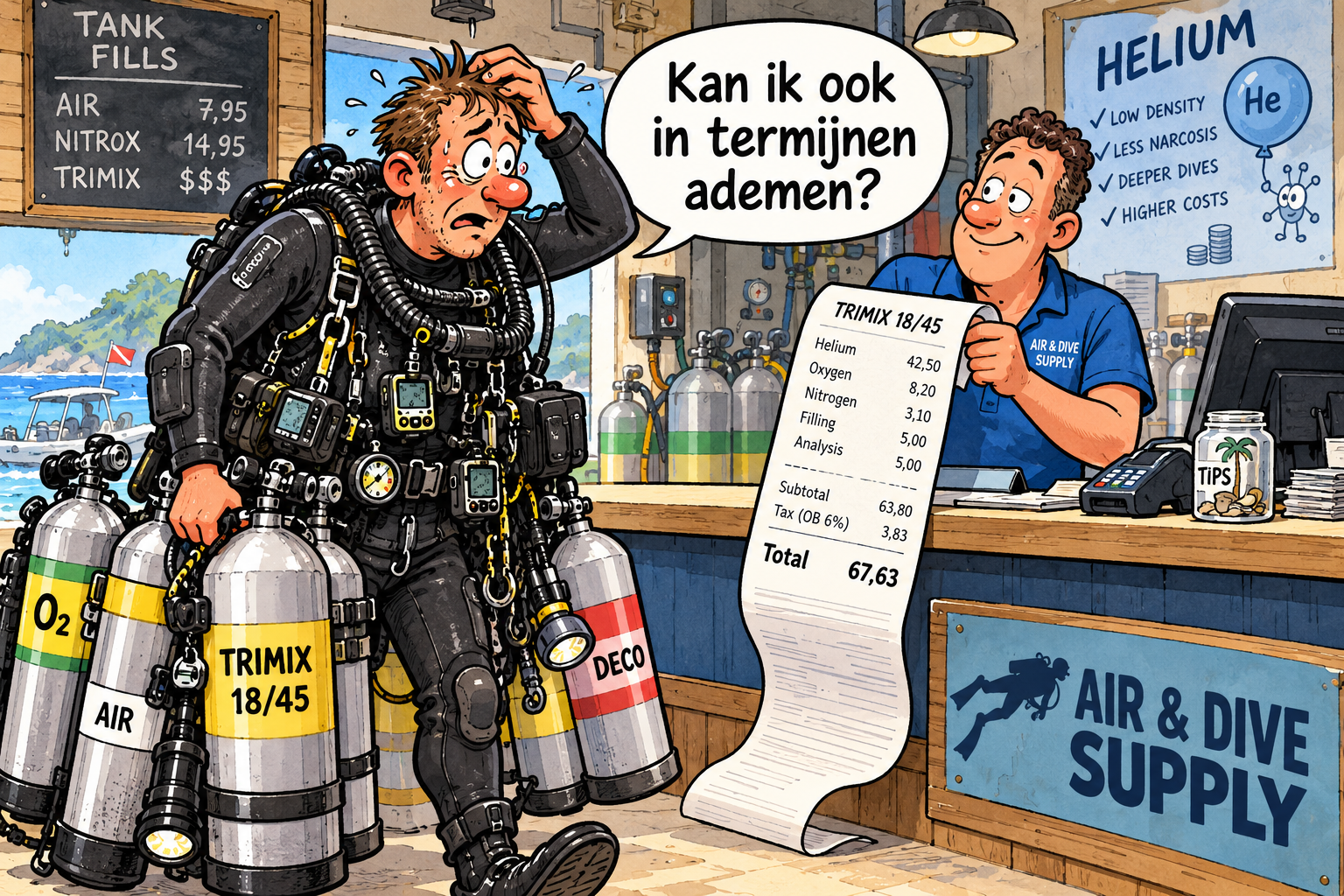
Especially from around 2005–2010, that increase is clearly visible. Around 1970, helium on the American bulk market cost roughly only about $0.75 per 1,000 liters. Around 2000, it was just under $2 per 1,000 liters, but in 2021 the price had already risen to roughly $7.40 per 1,000 liters and by 2025 the estimated base price was around $11.65 per 1,000 liters. Moreover, those are wholesale prices: what a diver ultimately pays at a filling station for helium is considerably higher due to transport, storage, cylinder rental, and other costs. Today, in 2026, as an end user you quickly pay US$0.10 to US$0.20 per liter of helium, depending on where in the world you buy the gas. If you consider that a commonly used bottom gas like Trimix 21/35 in a standard 11-liter cylinder, filled to 200 bar, contains about 770 liters of helium, you can understand that a single Trimix fill can easily cost US$100 to US$150.
In the short term, the helium price can both rise and fall, but there is little reason to expect helium to become cheap again. Economically recoverable reserves and production capacity are limited and concentrated in a relatively small number of countries, particularly the United States, Qatar, Algeria, and Russia, while demand from, among others, medical technology, science, and the semiconductor industry remains high.
In open-circuit diving, every breath exhaled is released as bubbles into the water after use. The helium the diver has paid for disappears after a single breath. The deeper the dive, the bigger this problem becomes. Due to the higher ambient pressure, an open-circuit diver consumes much more gas at depth than at the surface. At 70 meters, the ambient pressure is about eight times higher than at the surface. A one-liter breath thus consumes about eight liters of gas from the diver's supply. At the previously mentioned consumer prices, just the helium in such a single breath of Trimix 18/45 costs approximately $0.35 to $0.70. Under heavy exertion and larger breaths, this can rise to over a dollar per breath. A deep Trimix dive can therefore consume large amounts of helium and become quite costly just for breathing gas.
The high price of helium is an important reason why rebreathers have become increasingly attractive within technical diving. In open circuit, every breath—and thus the valuable helium—escapes as bubbles to the surface. The deeper the dive, the faster this occurs. A closed-circuit rebreather (CCR) does exactly the opposite: the exhaled gas largely circulates within a closed breathing loop. Carbon dioxide is removed, and oxygen is added to replenish the oxygen that the body has used. Only small amounts of gas that leave the breathing loop—for example during descent, when clearing the mask, or when gas is vented—need to be replaced.
Because of this, a CCR can manage a deep dive with a fraction of the helium an open-circuit diver would need for the same dive. As helium becomes more expensive, that economic advantage grows. This is one reason why rebreathers have taken an increasingly important place in deep and technical diving in recent years. The much higher purchase price of a CCR can eventually be partially recouped by an active technical diver through much lower Trimix costs.
Of course, a rebreather is not simply a cheap solution for expensive Trimix. The system is considerably more complex, requires specific training and maintenance, and introduces completely new risks. But for divers who regularly make deep helium dives, the much lower helium consumption can be a significant practical and economic reason to ultimately choose a CCR.
11. What if we replace helium with another gas?
If helium is so expensive and scarce, a natural question arises: can we replace it with another gas?
There are not many alternatives. Think back to the Periodic Table of Mendeljev, the periodic system you probably once had in front of you in chemistry class. It lists all known chemical elements arranged. Most of these are not gases under normal conditions. Of all 118 known chemical elements, only eleven are gaseous at normal temperature and pressure: hydrogen (H₂), nitrogen (N₂), oxygen (O₂), fluorine (F₂), chlorine (Cl₂), and the six noble gases: helium (He), neon (Ne), argon (Ar), krypton (Kr), xenon (Xe), and radon (Rn).
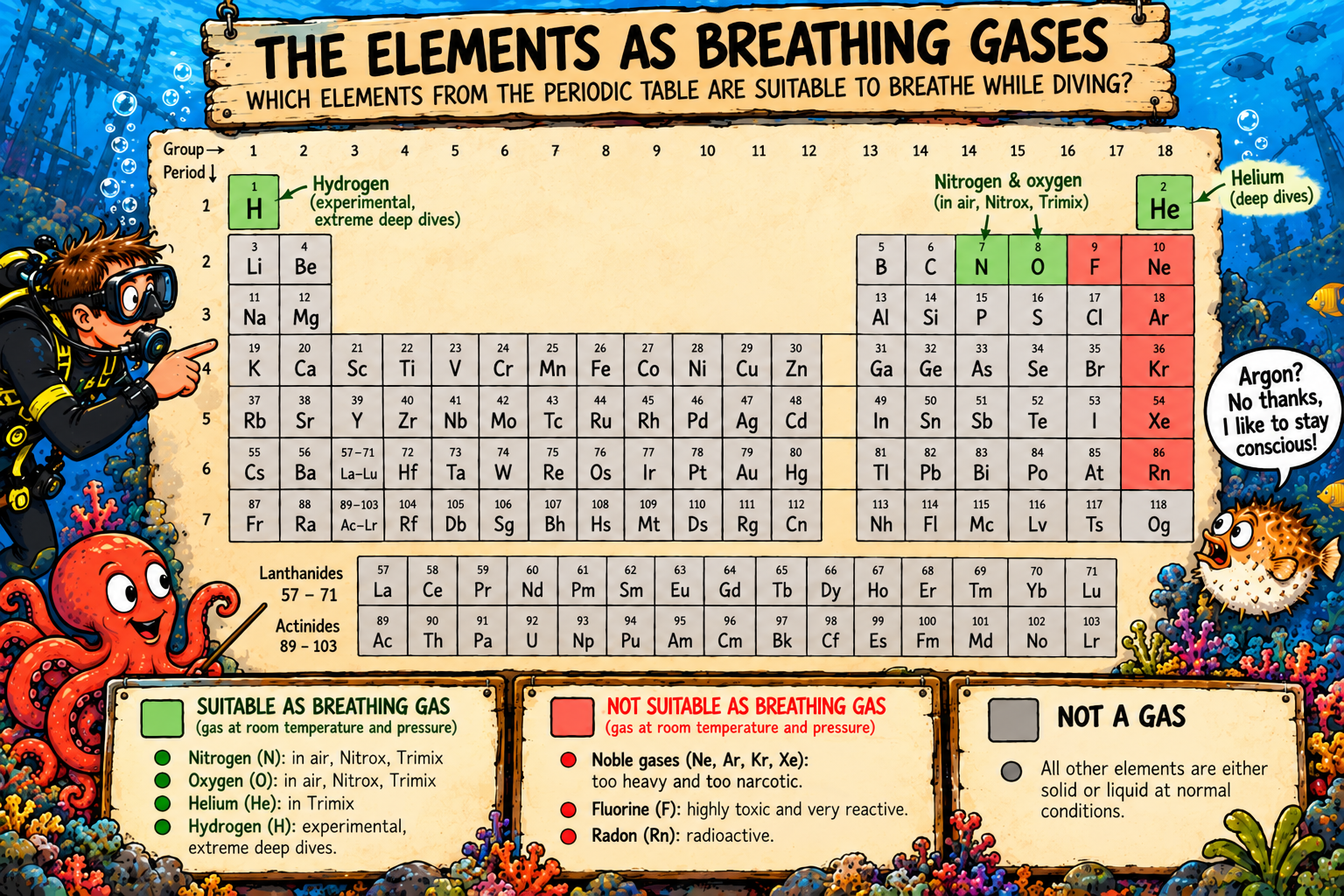
Oxygen, nitrogen, and helium are now well known to us. That leaves only eight other ‘candidates’ remaining. Most of these are immediately excluded. Some are toxic or extremely reactive, others are too heavy or have a strong narcotic effect under pressure.
Out of these eleven, we can immediately cross fluorine off. It is extremely reactive, corrosive, and very toxic upon inhalation. Chlorine is also highly toxic and can severely damage the airways and lungs. This occurs even at the relatively low partial pressures that one might be exposed to at the surface. As a component of a breathing gas, its partial pressure would furthermore increase with ambient pressure during descent. Both gases are therefore completely unsuitable as breathing gases.
Then there are the noble gases. We can immediately remove radon from the list: although chemically hardly reactive, it is radioactive and thus obviously not a serious candidate as a breathing gas. Krypton and xenon are chemically almost inert, but for deep dives they have exactly the wrong properties. They are much heavier than nitrogen and have a strong narcotic effect under pressure. Xenon is so narcotic that it is used in medicine as an anesthetic. Instead of reducing the narcosis and high gas density of nitrogen, krypton and xenon would only worsen these problems.
Argon has similar disadvantages. It is not toxic by itself but is more narcotic under pressure than nitrogen and is also significantly denser than air. As a replacement for helium, it would therefore increase the problems with narcosis and breathing work. Nevertheless, argon has a use within technical diving: it is sometimes used to fill dry suits because it conducts heat relatively poorly and thus serves as an insulating gas, but not as a breathing gas.
Neon is a more interesting candidate. It is much lighter than nitrogen, barely narcotic, and has actually been researched as a breathing gas for deep dives. Still, it has few practical advantages over helium. Neon is considerably heavier than helium and also much scarcer and more expensive. It would therefore produce a more costly breathing gas with a higher gas density. You get less for more money. Neon can therefore also be removed from our list.
That leaves only one notable candidate: hydrogen. Hydrogen is the lightest gas that exists. It is right at the top of the periodic table, with atomic number 1. It is the simplest and lightest atom that exists: one proton with one electron around it. Like oxygen (O₂) and nitrogen (N₂), hydrogen (H₂) does not exist as individual atoms under normal conditions but as molecules made up of two atoms of the same element. Such a molecule is called a diatomic molecule. As a gas, hydrogen has an extremely low density, about half that of helium. At first glance, this makes it a particularly attractive candidate for deep dives, where increasing gas density and breathing effort form significant problems.
There is only one rather important problem: hydrogen is highly flammable. In combination with sufficient oxygen an explosive mixture can be formed. Oxygen is, of course, the gas a diver needs to stay alive. Combining both gases therefore requires a very different approach to gas mixtures, equipment, and safety procedures than we are used to with air, Nitrox, or Trimix.
That does not mean that hydrogen as a breathing gas is only a theoretical idea. Experiments with it have been conducted for over eighty years, both in mixtures with oxygen (Hydrox) and in mixtures with helium and oxygen (Hydreliox). Swedish engineer Arne Zetterström conducted trials with it during World War II but died in 1945 during an experimental dive. Later, research was continued by, among others, the U.S. Navy and the French deep diving company COMEX. The latter had professional divers work with hydrogen-containing breathing gases at depths over 500 meters in the Mediterranean Sea in 1988. However, research remained largely limited to specialized military and commercial deep diving programs.
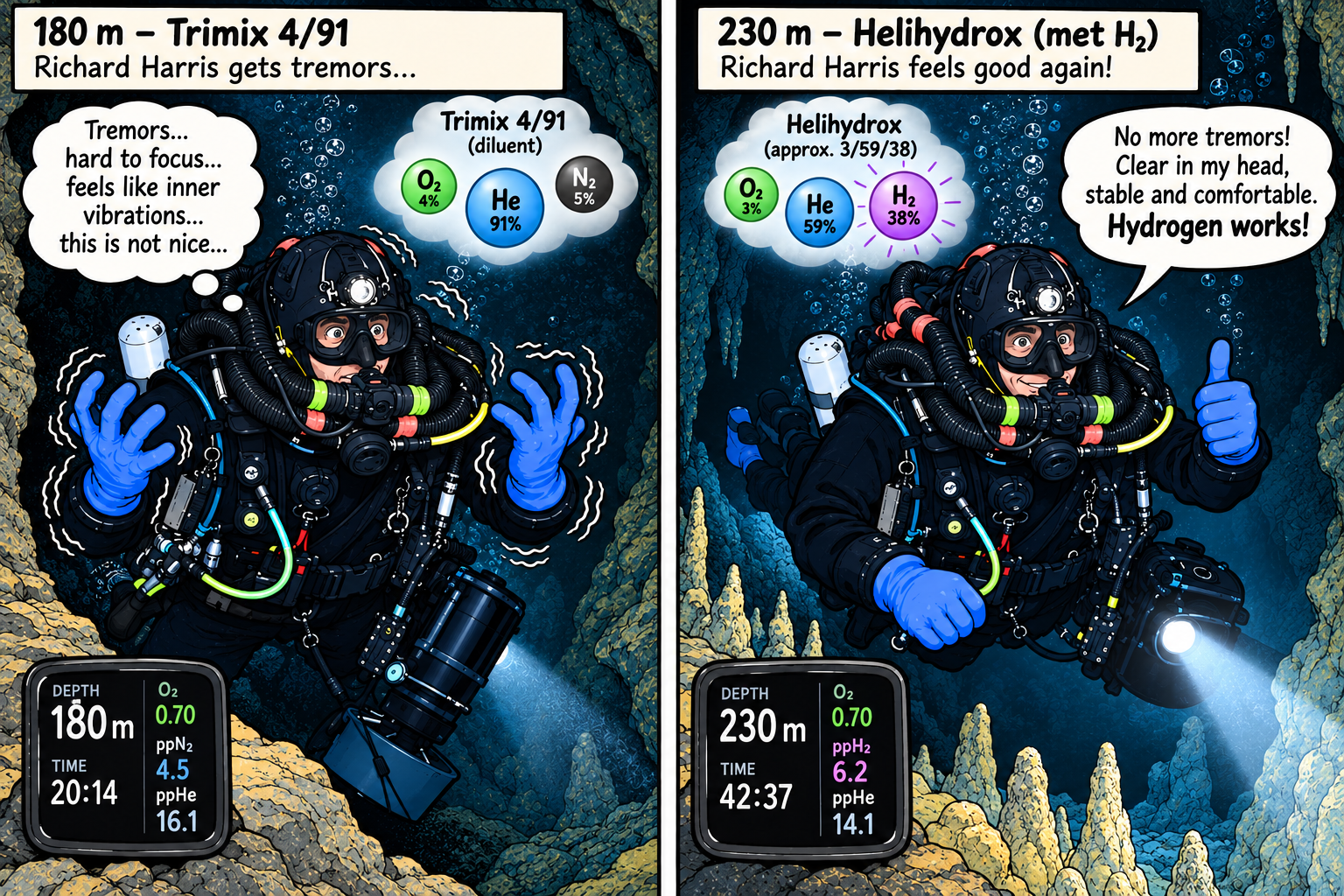
In February 2023, an experiment took place in New Zealand that might have opened a new chapter in technical diving. Australian cave diver and anesthesiologist Richard Harris, internationally known for his role in the 2018 rescue of the Thai soccer boys, wanted to investigate whether hydrogen could help to dive even deeper than is possible with conventional Trimix mixtures.
The location was the Pearse Resurgence, an impressive deep cave system on New Zealand's South Island. Harris and his team, the Wetmules, had already reached a depth of 245 meters there in 2020. However, a problem had occurred: at great depth, Harris experienced uncontrollable tremors caused by High Pressure Nervous Syndrome (HPNS). This is a neurological syndrome that can occur under extreme pressures and can cause dizziness, coordination problems, and motor disturbances.
But HPNS was not the only issue. At such extreme depths, the work of breathing becomes an increasing challenge. When a diver inhales, the breathing gas must flow through the breathing apparatus, hoses, and airways to the lungs. The gas encounters resistance along the way. This resistance depends, among other factors, on two properties: the density and viscosity (thickness) of the gas. The denser the gas, the more energy it takes to move it. And the higher the viscosity, the more resistance the gas experiences as it flows through narrow passages. At great depth, increasing gas density is especially problematic, as the gas is compressed under ever higher pressure. The result is that the diver must work increasingly hard to get enough breathing gas in and out of their lungs.
To counteract HPNS, a small amount of nitrogen is sometimes added to deep helium mixes. The narcotic effect of nitrogen can reduce neurological symptoms, but nitrogen is much heavier than helium and thus increases gas density. This creates a tricky dilemma: what helps against HPNS makes breathing heavier.
Hydrogen could potentially address both problems simultaneously. It has an even lower density and lower viscosity than helium, yet also possesses a mild narcotic effect that could suppress HPNS symptoms. The big question, of course, was whether these advantages outweighed the risks of using a flammable gas in a rebreather.
On February 14, 2023, Harris and his dive partner Craig Challen descended to 230 meters. Harris used a specially modified configuration with two independent rebreathers. Starting at about 200 meters, he began adding hydrogen to his breathing gas. At maximum depth, he breathed an estimated mixture of about 3% oxygen, 59% helium, and 38% hydrogen: an experimental breathing gas without nitrogen, but with hydrogen alongside helium (Hydreliox).
And then something remarkable happened. The tremors Harris had felt beginning around 180 meters disappeared. He could move calmly and in control again. The gas felt normal, and no immediately observable problems occurred.
After a dive lasting approximately thirteen hours, most of which was decompression, both divers surfaced safely. The experiment had not proven that hydrogen could henceforth be safely used as a breathing gas, but it showed that it was possible under these specific conditions and that it might offer a solution to some of the biggest limitations of extreme deep diving.
Dive physician Simon Mitchell, who was closely involved in the preparation and scientific evaluation, summarized the expedition's results with a notable combination of caution and optimism. His first conclusion was that the survival chance in such a dive is at least greater than zero. His second conclusion was far more ambitious: hydrogen could make it possible, in future technical exploratory dives, to surpass the 250-meter boundary.
Anyone who wants to see how much preparation, knowledge, and risk are behind such an experiment should definitely watch Mitchell's lecture. With spectacular footage, surprising insights into dive physiology, and a touch of understated humor, he offers a fascinating glimpse into a world where even the most experienced technical divers are still discovering what is possible.
12. No Magic, But Gas Physics
We began this article with ordinary air and end with experimental dives using hydrogen at depths over 200 meters. Between these points, we have encountered various types of Nitrox and Trimix, used as travel gas, bottom gas, or decompression gas. No matter how different these mixtures are, the starting point is always the same: we adjust the composition of the breathing gas to better fit the properties required for the depth and purpose of each phase of the dive.
But every adjustment brings new limitations. More oxygen means less nitrogen, but also a greater risk of oxygen poisoning. Helium reduces the narcotic load and breathing resistance, but is scarce and expensive. And hydrogen may offer new possibilities for extremely deep dives, but introduces entirely different safety risks. The perfect breathing gas does not exist.
As a Dive Professional, you do not have to be able to dive with all these mixtures yourself. However, it is important that you understand why they are used, what limitations are attached, and why correct analysis and identification of breathing gases is so important. This article is intended to provide that insight, not to teach you how to mix Trimix yourself or plan technical dives. For that, specialized training, appropriate equipment, and extensive practical training are necessary.
Ultimately, it all revolves around the same principle we encountered with ordinary compressed air: a breathing gas must not only be clean and suitable for inhalation, but also match the pressure under which it is used. What is an excellent breathing gas at one depth can be life-threatening at another depth. And that is exactly why, as a Dive Professional, it is important that you not only know what is in a dive cylinder, but also understand why.