Understanding the Diving Cylinder – From Liters and Cubic Feet to Buoyancy
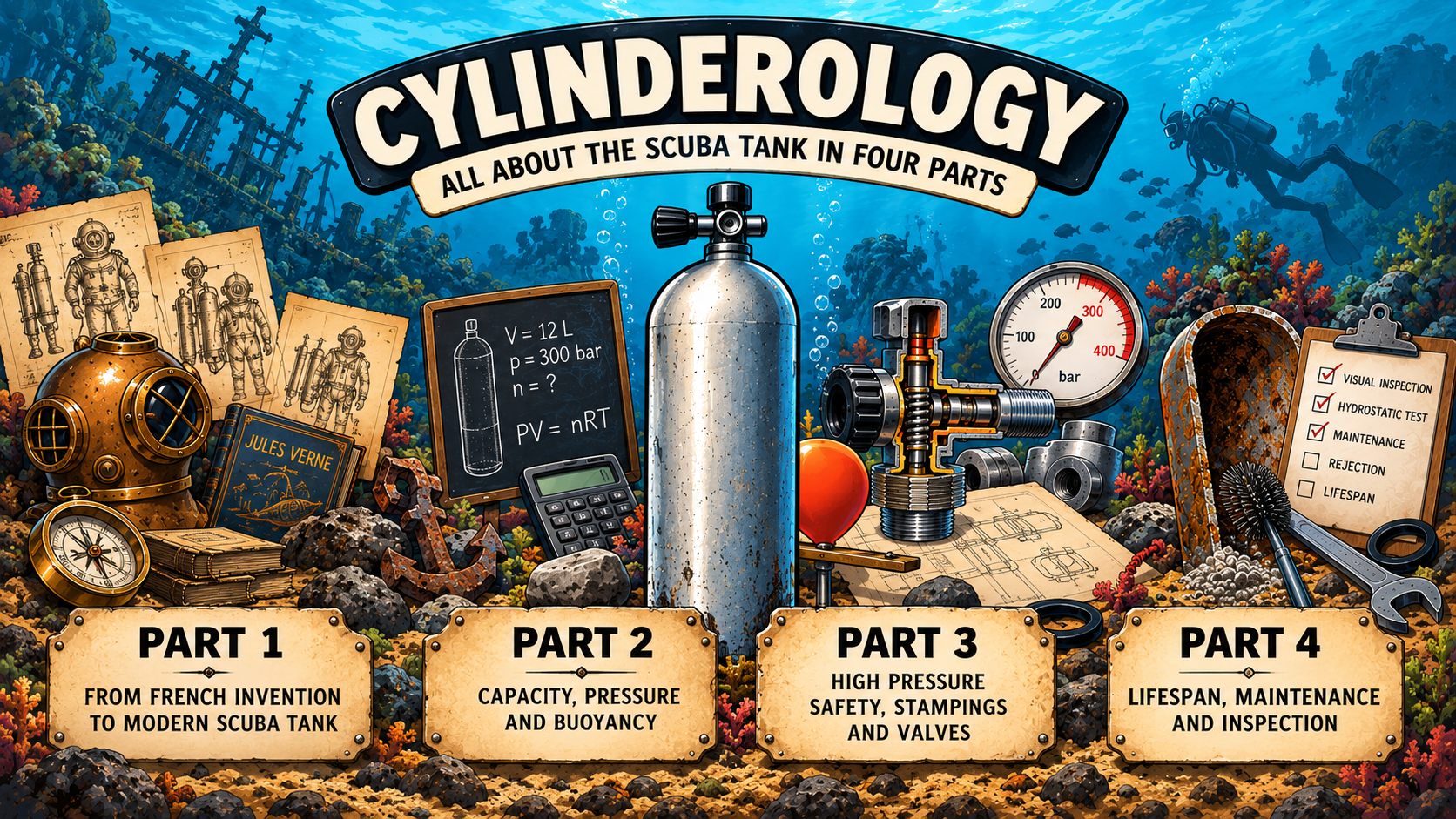
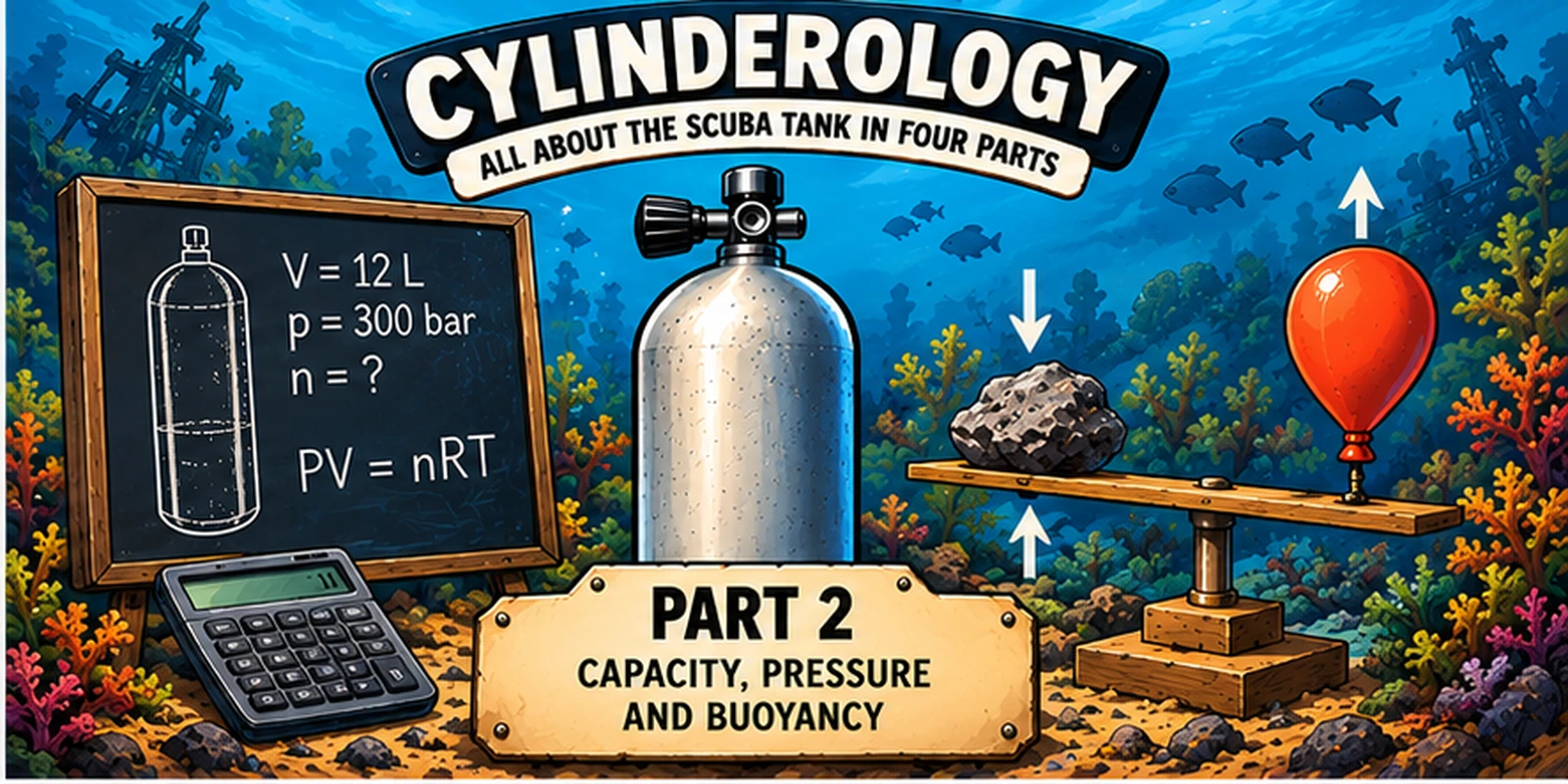
Every diver knows the diving cylinder. It might be the most familiar piece of our gear: a sturdy metal cylinder filled with breathing gas that we carry on our back and attach our regulator to. We know roughly how much air it holds and how long we can dive with it. But how much do we really know about the cylinder itself? How much breathing gas does a diving cylinder actually contain? Why do we use liters in Europe and cubic feet in America, and why does a cylinder at 300 bar provide less gas than you might expect? What different cylinder sizes exist, and why does the buoyancy of an aluminum cylinder change during the dive differently than that of a steel cylinder? In this second part, we dive into the physics behind the diving cylinder and discover how volume, pressure, weight, and buoyancy are interconnected. This is the second part of a four-part series about the diving cylinder. Welcome to the second lesson in cylinderology.
1. How much air is actually in a diving cylinder?
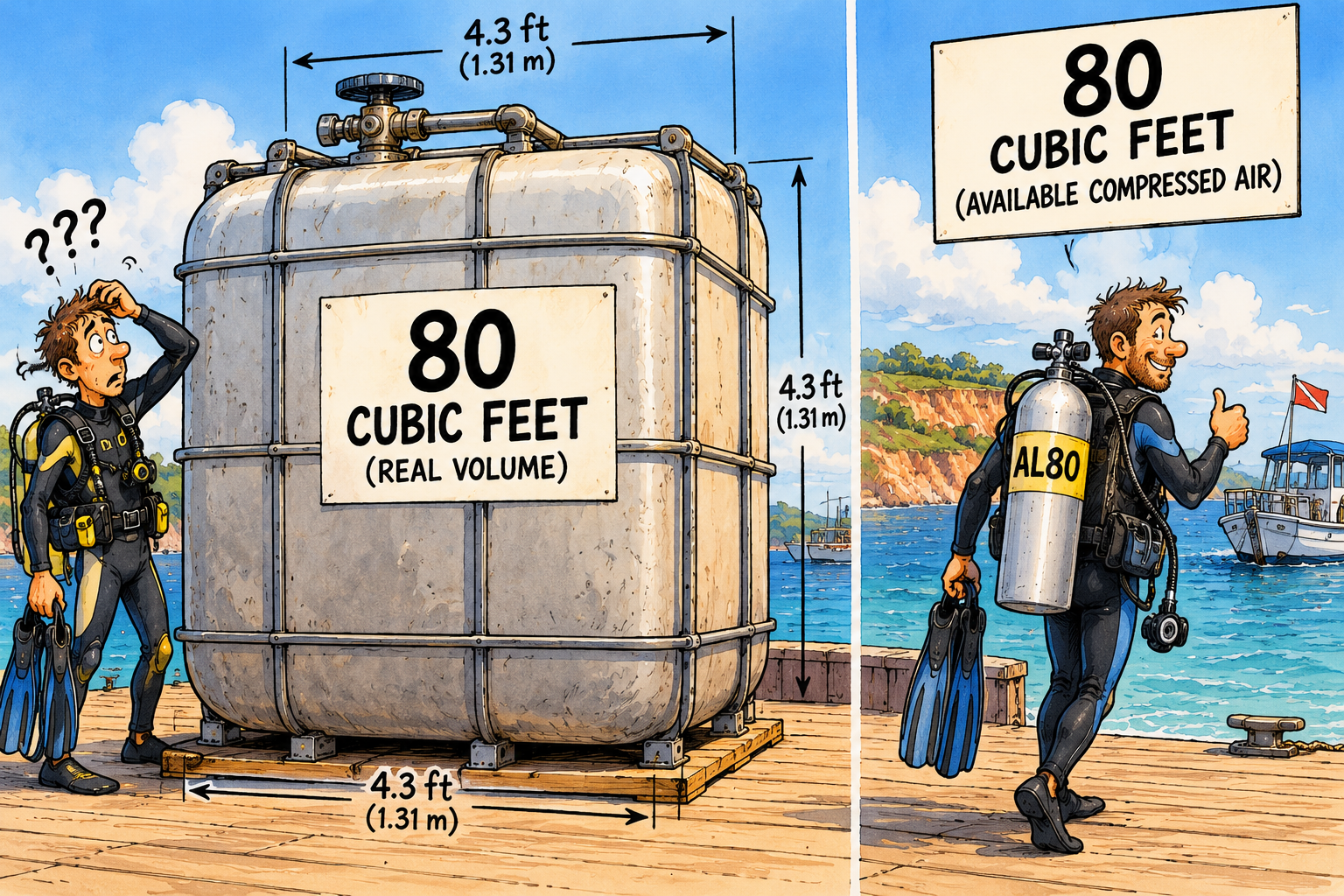
When renting a diving cylinder in Europe, you usually get a bottle of 10, 12, or 15 liters. In North America and the Caribbean, on the other hand, people often talk about an AL63, AL80, or AL100. These are two different ways to designate diving cylinders, and that can be quite confusing. After all, a European 12-liter cylinder contains much more than 12 liters of breathing air, while an American AL80 certainly does not have a volume of 80 cubic feet. That would correspond to a cube measuring over 4.3 feet, or 1.3 meters, on each side. Not exactly something you can comfortably carry on your back, let alone dive with.
To understand how much breathing gas a diving cylinder can actually hold, we first need to distinguish between the volume of the cylinder itself and the amount of air stored inside at high pressure. Then it turns out that both the European and American designations actually tell only half the story. Although it must be said that the Americans have succeeded remarkably well in making that half of the story twice as complicated. But this is not the place to mock the American measurement system. I've already done that extensively in my article about Measuring and Calculating in Diving.
In the metric system, a diving cylinder is usually designated by its water volume: the volume that would be available if you completely filled the empty cylinder with water. So, a 12-liter cylinder has an internal volume of 12 liters, regardless of whether it is empty or under pressure. How much breathing air it contains then depends on the pressure. At a working pressure of 200 bar, such a cylinder contains, according to a simple calculation, approximately 2,400 liters of air measured at atmospheric pressure. At 300 bar, that becomes 3,600 liters. These are theoretical values for now, but they clearly show why the water volume alone says little about the amount of breathing gas a diver can carry.
Another custom has developed in the American diving industry. There, cylinders are often referred to by the amount of breathing gas they can hold at their nominal working pressure, expressed in cubic feet. One cubic foot corresponds to about 28.3 liters. So, an AL80 is an aluminum cylinder with a nominal gas capacity of about 80 cubic feet, or more than 2,260 liters of breathing air. However, the water volume of a common AL80 is only about 11.1 liters, and the working pressure is 3,000 psi, about 207 bar. The designation AL80 therefore tells us something about the gas capacity, not directly about the physical size of the cylinder.
The difference between the two systems is mainly that the European designation is based on the volume of the cylinder, while the American designation refers to the amount of gas that can be stored inside. Neither system tells the full story on its own. With a European 12-liter cylinder, you need to know the working pressure to calculate the gas capacity, while with an American AL80, you need additional information to know the actual size of the cylinder. This becomes clear when we compare some common steel and aluminum diving cylinders side by side.
| Type of diving cylinder | Water volume | Working pressure | Gas volume (theoretical) |
|---|---|---|---|
| Steel 10 L | 10.0 L | 232 bar | 2,320 L |
| Steel 12 L | 12.0 L | 232 bar | 2,784 L |
| Steel 12 L (HP) | 12.0 L | 300 bar | 3,600 L |
| Steel 15 L | 15.0 L | 232 bar | 3,480 L |
| Aluminum AL40 | approx. 5.7 L | 207 bar (3,000 psi) | approx. 1,180 L |
| Aluminum AL63 | approx. 8.9 L | 207 bar (3,000 psi) | approx. 1,840 L |
| Aluminum AL80 | approx. 11.1 L | 207 bar (3,000 psi) | approx. 2,300 L |
| Aluminum AL100 | approx. 13.9 L | 228 bar (3,300 psi) | approx. 3,010 L |
The gas volume here is calculated by multiplying the water volume by the working pressure. These are theoretical values, without correction for the non-ideal behavior of compressed air. The water volume of aluminum cylinders can vary somewhat by manufacturer and model.
The table shows that the European and American designations are not directly comparable. Suppose we fill a European steel 12-liter cylinder and an aluminum AL80 both exactly to 200 bar, just under their nominal working pressures of 232 and 207 bar, respectively. The steel cylinder then has a theoretical gas volume of 2,400 liters, while the aluminum AL80 according to the same calculation contains about 2,220 liters. That's about 180 liters less. However, the name AL80 refers to the nominal gas capacity at the official working pressure of about 207 bar: 80 cubic feet corresponds to about 2,265 liters. For divers, it is therefore useful not only to look at the name of a cylinder but also at its actual water volume and filling pressure. An AL80 and a European 12-liter cylinder are often considered more or less comparable cylinders in practice, but they are not identical.
On an island like Curaçao, where primarily American diving equipment is used but often thought of in European terms, the American and European designations for diving cylinders frequently get mixed up in daily practice. For example, an AL80 is often incorrectly called a 12-liter cylinder and an AL100 a 15-liter cylinder, while their actual water volume amounts to approximately 11.1 and 13.9 liters respectively. It would therefore be more accurate to call the first an 11-liter cylinder and the second a 14-liter cylinder. The smaller AL63 is also not a 10-liter cylinder but, with a water volume of about 8.9 liters, rather a 9-liter cylinder. Such entrenched inaccuracies prove particularly persistent and are repeatedly perpetuated even by experienced dive professionals. When someone then calculates their available gas supply using those incorrect cylinder volumes, they unknowingly overestimate their gas.
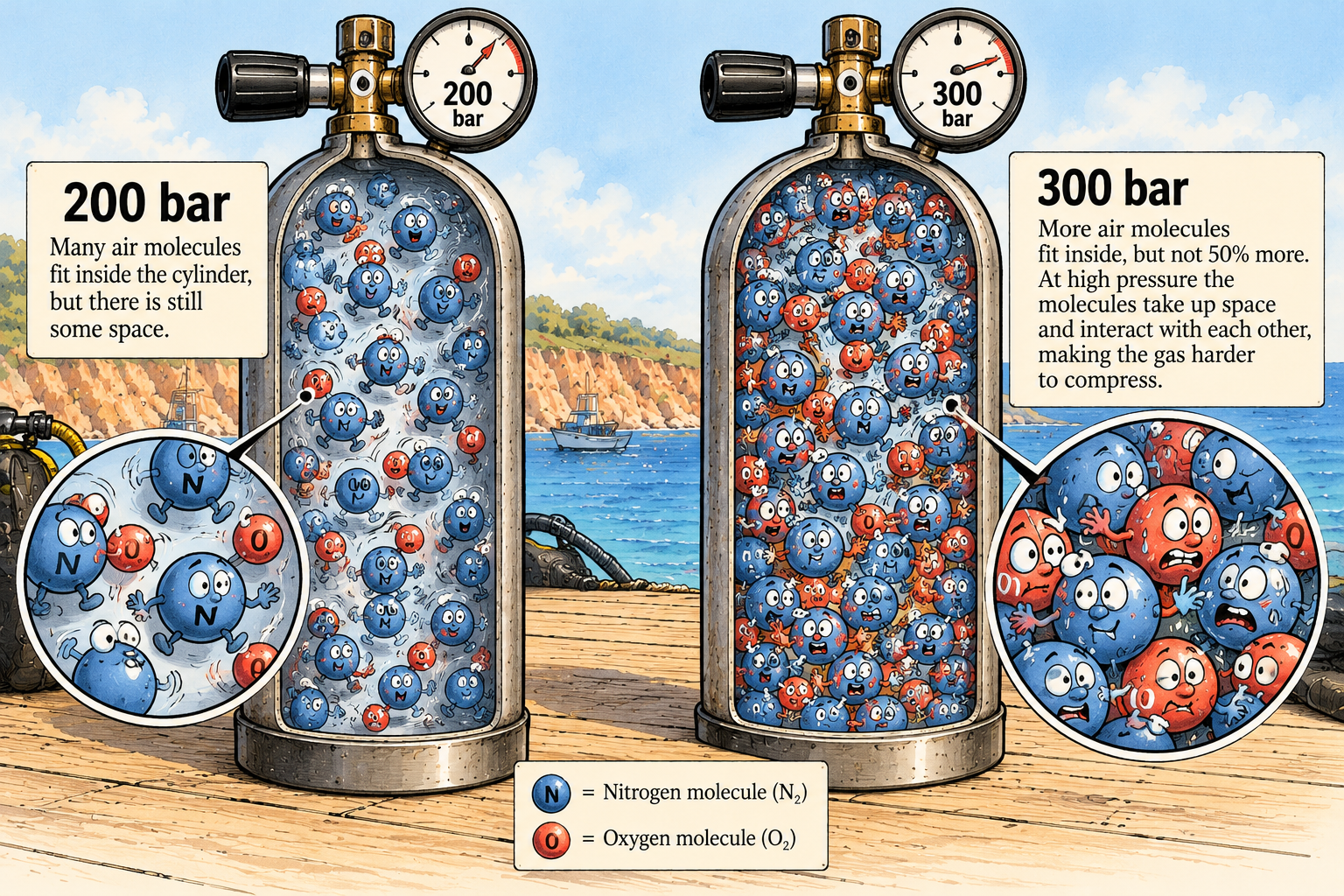
However, there is still a catch. So far, we have calculated the amount of breathing gas by multiplying the cylinder's water volume by the pressure. This is a very handy rule of thumb, but it is not entirely accurate at high pressures. Air does not always behave exactly as straightforward gas laws predict. A 12-liter cylinder at 300 bar therefore does not necessarily contain one and a half times as much breathing gas as the same cylinder at 200 bar. To understand why this is, we must delve a bit deeper into the physics of compressed gases.
2. Why 300 bar does not yield one and a half times as much air as 200 bar
In the previous chapter, we calculated the amount of breathing gas in a cylinder by multiplying the water volume by the pressure. According to that calculation, a 12-liter cylinder at 200 bar contains 2,400 liters of air, while the same cylinder at 300 bar would hold 3,600 liters. That seems logical: if we increase the pressure by 50%, there should also be 50% more air in the same space. Yet at such high pressures, this is not entirely correct. The simple calculation assumes a theoretical model in which gases behave a little more neatly than they actually do.
This model is based on the ideal gas law, which describes the relationship between pressure, volume, temperature, and the amount of gas. At constant temperature, this law states that doubling the pressure also doubles the amount of gas that can fit in the same space. For many everyday applications, this is an excellent approximation. But the ideal gas law relies on some simplifications. For instance, it assumes that gas molecules themselves occupy no space and that, apart from their collisions, they do not influence each other. In reality, molecules do have their own volume and exert attractive and repulsive forces on each other. At low pressures, these effects are usually negligible, but as gas is compressed further, these effects become increasingly significant.
At pressures between 200 and 300 bar, the gas molecules are so closely packed that air noticeably deviates from the ideal model. To describe this difference, physicists use the compressibility factor, denoted by the letter Z. For an ideal gas, Z is exactly 1. For highly compressed air under normal ambient temperatures, this factor is typically greater than 1. This means that at a certain pressure, less gas fits into the cylinder than the simple calculation predicts. The molecules become progressively harder to compress closer together. The pressure continues to rise, but the amount of additional gas stored increases less rapidly.
Moreover, the difference is greater at 300 bar than at 200 bar. A 12-liter cylinder at 300 bar therefore does not actually contain one and a half times as much breathing air as the same cylinder at 200 bar. The additional 100 bar still yields a substantial amount of gas but less than the theoretical 1,200 liters we would expect. The exact difference depends, among other things, on the temperature and the composition of the gas. Anyone who wants to determine the actual amount of breathing air accurately therefore needs to take the compressibility factor into account. When mixing breathing gases and calculating large gas supplies, this correction can be important. For simple dive calculations, however, multiplying liters by bar remains a particularly useful rule of thumb.
There is a second phenomenon to consider: temperature. When air is compressed during filling, it becomes warmer. This is not only due to the compression in the compressor itself but also because the high-pressure air streams into the cylinder. Especially when a dive cylinder is filled quickly, the temperature of the gas and the cylinder wall can noticeably rise. And since the pressure of a gas partly depends on its temperature, the pressure gauge can show a higher value immediately after filling than after the cylinder has had some time to cool down.
For example, suppose a dive cylinder shows 200 bar immediately after filling, while the air inside has warmed to 40 °C. If the same cylinder then cools down to 25 °C, the pressure drops, even though no air has escaped. According to a simple approximation using the ideal gas law, the pressure would then decrease to about 190 bar. In reality, the properties of compressed air and the cylinder's temperature also play a role, but the example clearly shows why a warm cylinder can indicate less pressure after cooling. The amount of gas hasn’t changed; only the temperature—and thus the pressure—has decreased.
The reverse happens when a filled dive cylinder warms up. A cylinder pressurized in a cool filling room that is then placed in tropical sunlight can show a higher pressure without any extra air being added. That, however, does not mean the cylinder suddenly contains more breathing gas. It mainly shows that pressure and gas content are not the same. A pressure gauge measures the pressure inside the cylinder but does not accurately tell us how many gas molecules are present without additional information about temperature and cylinder volume.
For a diver, this distinction is mainly of practical importance. When we calculate our remaining gas supply during a dive, we usually use the water volume of the cylinder and the pressure indicated by the pressure gauge. This is sufficient accuracy for many common applications, as long as we understand it is an approximation and plan with appropriate gas reserves. At higher working pressures, precise gas calculations, and during cylinder filling, deviations from the ideal model become more significant. Also, attention to the temperature during and after filling becomes important.
The amount of breathing gas we can carry thus depends not only on how large a cylinder is and the pressure to which we fill it. The physical properties of the gas and the temperature also play a role. This also makes clear why dive cylinders come in so many different sizes and types. A small cylinder can contain surprisingly much gas under high pressure, while a larger cylinder at a lower pressure can sometimes hold a similar supply. From tiny cylinders for inflating a surface marker buoy to huge buffer cylinders in a filling station: in the next chapter, we look at how varied these sizes can be.
3. From Mini Cylinder to Large Buffer Tank
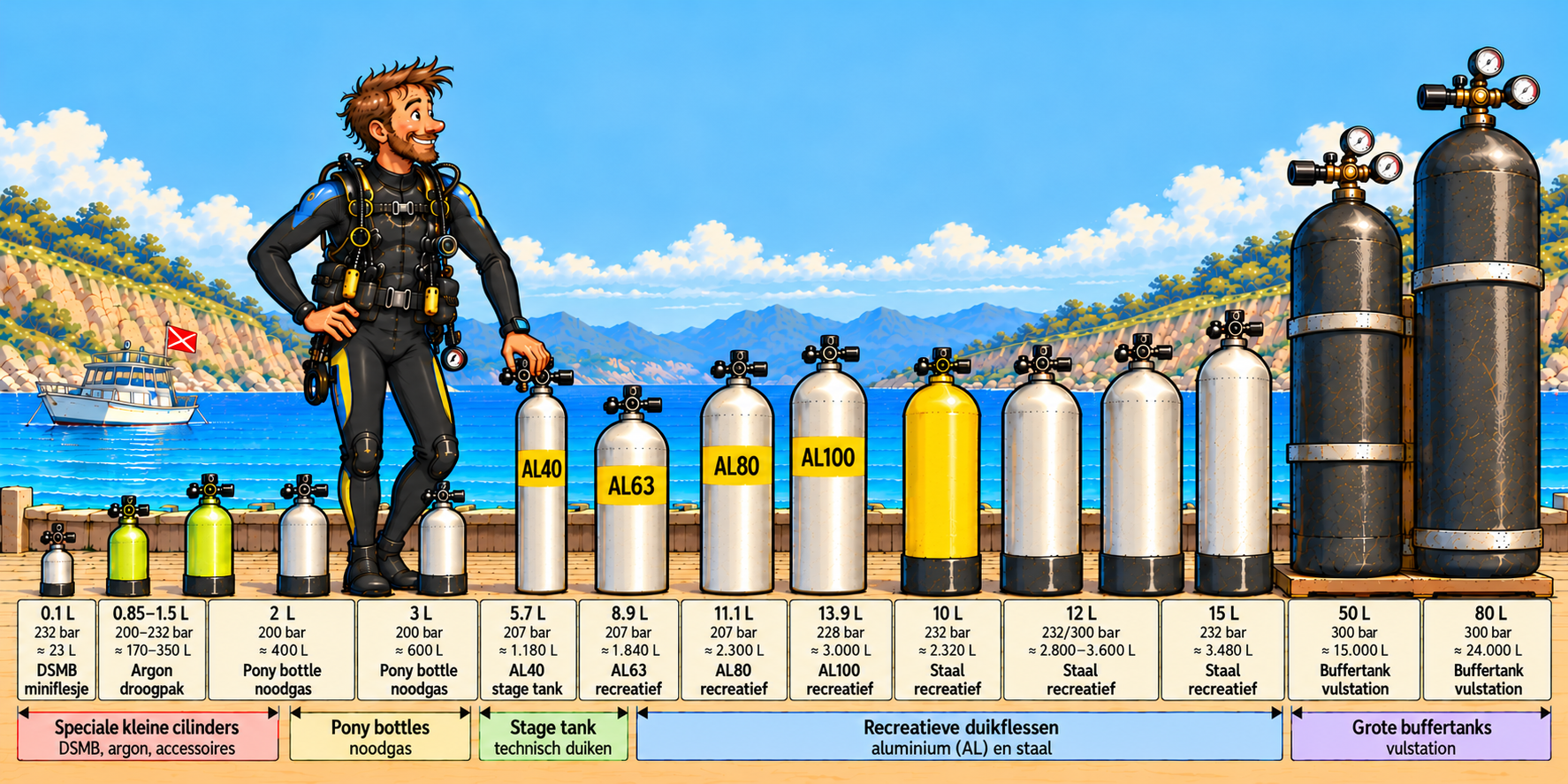
Dive cylinders come in all shapes and sizes, from tiny cylinders for inflating a surface marker buoy to large steel buffer tanks of 50 or 80 liters for storing breathing air in a filling station. Between these exist a great diversity of cylinder sizes, each developed for a specific application. When choosing a dive cylinder, it is also not just about the amount of gas it can hold but also about the length, diameter, weight, and the way the cylinder is used or carried. A larger cylinder generally offers more gas capacity but is not necessarily more practical. And sometimes a surprisingly small cylinder is exactly big enough for its purpose.
The Smallest Cylinders: DSMB and Argon
The very smallest dive cylinders are barely bigger than a palm. For instance, there are special mini cylinders with a water volume of only 0.1 liter (100 milliliters), which at a working pressure of 232 bar can theoretically contain about 23 liters of air. They are used, among other things, to fill a Delayed Surface Marker Buoy (DSMB), an inflatable surface marker buoy, underwater. Such a cylinder is only about 11.5 centimeters long and is prefilled from a standard dive cylinder. The available amount of air is far too small to breathe from meaningfully but can be sufficient to inflate a marker buoy. It is a nice example of how a small volume of compressed gas can still serve a useful function.
Another special application is small argon cylinders, usually with a water capacity of about 0.85 to 1.5 liters, which technical divers use to inflate their dry suits. Argon conducts heat less well than air and therefore can provide slightly better thermal insulation under certain conditions. Such cylinders are connected to the dry suit via a separate pressure regulator. They are thus not intended for breathing but to supply gas to another part of the diving equipment. This immediately shows that not every cylinder a diver carries necessarily contains breathing gas.
Pony bottles: an independent gas reserve
One step larger are the small diving cylinders that are intended for breathing, with a water capacity of about 2 to 6 liters. They are used among other things as an independent emergency air supply. A pony bottle is a small cylinder with its own valve and regulator, carried alongside the regular diving cylinder. The name indeed refers to a pony, a small horse: alongside the big workhorse, the diver metaphorically carries a smaller one as well. Should the primary air supply fail, the diver has a separate gas reserve allowing them to return to the surface. Such systems are used as backups especially for deeper dives, cold water diving, and certain forms of solo diving.
A common size is the aluminum AL19, with a water capacity of about 2.7 liters and a nominal gas capacity of 19 cubic feet, roughly 540 liters of breathing air at a working pressure of 207 bar. For a diver diving with an AL80, this means an extra, independent gas reserve of nearly a quarter of the capacity of their main cylinder. There is also a smaller version, the AL13. In Europe, we talk about 2 and 3-liter cylinders. A 3-liter cylinder at 200 bar contains, according to the simple calculation, approximately 600 liters of air, while a 6-liter cylinder at the same pressure contains about 1,200 liters. That may sound like a considerable amount, but at depth breathing gas is consumed much faster than on the surface. At 30 meters depth, the ambient pressure is around four bar and a diver with the same breathing volume per minute uses approximately four times as much air as on the surface. A small emergency gas bottle must therefore have sufficient capacity for the complete return journey, including any safety or decompression stops. Not every small cylinder is automatically suitable for this.
The ordinary recreational diving cylinder
For most recreational dives, cylinders with a water capacity of about 10 to 15 liters are used. In Europe, especially steel 10-, 12-, and 15-liter cylinders are popular. A 10-liter cylinder is relatively compact and easy to handle, while a 15-liter cylinder offers more breathing gas for longer dives or divers with higher air consumption. The 12-liter cylinder forms a practical compromise between capacity and weight for many divers. Larger steel 18-liter cylinders also exist but are less commonly used because of their size and weight. Which capacity is most suitable depends not only on the planned dive but also on air consumption, body build, and the preferences of the diver.
In North America and the Caribbean, the aluminum AL80 is probably the best-known recreational diving cylinder. Additionally, the smaller AL63 and the larger AL100 exist. As we saw in the first chapter, these designations refer to the nominal gas capacity in cubic feet. An AL63 is therefore not only smaller than an AL80 but usually also shorter and lighter. This can be preferable for smaller divers or those who need less breathing gas. An AL100 offers more capacity but is also bulkier and heavier.
The largest size is not automatically the best choice. Two cylinders with the same water capacity can have very different shapes. For example, there are relatively short, wide steel 12-liter cylinders and longer, narrower versions. The former can sit quite high on the back of a tall diver, while the latter may contact the legs of a smaller diver. Also, the position of the valve, the weight of the cylinder, and how it is distributed over the body influence comfort. Underwater, buoyancy adds another factor: an aluminum cylinder typically becomes increasingly positively buoyant during the dive, while a steel cylinder usually remains negatively buoyant. Therefore, the right cylinder is not only a matter of sufficient breathing gas but also of good balance. We will revisit these differences extensively in the final chapter.
The AL40: a small cylinder with a big role
A particularly popular size in technical diving is the aluminum AL40, with a water capacity of about 5.7 liters and a nominal gas capacity of 40 cubic feet, or over 1,130 liters of breathing gas. Typical working pressure is 3,000 psi, roughly 207 bar. This makes the AL40 about half the size of an AL80 but still good for a considerable amount of breathing gas. The cylinder is relatively compact and easy to attach at the side of the body, making it especially suitable as an additional cylinder.
The AL40 is mainly used as a stage cylinder or decompression cylinder. In technical dives, divers often carry different breathing gas mixes, each intended for a certain part of the dive. An AL40 might, for example, be filled with EAN50, a blend of 50% oxygen and 50% nitrogen, used during decompression stops at appropriate depths. The AL40 is also commonly used for pure oxygen during the final decompression stops, at depths where that is safe. The choice for this size is not only about gas capacity but also about the relatively favorable buoyancy of aluminum cylinders. This allows an AL40 to be carried easily alongside the body without constantly pulling strongly downward.
Although the AL40’s dimensions lie between pony bottles and standard recreational diving cylinders, it usually serves a very different function. A pony bottle is intended as an independent emergency gas supply, whereas a stage or decompression cylinder is part of a preplanned gas strategy. The cylinder itself does not need to be different for this: it is mainly the content and how the cylinder is used that make the distinction. In the next chapter, we will take a more detailed look at how technical divers combine and manage such additional cylinders.
Small cylinders for rebreathers
Besides regular recreational diving cylinders, there are cylinders specifically adapted for equipment with very different gas consumption. A good example is the small cylinders of a rebreather, often with a water capacity of only 2 or 3 liters. A rebreather operates differently than a regular open-circuit regulator: the exhaled gas is largely reused, while carbon dioxide is removed and oxygen is replenished. This means much less breathing gas is lost, and large cylinders are not needed for the normal gas supply. Closed-circuit rebreathers commonly have two separate cylinders: one with oxygen and one with a diluent gas, such as air or trimix.
However, this does not mean a rebreather diver can go out with only two small cylinders. In case of failure, the diver must be able to switch to an independent breathing gas supply, the so-called bailout gas. Depending on the dive, one or more larger cylinders may be necessary for this. The small cylinders of the rebreather primarily illustrate how strongly the required gas supply depends on the way breathing gas is used. An open-circuit diver expels gas into the water with every breath, whereas a rebreather diver reuses most of it. Because of this, two systems with very different cylinder sizes can still be suitable for comparable dive times.
Medical oxygen cylinders
Another cylinder you will encounter at virtually every dive school is the oxygen cylinder. This is part of first aid equipment and intended to administer oxygen as quickly as possible in case of a diving accident. The same type of cylinders are also found in hospitals and ambulances. Here, the diving world and the medical world intersect: oxygen in this case is not just a breathing gas, but a medicine that we administer as first aid in a diving emergency. Although such a cylinder may look very similar to a regular diving cylinder, it is not intended for underwater use. Medical oxygen cylinders usually have their own color coding and a special valve connection.
In the United States and Canada, medical oxygen cylinders are traditionally recognizable by their green shoulder—a color coding also found in parts of the Caribbean. Many American models have a working pressure of 2,015 psi (about 140 bar). The smaller, portable cylinders typically contain several hundred liters of oxygen and use a so-called pin-index connector (CGA-870). Two small metal pins ensure that only a suitable oxygen regulator can be attached. Larger cylinders, which can hold thousands of liters of oxygen, usually have a screw connection (CGA-540).
In Europe, medical oxygen cylinders are typically completely white and are often filled up to 200 bar. The pin-index system is also used here, for example in the portable emergency oxygen sets from DAN. In addition, there are various screw connections that can differ from country to country. For instance, Germany uses different connections than France or Belgium. Even small medical oxygen cylinders are available with both pin-index and screw connections. The choice therefore depends not only on the size of the cylinder but also on the national standard and the corresponding pressure regulator valve.
All these different connections serve the same purpose: to prevent oxygen equipment from accidentally being connected to a cylinder containing another gas. Oxygen itself is not flammable but can strongly accelerate the combustion of other materials. For that reason, both the cylinder valve and the pressure regulator must be specially suitable for oxygen. A medical oxygen cylinder is thus not just an ordinary diving cylinder with a different content.
The largest cylinders remain on land
At the other end of the spectrum, we find the large cylinders that are not at all intended for diving. Professional fill stations store breathing air in large steel high-pressure cylinders, which are usually permanently mounted in a rack or frame. Common sizes have a water capacity of 50 or 80 liters and are suitable for storage pressures of, for example, 300 bar. A single 50-liter cylinder at that pressure theoretically contains 15,000 liters of air, while an 80-liter cylinder at the same pressure holds 24,000 liters. For industrial applications, there are even larger high-pressure cylinders and pressure vessels, with water capacities of hundreds or even thousands of liters.
At Air & Dive Supply in Curaçao, we currently use 43 steel buffer cylinders, each 50 liters, with a maximum storage pressure of 300 bar. Together they have a water capacity of 2,150 liters and a theoretical storage capacity of no less than 645,000 liters of breathing air. That corresponds to the theoretical content of more than 290 regular 11-liter tanks at 200 bar. The cylinders are divided into three banks, labeled LOW, MID, and HIGH. By using air from different banks consecutively during filling, we can utilize the available air supply much more efficiently than if all cylinders were permanently connected. This allows us to fill large numbers of diving cylinders without being entirely dependent on the quantity of air our compressors produce at that moment. Note that the full theoretical storage capacity is not the same as the amount of air we can actually transfer to diving cylinders at a specific fill pressure.
That takes us from a tiny 100-milliliter mini-cylinder to a storage installation with over 2,000 liters. Yet both are based on the same principle. By compressing gas under high pressure, we can store a surprisingly large amount of it in a relatively small space. The dimensions of a cylinder are ultimately determined by the amount of gas required, the pressure it is designed for, and the practical conditions in which it is used.
But having the right cylinder volume is not enough. Sometimes one cylinder suffices for a diver, while other dives require multiple tanks, for example for extra gas supply, an independent emergency reserve, or different breathing gas mixtures. These cylinders can be carried on the back, attached along the sides of the body, or assembled in various combinations. And that brings us to the next question: how do divers organize all these cylinders when one tank is no longer enough?
4. One cylinder, two cylinders, or a whole collection?
For most recreational dives, one diving cylinder is sufficient. An AL80 or a steel 12-liter cylinder usually provides enough breathing gas for a relaxing dive, as long as the depth, air consumption, and planned dive time remain within usual limits. But as dives become longer, deeper, or more complex, one cylinder may be insufficient. Sometimes simply more breathing gas is needed, sometimes divers want a fully independent reserve, and sometimes multiple breathing gas mixtures must be carried. In such cases, the diving equipment is extended with extra cylinders, which can be carried and connected together in different ways.
It's not just about the amount of gas. The accessibility of the valves, the distribution of weight, freedom of movement, and the ability to act safely in case of a malfunction also play an important role. Technical divers can therefore enter the water with two, three, or even more cylinders. To an outsider, it may look like someone has taken half the supply from a fill station, but essentially every cylinder has its own function.
Double Sets: Two Cylinders on the Back
The most obvious way to carry more breathing gas is to wear two cylinders side by side on the back. In technical diving, double sets with two steel 7-, 10-, or 12-liter cylinders are especially known, designated as bi-7, bi-10, and bi-12. For example, a bi-12 consists of two cylinders of 12 liters each, together providing a water volume of 24 liters. At a pressure of 232 bar, according to a simple calculation, this corresponds to 5,568 liters of breathing gas. This gives the diver significantly more gas than a single cylinder, but the weight and bulk of the equipment also increase considerably.
In North America and the Caribbean, aluminum double sets are also used, for example two AL80 cylinders collectively referred to as double 80s or twin 80s. Their combined water volume is approximately 22.2 liters, and at an operating pressure of 207 bar, they theoretically contain about 4,600 liters of breathing gas. However, steel double sets are particularly popular in technical diving, partly because they can contain a lot of gas in a relatively compact size and generally remain negatively buoyant. Which configuration is most suitable depends on the dive conditions, the required gas supply, and the diver's preference.
The two cylinders are usually fastened together with sturdy metal bands and carried as a single unit on the back. In many technical configurations, they are also connected by a manifold: a high-pressure connection between both cylinders, equipped with a closable isolation valve. On the outside are the usual cylinder valves, to which two separate regulators are connected. As long as the isolation valve is open, both regulators can use gas from the combined supply. So the diver doesn't simply have two completely separate cylinders but one gas supply accessible via two independent regulators.
The advantage of such a manifold becomes especially clear when something goes wrong. In case of a regulator malfunction or a leak at one of the connections, the respective valve can be closed. If the problem is located in part of the connection between the cylinders, the isolation valve can be closed to prevent the entire gas supply from being lost. The amount of gas preserved depends on the location of the malfunction and the actions the diver takes. This obviously requires practice: underwater, with thick gloves and possibly limited visibility, a technical diver must be able to reach his valves and perform the correct shut-off procedure.
Double sets are therefore primarily used in dives requiring a larger gas supply and a certain degree of redundancy, such as deep dives, cave dives, and wreck penetrations. When a direct ascent to the surface is not possible, a problem with the gas supply can have much more serious consequences. The extra cylinder then not only provides more breathing gas but also forms part of a carefully designed safety system.
Sidemount: Cylinders Alongside the Body
Not every diver carries cylinders on their back. In sidemount, the cylinders are attached alongside the body, usually one on the left and one on the right. Each cylinder usually has its own valve and regulator, keeping the gas supplies independent of each other. During the dive, the diver regularly switches between the two regulators to distribute gas consumption across the cylinders. This fundamentally distinguishes sidemount from a double set with an open manifold: the two cylinders do not form a combined gas supply.
Sidemount has become especially known in cave diving. In narrow passages, a large double set on the back can be quite cumbersome, whereas separate cylinders along the body allow for a lower profile. Moreover, depending on the configuration, the cylinders can be temporarily detached and brought forward to pass through particularly tight sections. Meanwhile, sidemount is also widely used in open water, where divers appreciate the configuration partly because of the accessibility of the valves and the possibility to handle the cylinders separately.
Both aluminum and steel cylinders are used for sidemount diving. In warm water, AL80 cylinders are a common choice, while steel cylinders are also popular in cold water. The buoyancy of the cylinders plays an important role here. A cylinder that hangs nicely horizontal alongside the body when fully filled can assume a different position as the gas is consumed. Especially aluminum cylinders can become positively buoyant at the end of the dive, causing the back of the cylinder to want to move upward. With the right attachment points and a good adjustment of the harness, the diver can compensate for that.
Sidemount does not automatically mean that a diver carries more breathing gas than someone with a doubleset. Two AL80 cylinders together contain about the same amount of gas as the same two cylinders on the back. The difference lies mainly in the configuration, the independence of gas supplies, and how the diver manages their equipment. Sidemount also requires specific training, including switching regulators, checking both pressure gauges, and handling malfunctions.
Stage Cylinders: Extra Gas for the Trip
For longer or deeper technical dives, even a doubleset or sidemount configuration may not contain enough gas. In that case, divers can carry additional cylinders, which are usually attached at the side of the body. Such cylinders are often called stage cylinders. They contain extra breathing gas that is used during a particular part of the dive, for example to increase the available gas supply or to carry a specific mixture for descent or ascent.
The word 'stage' refers to a phase or segment of the dive. In cave diving, for example, a stage cylinder can be used during the initial part of the penetration, after which the diver leaves the cylinder at a predetermined spot. On the way back, the same cylinder is picked up again and the remaining gas can be used. This way, not all the needed gas needs to be carried continuously on the back. Of course, this requires precise gas planning: the diver must determine beforehand how much gas may be used from each cylinder and which reserves must remain.
A commonly used size is the aluminum AL80, which contains enough gas for a substantial extra supply. For smaller amounts, AL40 cylinders are also used. As we saw in the previous chapter, an AL40 has a water volume of approximately 5.7 liters and a nominal capacity of 40 cubic feet, or over 1,130 liters of breathing gas. The choice between these sizes depends on the amount of gas needed, but also on weight, dimensions, and how the cylinder is carried underwater.
Stage cylinders are usually attached to the harness with two mounting points, allowing them to lie as close to the body as possible. Each cylinder has its own valve, regulator, and pressure gauge. When using multiple cylinders, it becomes important to clearly recognize the contents and purpose of each cylinder. A mix-up between two breathing gas mixtures can have much more serious consequences than confusing two cylinders that both contain regular compressed air.
Decompression Cylinders: The Right Gas at the Right Depth
A special application of extra cylinders is the decompression cylinder. In technical dives where mandatory decompression stops are required, divers can switch during ascent to breathing gas mixtures with a higher oxygen percentage. That can, within the limits of the decompression plan, speed up the elimination of absorbed inert gas. Such mixtures are therefore often called decompression gases.
A well-known example is EAN50, a mixture of 50% oxygen and 50% nitrogen. This gas is often used in technical dives starting from a maximum depth of about 21 meters, based on a maximum partial oxygen pressure of 1.6 bar. Another frequently used decompression gas is pure oxygen, which at the same oxygen pressure limit may only be breathed from 6 meters depth or shallower. These limits are not general recommendations to switch gases at those depths arbitrarily: the exact switch depths, oxygen exposure, and decompression procedure are part of a dive plan prepared in advance.
For such decompression gases, the aluminum AL40 is especially popular. The cylinder is relatively compact, offers sufficient capacity for many decompression profiles, and can be easily carried alongside the body. When more gas is needed, an AL80 may be more suitable. The choice depends on the planned decompression time, gas consumption, and necessary reserves. Some technical dives carry multiple decompression cylinders, each with a different mixture and its own maximum use depth.
The distinction between a stage bottle and a decompression bottle is therefore not necessarily in the cylinder itself. The same AL40 can be used one day as an extra supply of breathing gas and the next day as a decompression bottle with EAN50. What changes is the function and especially the gas inside. Therefore, clear identification of the mixture, the maximum operating depth, and careful gas checking are essential. When switching gases, the diver must be absolutely sure that the correct regulator is used and that the mixture is safe at the current depth.
Bailout: an Independent Escape
Extra cylinders are not only carried to enable longer dives or faster decompression. They can also serve as an independent emergency gas supply, commonly referred to as bailout gas. This principle was already encountered with the pony bottle, but in technical diving, the required amount of emergency gas can be considerably larger.
Especially in rebreather diving, bailout plays an important role. A closed rebreather largely reuses the breathing gas, which means the normal gas supply usually consists of two relatively small cylinders: one with oxygen and one with diluent gas. But when the rebreather can no longer be used safely, the diver must be able to switch to an independent open-circuit system. From that moment, with every breath, gas is released into the water and consumption increases strongly. The small cylinders of the rebreather are therefore usually insufficient to function as a full emergency gas supply.
For this reason, a rebreather diver may carry one or more bailout bottles, depending on the depth, planned dive time, and any decompression obligations. For a deep technical dive, it may be necessary to have multiple bailout gases available for different parts of the ascent. The required supply must be sufficient to safely finish the dive, even if the problem occurs at the most unfavorable moment. The presence of an extra bottle alone is therefore no guarantee of sufficient safety; it is about the amount of gas, the suitability of the mixture, and its accessibility when needed.
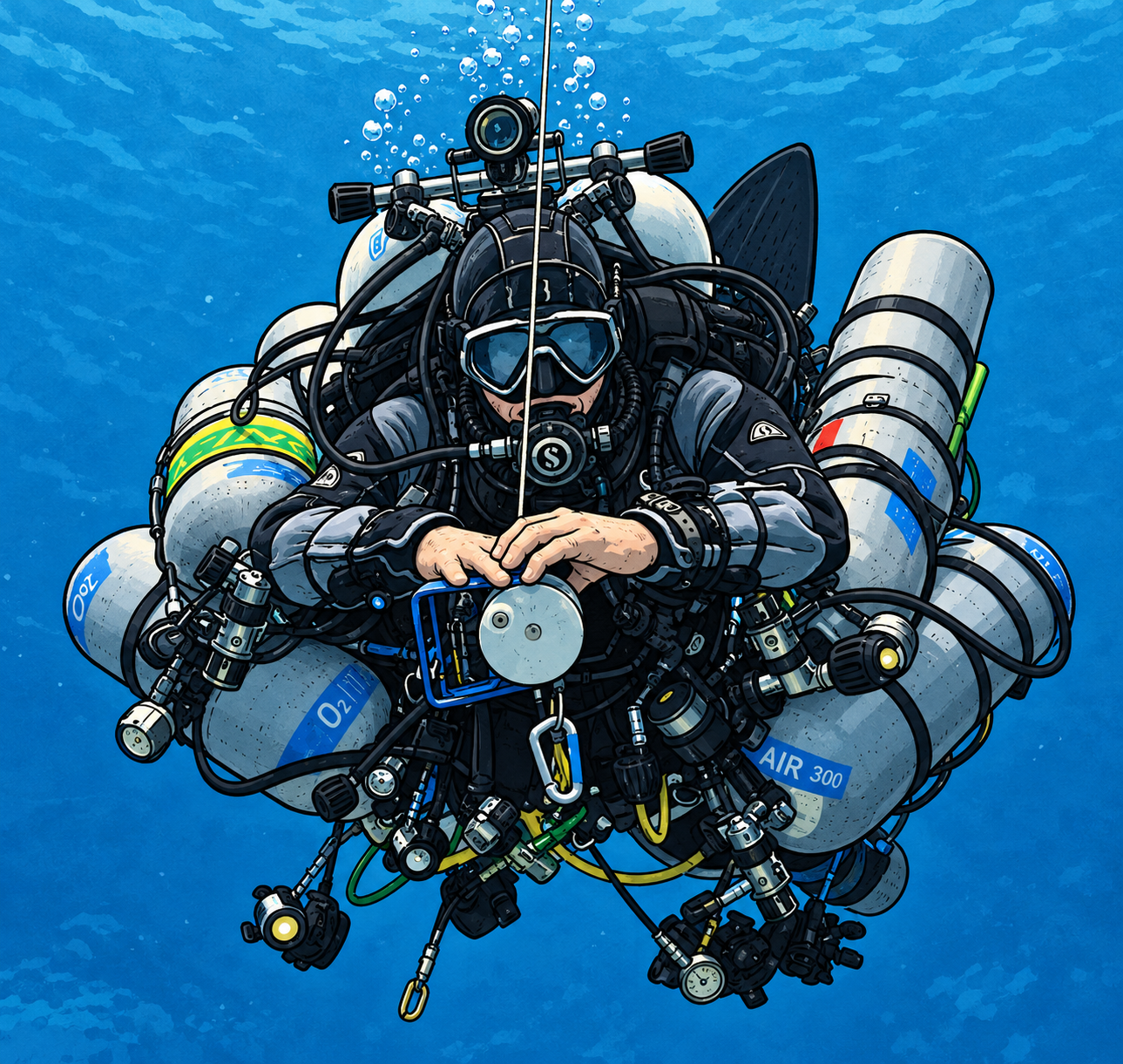
Thus, one diver may eventually enter the water with quite an impressive collection of cylinders: a double set on the back, one or two stage bottles, various decompression gases, and possibly an additional emergency supply. Each cylinder then has its own place in the dive plan. The whole may seem complicated, but the underlying idea is relatively simple: carry enough gas, use the right gas at the right moment, and have safe alternatives in case of failure.
This brings us back to a question that is also important for the regular recreational diving cylinder: how do all those cylinders actually behave underwater? Because when carrying multiple cylinders, you not only deal with their combined weight but also with their buoyancy. A steel double set can be quite negatively buoyant, whereas aluminum stage bottles become lighter as they are emptied. And that brings us to one of the most interesting properties of diving cylinders: why an aluminum cylinder can start to float at the end of the dive, while a steel cylinder usually continues to sink.
5. Why an Aluminum Cylinder Buoys Differently Than a Steel Cylinder
Anyone who has dived with both steel and aluminum diving cylinders knows that they can behave very differently underwater. A steel cylinder usually remains negatively buoyant, even when nearly empty, while an aluminum AL80 tends to float upward at the end of the dive. That might seem strange. After all, aluminum is much lighter than steel, but an aluminum diving cylinder is often hardly lighter than a comparable steel cylinder. Moreover, the cylinder does not significantly change shape or size during the dive. Where does this difference in buoyancy come from then? To understand this, we must go back to a physicist who lived more than two thousand years ago: Archimedes.
Archimedes and the Upward Force
According to tradition, the Greek scholar Archimedes discovered the principle of buoyant force more than two thousand years ago when he stepped into a bath. He was so enthusiastic about his discovery that he ran naked through the streets of Syracuse shouting "Eureka!" Fortunately, that is no longer the usual reaction nowadays when a diver finally understands how much weight is needed. The principle itself, however, is still exactly the same.
Archimedes' principle states that any object submerged in water experiences an upward force equal to the weight of the water it displaces. An object with an external volume of 10 liters thus displaces 10 liters of water. In fresh water, that corresponds to about 10 kilograms, while the same volume in seawater displaces about 10.2 to 10.3 kilograms of water. Whether the object sinks or floats depends on the ratio between its own weight and the weight of the displaced water. If the object weighs more than the water it displaces, it sinks. If it weighs less, it floats.
For a diving cylinder, we must therefore not look at the water content, but at the total external volume. An aluminum AL80, for instance, has a water capacity of about 11.1 liters, but due to relatively thick walls, the cylinder occupies considerably more space on the outside. A steel cylinder with a similar gas capacity generally has thinner walls and thus displaces less water. Although steel as a material is almost three times heavier than aluminum, the difference in the weight of the complete cylinders is much smaller than one might expect based on material density alone. The buoyancy is ultimately determined by the weight of the entire cylinder, including the valve and the contained air, compared with the weight of the water it displaces.
Why aluminum cylinders are more positively buoyant
In the first part of Cylinderology, we already saw that steel has a density of about 7.8 grams per cubic centimeter, compared to about 2.7 grams for aluminum. To withstand the same high pressure, an aluminum diving cylinder usually requires much thicker walls than a steel cylinder. These thicker walls not only add material and weight but also increase the external volume and thereby the amount of water the cylinder displaces. The result is that an aluminum cylinder experiences relatively much upward force. In a common AL80, that upward force, when the cylinder is almost empty, can even become greater than the weight of the cylinder itself.
This usually differs with a steel diving cylinder. Due to the greater strength of the material, the walls can remain relatively thin, while steel itself has a high density. As a result, the weight of the cylinder is generally greater than the weight of the water it displaces, even when there is only a little breathing gas left inside. The steel cylinder therefore remains negatively buoyant, while an aluminum cylinder can become neutral or positively buoyant depending on its construction and the remaining gas supply. This is not an absolute rule: there are also significant differences between different models of steel and aluminum cylinders. The material alone does not determine whether a cylinder sinks or floats.
The weight of the air
But why does the buoyancy actually change during the dive? The cylinder does not become smaller and the amount of water it displaces remains virtually the same. What does change, however, is the weight of the air inside it. Air has mass, even though we hardly notice that in daily life. One liter of air at atmospheric pressure weighs about 1.2 grams. A diving cylinder with 2,400 liters of breathing air therefore contains almost 3 kilograms of air. When that air is consumed during the dive, that weight gradually leaves the cylinder, while the upward force remains nearly unchanged.
For example, take a steel 12-liter cylinder filled to 200 bar at the start of the dive. According to our simple calculation, this cylinder contains about 2,400 liters of air. When the diver returns with 50 bar, about 600 liters remain. So about 1,800 liters of air has been used, with a mass of approximately 2.2 kilograms. The cylinder has become more than two kilograms lighter during the dive, without its external volume changing noticeably. Its buoyancy has thus become about 2.2 kilograms more positive. This applies equally to a steel as to an aluminum cylinder: the difference is not in how much buoyancy changes during the dive, but in the starting point.
An AL80 with a nominal gas capacity of about 2,265 liters contains roughly 2.7 kilograms of air when fully filled. When the pressure drops from about 207 to 50 bar, most of that air has been consumed. The cylinder thus becomes about 2 kilograms lighter and gains about 2 kilograms more positive buoyancy. An AL80 that was clearly negatively buoyant at the start of the dive can be neutral or even positively buoyant at the end. A steel cylinder that was initially, for example, four kilograms negative can still be about two kilograms negative after the same gas consumption.
This also explains why a proper weight check is preferably done with an almost empty dive cylinder or with a weight amount that takes into account the gas yet to be consumed. At the end of the dive, when the cylinder is lightest, the diver must still be able to control their buoyancy and perform a safety stop. Anyone who calibrates their weight solely based on the weight of a full cylinder may find later during the dive that they don't have enough weight to stay comfortably at depth.
Freshwater and Saltwater
The type of water you dive in also makes a difference. Seawater contains dissolved salts and therefore has a higher density than freshwater. On average, a liter of seawater weighs about 1.025 kilograms, compared to approximately 1 kilogram for freshwater. That 2.5% difference may seem small, but over the total volume of a diver and their equipment, it can be significant. That is why divers in the sea generally require more weight than in a freshwater lake, even when using precisely the same equipment.
The same principle applies to a dive cylinder. A cylinder that just barely sinks in freshwater can become neutrally buoyant or even positively buoyant in seawater because it experiences slightly more upward force there. The difference for a single cylinder is usually limited to a few hundred grams, but with multiple cylinders, it can become noticeable. Moreover, the density of seawater varies somewhat with salinity and temperature. So the buoyant force of a cylinder is not exactly the same everywhere in the world, even though its weight and dimensions do not change.
Why Technical Divers Prefer Aluminum Stage Cylinders
The changing buoyancy of aluminum cylinders might seem mainly a disadvantage, but in technical diving it can actually be very practical. Stage and decompression cylinders are often carried on the side of the body, attached to the harness with two carabiners. A steel stage cylinder can be quite negatively buoyant and therefore pull downwards, while an aluminum cylinder is typically less negative and becomes lighter as it is breathed down. This makes it easier to carry multiple cylinders without the total gear becoming unnecessarily heavy and awkward to balance.
Especially aluminum AL40 and AL80 cylinders are popular as stage and decompression cylinders. The AL40, which we encountered earlier, has a water capacity of about 5.7 liters and offers sufficient capacity for many decompression applications. The larger AL80 can be used when more breathing gas is needed. Both sizes are readily available and usually have favorable buoyancy characteristics for these uses. As the gas is consumed, their position in the water changes and they sometimes need to be attached slightly differently to hang neatly along the body. Experienced technical divers take this into account when configuring their equipment.
The choice for aluminum thus is not only related to dry weight but mostly to how the cylinder behaves underwater. A full aluminum stage cylinder can be slightly negatively buoyant, while the same cylinder can become neutrally or positively buoyant after consuming much of its gas supply. This requires good attachment and thoughtful weight distribution, but usually prevents the diver from constantly swimming around with a large amount of extra negative weight on their harness. With multiple stage cylinders, this difference becomes even more important.
Ultimately, this shows why the choice between steel and aluminum is not simply a matter of which material is lighter. A dive cylinder is a combination of material, wall thickness, gas supply, and water displacement. Archimedes' principle determines how much upward force the cylinder experiences, while the weight of the cylinder and the remaining air determine if it sinks or floats. And because the latter changes during every dive, good weight distribution is at least as important as the amount of breathing gas you carry.
In Conclusion
And with that, we have reached the end of this second part of Cylinderology. We have discovered that the content of a dive cylinder is not as simple as the number printed on it. We have seen why liters and cubic feet describe different things, why 300 bar does not automatically provide one and a half times the gas of 200 bar, how greatly dive cylinders can differ in size, and why even the air inside a cylinder has a noticeable influence on buoyancy. But a cylinder that must withstand hundreds of bar also raises other questions. How do we actually know that a dive cylinder is safe? What do all the markings on the shoulder mean, and why are there so many different cylinder valves and threads? That is the subject of the third part of Cylinderology.