How Long Does a Diving Cylinder Last? Maintenance, Inspection, and Retirement
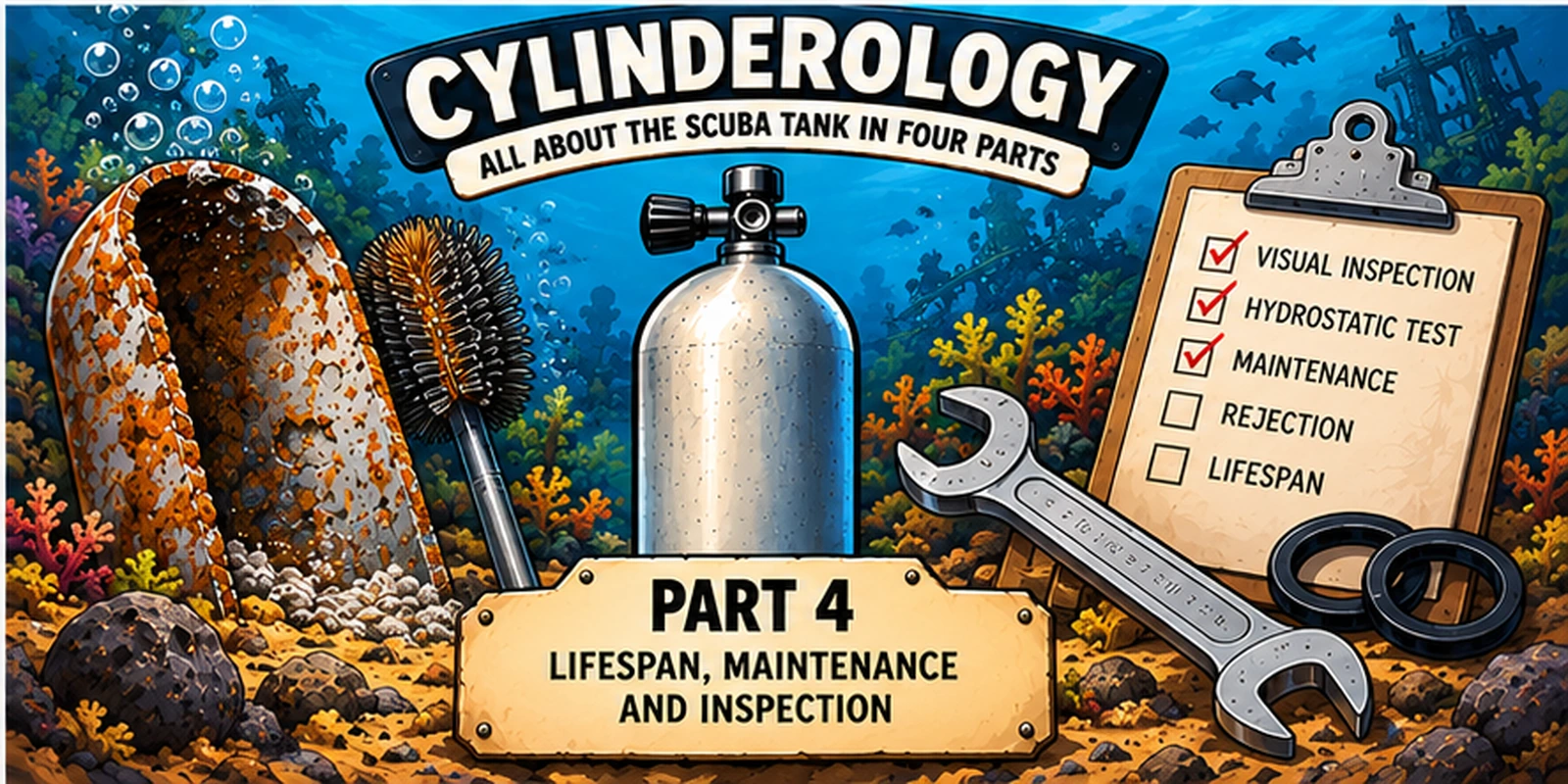
Every diver knows the diving cylinder. It might be the most trusted part of our equipment: a sturdy metal cylinder filled with breathing gas, which we carry on our back and to which we attach our regulator. We know how much air it holds and roughly how long we can dive with it. But how much do we really know about the cylinder itself? How long does a diving cylinder actually last? What happens when saltwater, corrosion, and years of use leave their marks? How does an inspector uncover hidden damage, and why is a diving cylinder subjected to water pressure far exceeding its normal working pressure during a hydrostatic test? In this final part, we follow the lifecycle of a diving cylinder: from daily maintenance and periodic inspections to the moment it is definitively rejected and perhaps given a second life. This is the fourth and last part of a four-part series about the diving cylinder. Welcome to the final lesson in cylinderology.
1. The Enemies of a Diving Cylinder: Moisture, Salt, and Damage
A diving cylinder can still look beautiful on the outside while serious problems are developing inside. Conversely, a cylinder full of scratches and flaking paint can technically still be in excellent condition. The appearance tells only part of the story. Ultimately, what counts is the condition of the metal from which the cylinder is made, and that is far from always assessable with the naked eye.
Moreover, diving cylinders do not have an easy life. They are constantly being filled and emptied, exposed to tropical sun, transported over beaches and boats, and regularly come into contact with salt water. On the way to the filling station or the next dive site, they often lie in the back of cars, where they are not always treated carefully. Sometimes they fall over, bump into other cylinders, or remain wet in storage areas. Steel and aluminum are strong materials, but neither is completely insensitive to damage or corrosion. Proper maintenance is therefore more than just about keeping a cylinder neat: it helps prevent small problems from unnoticed development into damage that affects the safety or lifespan of the cylinder.
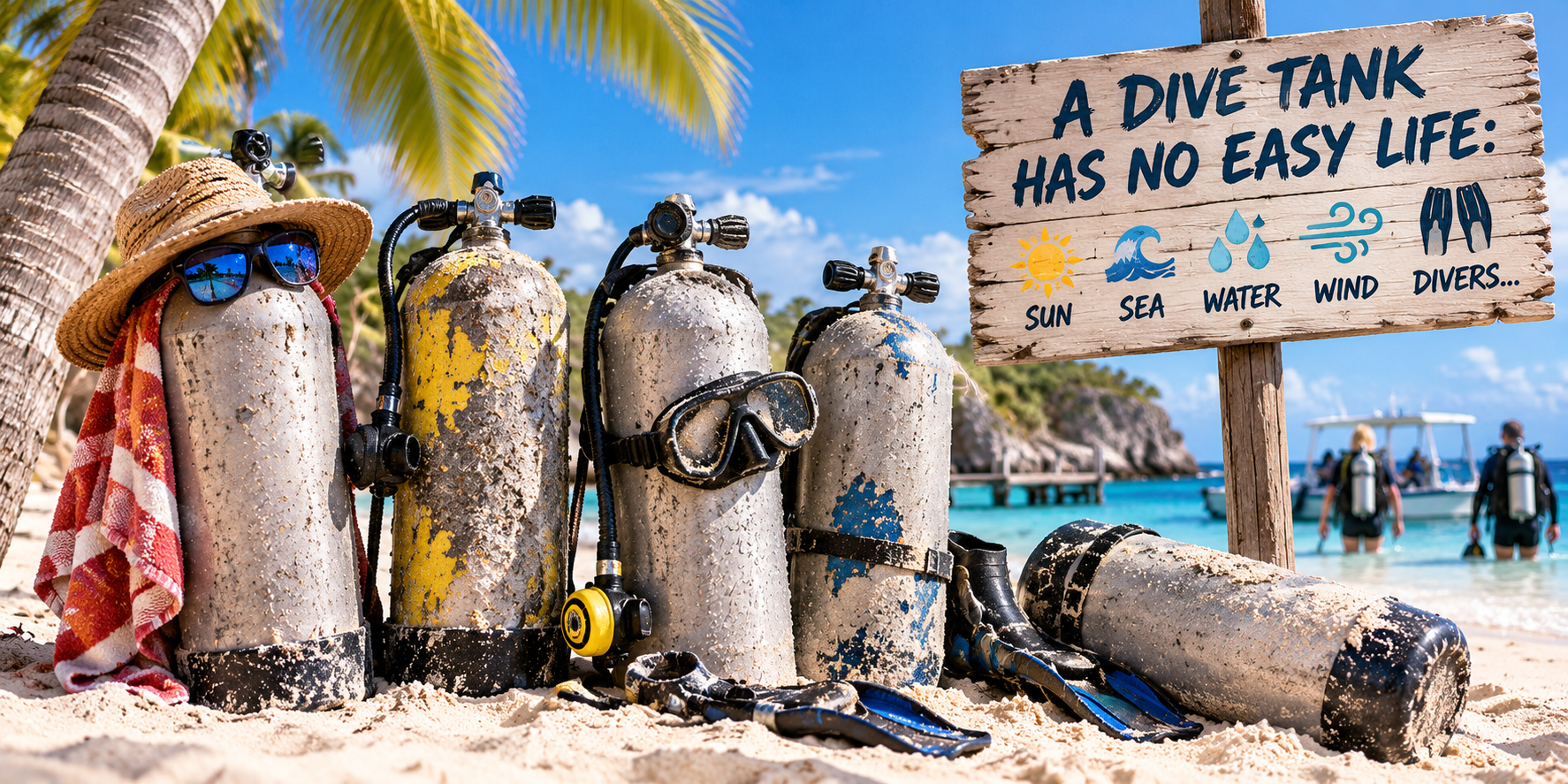 A scuba tank has a tough life. Sun, saltwater, moisture, and the occasional careless diver all leave their mark.
Rinsing, Drying, and Storing
The simplest maintenance of a diving cylinder starts after every dive: rinsing with clean fresh water. Salt water leaves salt crystals after drying, which can attract and hold moisture. Especially in places where water drains poorly, such as around the cylinder valve, under a rubber tank boot, or between a protective net and the cylinder wall, a moist environment may persist for a long time. For steel cylinders, this promotes rust formation, while aluminum can also be affected under certain conditions. A tank boot thus protects the cylinder from damage but can simultaneously create the conditions in which corrosion thrives. Good intentions are apparently no guarantee for a good result even in materials science.
When rinsing, also pay attention to the less visible spots. Rinse the valve and the connection carefully, without opening the valve or letting water remain in the filling connection. Then let the cylinder dry thoroughly before storing it for an extended period. For cylinders with a removable tank boot, it is advisable to remove it regularly so the bottom can be checked and dried.
For storage, preferably choose a dry, well-ventilated place, out of direct sunlight and away from heat sources. Also ensure that upright cylinders cannot fall over and lying cylinders cannot roll away. The valve especially deserves protection, because a hard knock against the connection can have much more serious consequences than a scratch in the paint.
How Does Water Get Inside a Diving Cylinder?
The outside of a diving cylinder may of course get wet during diving. The inside, however, should remain dry. Still, moisture can enter, potentially causing internal damage. An obvious cause is water entering through the cylinder valve. As long as the cylinder contains sufficient pressure and the valve is closed, moisture ingress is normally prevented. But when a cylinder is completely empty and the valve is open, moist outside air or even water can enter the cylinder. This risk is especially present when an empty cylinder is handled or stored in a wet environment.
A second, less visible cause is the quality of the breathing air used to fill the cylinder. Ambient air always contains a certain amount of water vapor. During compression and cooling, some of it can condense. That is why professional filling stations have moisture separators and drying filters to ensure that the produced breathing air meets the applicable moisture content requirements. When drying is insufficient, moisture can enter the cylinder along with the compressed air. Repeated filling can eventually lead to significant problems. The quality of breathing air is therefore important not only for the diver but also for the lifespan of the cylinder. A cylinder filled for years with sufficiently dry air is much less likely to experience internal corrosion than one regularly filled with moist air.
Why Don’t You Store a Diving Cylinder Completely Empty?
Divers typically learn during their initial training that it's better not to let a cylinder run completely empty. There is a good reason for this. By maintaining a positive residual pressure inside the cylinder, you reduce the chance that moist outside air will enter when the valve is briefly opened. In practice, it is often advised to keep a residual pressure of several tens of bar. However, this residual pressure does not guarantee that the inside of the cylinder remains dry. When the valve is closed, water should not enter even without high pressure. Conversely, a cylinder filled previously with moist air can already be internally damaged, even when there is still plenty of pressure inside. Residual pressure is thus a useful precaution but no substitute for proper filling procedures and periodic inspections. For long-term storage, conditions, valve condition, and manufacturer recommendations also matter. A cylinder does not need to be kept at its maximum working pressure continuously to be properly preserved.
Rust in Steel, Corrosion in Aluminum
Steel and aluminum diving cylinders react differently to moisture. With steel, the most well-known problem is rust formation. When iron comes into contact with water and oxygen, iron oxides may form. This is often visible on the outside as reddish-brown discoloration, especially where the protective paint layer is damaged. Inside the cylinder, rust is more difficult to detect. Superficial rust does not automatically mean a cylinder is unusable. Much depends on the depth and extent of the attack. It becomes more serious when corrosion causes pits in the metal, a phenomenon known as pitting corrosion. Such pits can locally reduce the wall thickness and concentrate stresses. Even a small affected spot can thus influence the strength of the cylinder.
Aluminum does not rust like steel. It naturally forms a thin oxide layer that protects the underlying metal from further attack under many conditions. However, this does not mean aluminum is immune to corrosion. Especially in the presence of chlorides, such as in seawater, localized damage can occur. Aluminum can also develop pits and other forms of corrosion that affect the cylinder’s strength.
A special point of attention is galvanic corrosion, which can occur where different metals contact each other. Many aluminum diving cylinders, for example, have a brass valve. When two different metals make electrical contact and a conductive fluid like saltwater is present, galvanic corrosion can occur. The combination of material choice, surface treatment, and correct assembly is therefore important, especially around the neck and valve connection.
Scratches, Dents, and Damaged Threads
Not every damage to a diving cylinder is equally serious. A scratch in the paint layer is usually mainly a cosmetic issue, as long as the underlying metal is not deeply damaged. For steel cylinders, it is advisable to protect exposed metal against rust early with a suitable surface treatment according to manufacturer recommendations. Deep scratches, grooves, and dents deserve more attention. A diving cylinder is under considerable mechanical stress during filling. Damages that reduce the wall thickness or change the cylinder’s shape can cause localized stress concentrations. Especially sharp grooves, deep dents, and damage near the neck should therefore be carefully assessed. A cylinder with suspicious damage should not be refilled until a qualified inspector has established whether it can still be safely used.
The threads in the cylinder neck are also a critical part. This connection firmly holds the valve to the cylinder. Damaged threads, corrosion, or the use of a valve with the wrong thread type can seriously compromise safety. The threads are mostly hidden when a valve is mounted and are therefore checked during an internal inspection, when the valve is removed.
Grinding away metal yourself, smoothing deep damage, or reworking the neck threads without an approved procedure is forbidden. This can remove material needed to safely withstand the high pressure.
Tank boots, nets, and protective covers: protection with a downside
Many diving cylinders are equipped with accessories that make them easier to use or protect them against damage. A rubber or plastic tank boot allows a cylinder with a rounded bottom to stand upright and protects the bottom against direct contact with the ground. A protective net helps absorb scratches and minor knocks, while a cover can also offer protection during transport.
As we have seen earlier, these accessories can also retain moisture. Salt water sometimes dries slowly under a tank boot; nets and covers can collect dirt and hide damage from view. Therefore, remove detachable protective materials regularly and check the cylinder wall underneath, especially the bottom of steel cylinders. An accessory that offers protection against impacts should not conceal early corrosion for years.
Safe transport: not just thrown in the back of the car
A large part of a diving cylinder’s life is not spent underwater, but in transit. Divers drive their cylinders to the filling station, dive shop, or a remote dive site. During transport, cylinders sometimes end up at the back of a car, between bags, lead weights, and other equipment. As long as the road is smooth and driving is careful, this may seem no problem. But in a sudden braking action or sharp turn, a heavy diving cylinder can slide or roll with considerable force.
That is why diving cylinders must be securely fastened during transport so they cannot shift, fall over, or collide with each other. The cylinder valve especially needs protection against hard impacts. The valve must be closed, and equipment should be arranged so that no unnecessary forces are exerted on the connection. For larger numbers of cylinders, suitable transport racks or securing devices are particularly useful.
Heat also deserves attention. When a filled cylinder warms up, the pressure of the gas inside rises. This does not mean that a diving cylinder becomes dangerous at the first ray of sunshine, but it is wise to avoid unnecessary heating. Therefore, do not leave filled cylinders lying for long periods in a closed car in full sun, especially not in a tropical climate.
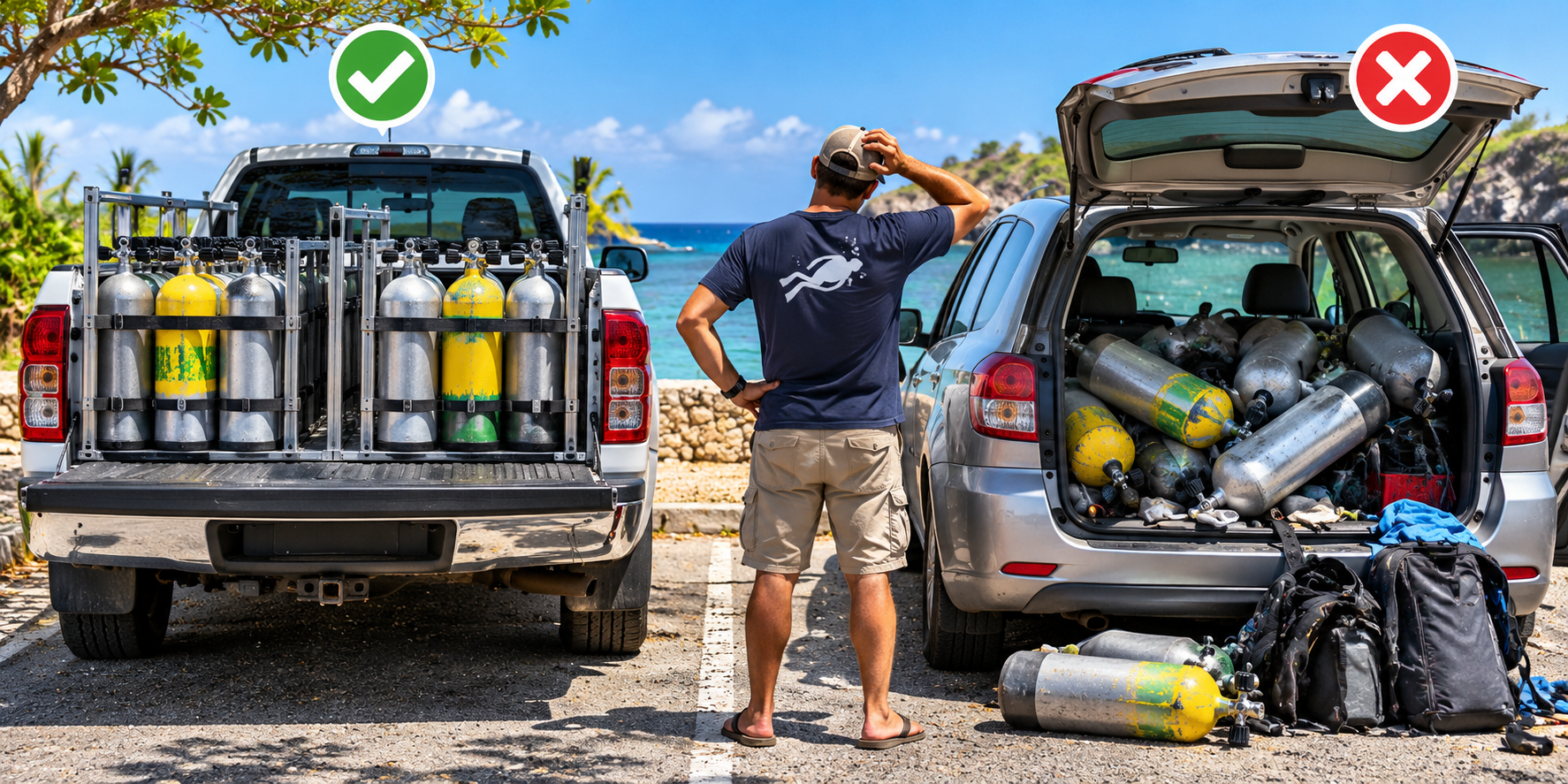 Diving cylinders should be properly secured during transport. Loose in the back of a car is never a good idea, however short the journey.
Proper maintenance starts with attention
Daily maintenance of a diving cylinder is not complicated in itself. Rinsing, drying, careful storage, protecting the valve, and preventing moisture ingress are simple actions that can prevent many problems. Equally important is noticing changes. A new dent, a suspicious rust spot, damaged threads, or a cylinder unexpectedly losing pressure are signs you should not ignore lightly.
But even with careful maintenance, hidden problems can arise. That is why, besides daily care, there is also a periodic, more thorough check: the visual inspection. In the next chapter, we will look at how such an inspection is carried out and exactly what an inspector is looking for.
2. What happens during a visual inspection?
Daily maintenance prevents many problems but does not reveal what happens inside a closed cylinder. The neck and threads are also largely hidden from view as long as the cylinder valve is mounted. During a periodic visual inspection, the entire cylinder is therefore examined: from the outer wall and bottom to the interior and the valve connection.
Such an inspection is often referred to by the English abbreviation VIP, from Visual Inspection Procedure or Visual Inspection Program. The name varies by organization, but the goal is the same: to determine whether a diving cylinder is still safe to fill and use, and whether there are signs of damage that require further investigation. That seems simple: you look inside a cylinder, search for damage, and give it approval. In reality, much more is involved. A qualified inspector must know what to look for, which deviations can be dangerous, and according to which standards a cylinder must be evaluated.
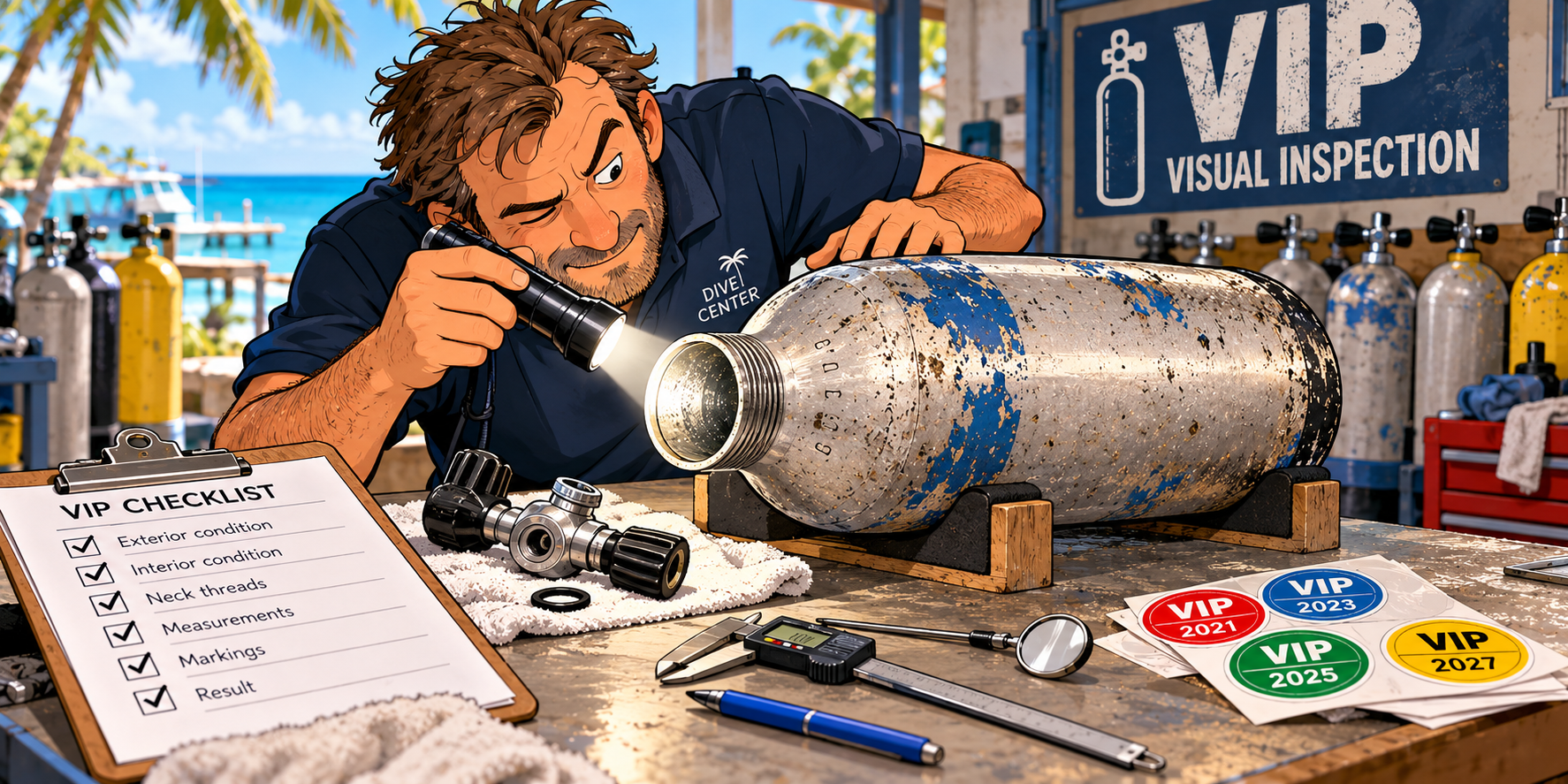 During a visual inspection (VIP), a diving cylinder is examined inside and out, with particular attention to the neck and threads.
First the Technical Passport
A visual inspection usually begins even before the cylinder valve is removed. The inspector checks the permanent markings on the cylinder shoulder. Who manufactured the cylinder? What material is it made from? What is the allowed working pressure? According to which standard was it manufactured, and when was the last hydrostatic test performed? It is also checked whether the serial number is clearly readable and whether the cylinder possibly belongs to a production series for which special inspection regulations apply.
This data is important because not every diving cylinder may be assessed according to the same criteria. An American aluminum cylinder per DOT-3AL, for example, falls under different regulations than a European steel cylinder. Manufacturers can also set additional restrictions or inspection requirements. Therefore, an inspector must first know the type of cylinder he is dealing with before determining which checks are necessary and which damages are still acceptable.
Next, the exterior is examined. The inspector pays attention to the general condition of the cylinder, any dents, deep scratches, grooves, corrosion, and signs of overheating. For steel cylinders, damage to the protective paint layer deserves extra attention because rust formation can start there. For aluminum cylinders, pit corrosion and other forms of local deterioration are looked for among other issues. The bottom and the transition to the neck are also important inspection points. A rubber tank boot or protective cover is removed to reveal hidden damage.
Removing the Valve and Looking Inside
To inspect the interior, the cylinder must be completely depressurized and the valve removed. This is done following a fixed procedure, first confirming that there is indeed no remaining pressure. Then, the valve can be removed with suitable tools without damaging the neck or threads.
The opening in the neck of a diving cylinder is relatively small. However, the inspector must be able to examine the entire inner wall through that opening, including the bottom and the shoulder. For this purpose, special inspection lamps, mirrors, and sometimes small cameras or endoscopes are used. A strong light source reveals discolorations, corrosion, pits, and other abnormalities that can easily be overlooked under normal lighting.
In a well-maintained cylinder, the inner wall is usually clean and free of noticeable deterioration. A steel cylinder can show a uniform metal surface, while aluminum cylinders often have a somewhat duller, grayish interior. Small differences in color or surface texture do not necessarily indicate a problem. What matters is whether the material is locally compromised, whether there are foreign deposits, and whether there are signs that the cylinder has been exposed to moisture, contaminants, or unusual stresses.
Sometimes, upon opening a cylinder it is already clear that something is wrong. There may be visible moisture present, or an unusual odor may emanate from the cylinder. Oily residues, loose corrosion particles, or other contaminants also require attention. Such findings do not automatically mean the cylinder must be rejected permanently, but they can prompt cleaning, further investigation, or taking the cylinder out of service until the cause is determined.
How Severe Is the Corrosion?
Assessing corrosion is one of the most challenging parts of a visual inspection. Discoloration does not necessarily mean a problem, while a small but deep corrosion pit can be more serious than a large area with light rust. For steel cylinders, superficial rust can sometimes be removed with a suitable cleaning procedure. When deterioration is limited to the surface and the wall thickness has not been significantly reduced, the cylinder can possibly be reapproved after treatment and reinspection. But with deeper pit corrosion, it becomes more complicated. The inspector must evaluate how deep the deterioration is, how large the affected area is, and whether the remaining wall still meets requirements. Aluminum cylinders can also develop pits that locally weaken the wall. White or gray corrosion products can also indicate that the aluminum has been in contact with moisture or aggressive substances.
There are technical rejection criteria for evaluation, which depend on the applicable standard, the type of cylinder, and the manufacturer's regulations. Therefore, an inspector cannot simply decide that a dent of a certain depth is always acceptable. In case of doubt, additional measurement or assessment may be necessary. Some damages can be treated within an approved procedure, while others mean the cylinder must be permanently taken out of service.
The Neck and the Thread
A particularly critical part of the inspection is the neck of the diving cylinder. This is where the cylinder valve is screwed into the cylinder, and the connection must safely withstand the full cylinder pressure. Therefore, the inspector checks the thread for damaged or deformed thread turns, corrosion, wear, and other deviations. The sealing surface and the surrounding area of the neck are also examined. Damages can occur due to incorrectly mounted valves, mechanical stress, or corrosion. An incorrect combination of thread types is especially dangerous: some screw threads resemble each other enough to screw a valve a few turns into the neck without the connection being technically suitable. As discussed in the chapter about cylinder valves, thread types such as M25×2, ¾-14 NPSM, and ¾-14 BSPP should never be considered interchangeable without verification. For certain aluminum cylinders, the neck deserves extra attention for another reason. A specific form of cracking may occur there which is not necessarily related to visible corrosion or misuse.
Sustained-load Cracking: The Problem with Older Aluminum Cylinders
In the chapter about materials, we briefly encountered a special aluminum alloy: 6351-T6. This alloy was used in the past by some manufacturers for high-pressure cylinders, including diving cylinders. Later, it became clear that some cylinders made of this material were sensitive to a phenomenon called sustained-load cracking, literally cracking under prolonged load. What is special about these cracks is that they can develop while the cylinder remains pressurized for a long time, without the need for exceptional overfilling or a hard impact. Especially around the neck and thread, locally high stresses can occur. In cylinders sensitive to this, small cracks can develop under certain conditions and then slowly grow further.
Not every 6351-T6 diving cylinder develops such cracks, and the presence of this alloy does not automatically mean a cylinder is unsafe. However, the risk is serious enough to justify special attention. For certain older aluminum cylinders, an additional inspection of the neck is therefore necessary, depending on the manufacturer, production date, and applicable regulations.
To detect very small cracks, eddy-current testing can be utilized. In Dutch, this is called wervelstroomonderzoek. This method uses a special probe to generate an alternating magnetic field that induces electrical eddy currents in the conductive metal. Cracks or other interruptions can change the pattern of these currents, allowing the equipment to indicate possible damage. However, eddy-current testing is not a magic method that automatically detects every damage. The equipment must be used correctly and the results interpreted by a trained inspector. Also, geometric features of the neck or other material irregularities can cause signals that need further investigation. The testing thus complements the visual inspection and does not replace it.
The history of 6351-T6 shows how important material choice and long-term experience are when designing pressure vessels. An alloy can meet all prescribed strength requirements at production, while only after many years of use it may become apparent that it is sensitive to a specific form of cracking under certain conditions. Modern aluminum diving cylinders are generally made from 6061-T6, which does not show the same known sensitivity to sustained-load cracking. This does not mean modern cylinders no longer need inspection: they can also become unsafe due to corrosion, damage, or misuse.
And the valve itself?
When the valve has been removed from the cylinder, this is also a suitable moment to assess its condition. After all, the valve is a separate mechanical component with moving parts, seals, and threads. The inspector looks at visible damage, corrosion, and the condition of the connection to the cylinder. For valves with a burst disk, the presence and suitability of this pressure relief device can also be checked.
A complete valve overhaul is, however, different from a visual inspection of the cylinder. Depending on its condition, maintenance history, and regulations, it may be necessary to have the valve serviced separately. During this, seals and other wear parts can be replaced and it is verified whether the valve functions properly. It is important to distinguish these two activities: an approved cylinder with a defective valve is still not a safely usable dive cylinder.
Approve, treat or reject
After the inspection, a decision must be made. Broadly speaking, there are three options. The first is that the cylinder is in good condition and can be put back into use without further treatment. The second is that a problem has been found that can be remedied according to an approved procedure, for example certain forms of superficial contamination or corrosion. After treatment, the cylinder must be re-inspected before it can be released.
The third possibility is that the damage is so severe that the cylinder can no longer be safely used. This might be the case with unacceptable deep corrosion, serious mechanical damage, cracks, or a neck that no longer meets technical requirements. Sometimes additional assessment is needed before a final decision can be made. A cylinder with a suspicious defect must not be filled in the meantime.
In case of final rejection, measures must be taken to prevent the cylinder from re-entering circulation as a pressure vessel. The procedure for this depends on applicable regulations. Cleaning alone cannot make a rejected cylinder safe to use again.
A sticker is no guarantee
After a successful visual inspection, the check is usually recorded. Many dive centers and inspection companies also apply a sticker showing the inspection date, the identification of the inspector or company, and optionally the next inspection date. Especially in North America and the Caribbean, such a VIP sticker is a familiar sight on dive cylinders.
However, it is important to understand what the sticker means. A visual inspection is an assessment of the cylinder’s condition at the time of examination. It is not a guarantee that the cylinder will remain safe under all conditions for an entire year or other specified period. A cylinder that suffers severe damage shortly after inspection or that gets water inside may need to be examined again immediately.
However, a visual inspection does not tell how the cylinder behaves under high pressure. For that, there is another test: the hydrostatic inspection. In the next chapter, we’ll explore why the cylinder is filled with water during this test and subjected to a pressure significantly higher than its normal working pressure.
3. The Hydrostatic Inspection: Putting a Cylinder Under Pressure to Trust It
A dive cylinder may appear to be in excellent shape during a visual inspection. The inside wall is clean and no suspicious damage was found. But does the cylinder behave under high pressure as the manufacturer intended? After all, a dive cylinder isn’t an immutable piece of metal. Each time it is filled, the wall expands a tiny bit. When the pressure then decreases, the material almost completely returns to its original form. But what if that no longer happens at some point?
To answer this question, dive cylinders are periodically subjected to a hydrostatic inspection, also called a hydrotest. You might compare it to a particularly unpleasant medical exam: the patient is put under significant pressure and may then either return to work or be permanently retired. Personally, I’d find such an exam quite stressful!
During this hydrostatic inspection, the cylinder, as the name suggests, is filled with water and exposed under controlled conditions to a pressure significantly higher than the normal working pressure. Depending on the prescribed test method, it is checked whether the cylinder can safely withstand the test pressure, whether it leaks, and how much it expands under load. There are quite a few misunderstandings regarding this test.
Why do we test with water and not compressed air?
At first glance, it may seem strange to test a diving cylinder with water. After all, during diving it contains compressed air, not water. Why not just fill the cylinder with compressed air to the required test pressure? The answer has everything to do with the amount of energy stored in compressed gas. Air is highly compressible. When we fill a diving cylinder to 200 or 300 bar, we compress a large volume of gas into a relatively small space. Should the cylinder suddenly fail, that compressed air can expand extremely rapidly. This releases an enormous amount of energy, with potentially devastating consequences.
Water behaves very differently. It is much less compressible than air. To bring a water-filled cylinder to the same pressure requires adding only a relatively small extra amount of water. If the cylinder cracks during the test, the pressure drops much faster and significantly less stored energy is released than would be the case in a comparable test with compressed air. This makes the test much safer, although specialized equipment and safety measures remain necessary. There is a second advantage. Because water is hardly compressible, we can accurately measure the small volume changes of the cylinder as pressure is applied. These changes tell us something about the mechanical condition of the metal.
How much pressure is applied to a cylinder during inspection?
In a previous chapter, we already distinguished between the working pressure and the test pressure of a diving cylinder. The working pressure is the pressure for which the cylinder is approved for normal use. The test pressure is substantially higher and is determined by the applicable production standard and inspection regulations. For many European diving cylinders, the test pressure is one and a half times the working pressure. A steel cylinder with a working pressure of 200 bar is tested at 300 bar, while a cylinder of 232 bar has a test pressure of 348 bar. For a cylinder with a working pressure of 300 bar, the test pressure can be as high as 450 bar. For many American aluminum diving cylinders, a different ratio applies. An AL80 produced according to the American DOT-3AL specification typically has a working pressure of 3,000 psi, approximately 207 bar. The prescribed test pressure is 5,000 psi, approximately 345 bar. That is five-thirds of the working pressure, or about 167%.
The inspection authority must always check the markings and regulations for the specific cylinder type. A higher test pressure does not mean the cylinder may be filled to that pressure during normal use. The test is intended to assess the safety of the pressure vessel, not to increase the allowable working pressure.
What happens during the test?
Before a hydrostatic inspection can begin, the cylinder is identified and checked for damage that would render it unsuitable for further testing. The valve is removed, and the cylinder is prepared according to the prescribed procedure. Then the cylinder is completely filled with water, taking care to avoid trapped air bubbles. Trapped air could still be compressed and affect the safety and accuracy of the test.
A widely used method is the so-called water-jacket test, in which the water-filled diving cylinder is placed inside a sealed measuring reservoir also filled with water. The cylinder is then pressurized to the prescribed test pressure with a hydraulic pump. As pressure increases, the cylinder expands slightly. This displaces water from the measuring reservoir, and the volume of water displaced can be accurately measured.
The expansion is surprisingly small. For an ordinary diving cylinder, it is usually only a few tens of milliliters. Nonetheless, that small change provides important information about the behavior of the material. The test equipment must therefore be precisely calibrated and checked. Temperature, the presence of air bubbles, and the manner in which the pressure is built up and maintained can also affect measurement results.
When the prescribed test pressure is reached, it is held for the required time. Then the pressure is released. The cylinder contracts largely back to its original dimensions. But sometimes a small volume increase remains. This permanent volume increase is an important part of the evaluation during this test.
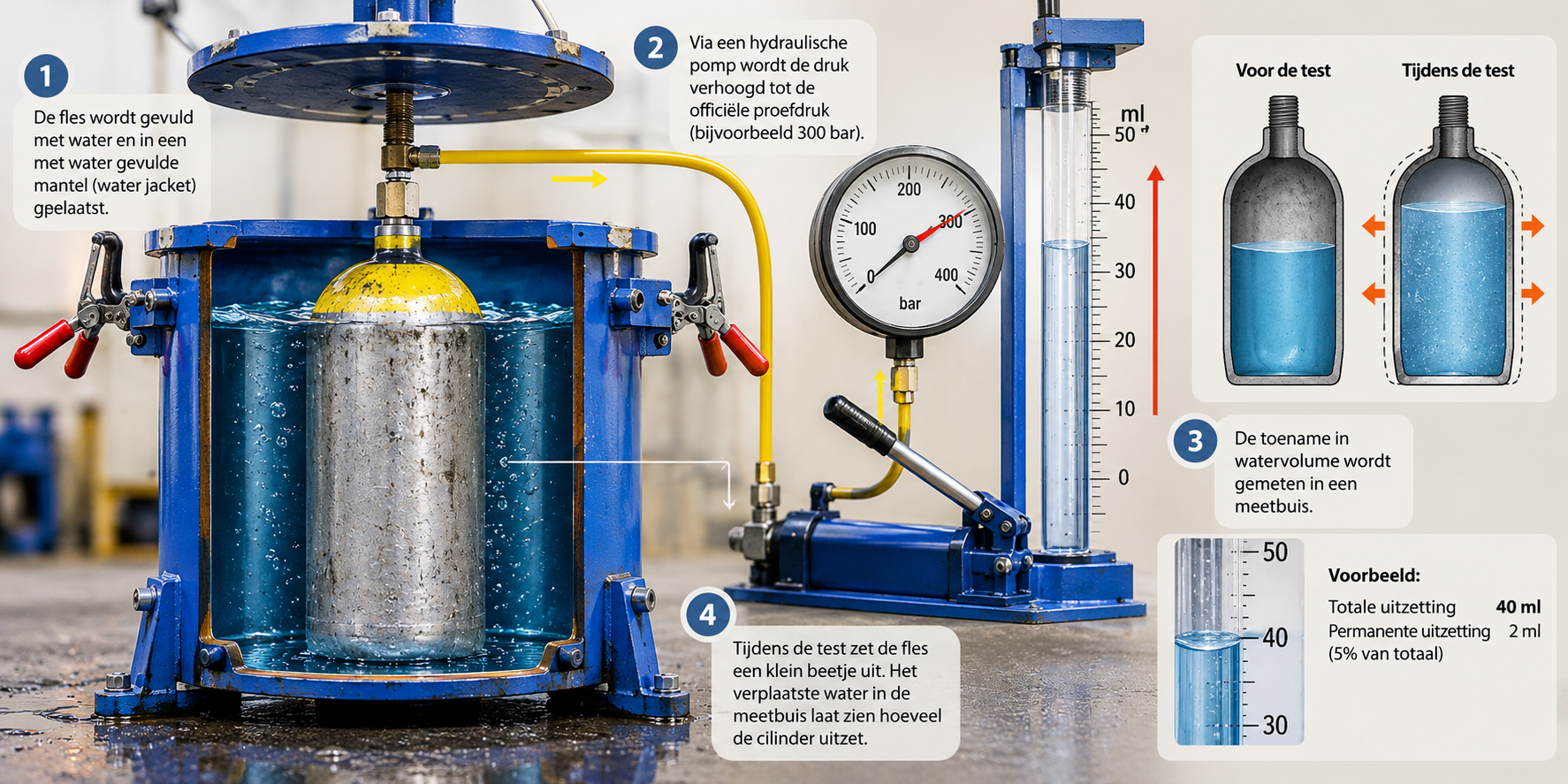 During a hydrostatic test, a water-filled diving cylinder is subjected to high pressure. The small change in volume reveals how the metal responds.
Elastic and Permanent Expansion
To understand what exactly the inspection agency measures, we need to revisit two concepts from materials science: elastic and plastic deformation. In elastic deformation, the material temporarily changes shape. When the load is removed, it returns to its original state. This is exactly what we expect from a diving cylinder. During filling, the wall expands slightly, and during emptying, it retracts again. The material behaves approximately like a very stiff spring.
Plastic deformation is different. Here the material changes shape permanently. When the pressure is released, the cylinder no longer fully returns to its original dimensions. In a volumetric hydrostatic test, a distinction is therefore made between the total expansion at the test pressure and the permanent expansion that remains afterward.
Suppose a cylinder expands by a total of 40 milliliters during the test. When the pressure is released, the cylinder springs back but retains a permanent volume increase of 2 milliliters. The permanent expansion then amounts to 5% of the total expansion.
For many American DOT cylinders, the permanent expansion may not exceed 10% of the total expansion. In our example, a permanent expansion of 4 milliliters would thus be exactly 10%. A larger permanent expansion would exceed the permissible limit for such a cylinder.
That 10% limit does not apply to every diving cylinder. The allowable permanent expansion and the way it is assessed depend on the applicable standard and the type of cylinder. It is therefore important to use the correct criteria for each inspection, rather than applying one general limit to all cylinders.
Not Every Hydrotest Measures Expansion
Although the volumetric expansion test is a well-known method, not every hydrostatic inspection is performed in the same way. For some cylinder types and inspection regulations, a so-called proof-pressure test is also permitted. In this test, the cylinder is brought to the prescribed test pressure and held under pressure for a certain time. The main question is whether the cylinder can withstand that pressure without leakage or other unacceptable phenomena.
In this method, the permanent volume increase is not measured as in a water-jacket test. It is a different assessment method allowed under specific regulations. Which method may be used is not determined by the personal preference of the inspector but by the applicable technical regulations.
There are also other examination methods, including ultrasonic testing. This can detect certain material defects without subjecting the cylinder to the same hydraulic load. Under specific standards and conditions, such a test can be accepted as an alternative to a traditional pressure test. However, this does not mean that a simple ultrasonic wall thickness measurement can automatically replace a full hydrostatic inspection. The equipment, testing procedure, and authority of the inspection body must comply with applicable requirements.
Why Are Inspection Intervals Not the Same Everywhere?
Those working with diving cylinders from different countries quickly notice that inspection intervals are not the same everywhere. In the Netherlands, Belgium, Germany, the United Kingdom, and the United States, a five-year hydrostatic reinspection applies to many common diving cylinders. In France, the general interval is two years but can be extended to six years under a recognized system of annual visual inspections. New Zealand also requires a hydrostatic test every two years combined with an annual visual inspection.
A shorter interval does not automatically mean that a country works more safely. Inspection intervals are part of a larger system comprising production standards, inspection procedures, usage conditions, and legal obligations. Whether a cylinder is used for underwater breathing, industrial gas storage, or another application can also influence the requirements.
An important distinction is also that between a technical standard and a legal requirement. A standard such as ISO 18119 describes procedures for periodic inspection and testing of certain seamless steel and aluminum gas cylinders. But that does not automatically determine which inspection interval is mandatory in each country. This depends on the regulations under which the cylinder is used and how that standard is incorporated therein.
For a dive center or filling station in Curaçao, this is particularly relevant. Here, American DOT cylinders and European certified cylinders come together. It would be incorrect to assume that all American regulations automatically apply to every dive cylinder in Curaçao. Conversely, we cannot simply assume that a European inspection date or a European inspection interval is sufficient for every cylinder used here.
The correct assessment therefore requires knowledge of the cylinder's certification, the applicable local rules, and any additional requirements from manufacturers or inspection bodies. Filling stations may also apply their own acceptance conditions, as long as they do not conflict with the applicable regulations. An inspection stamp is only meaningful when we know according to which system the cylinder was evaluated.
What Happens After the Inspection?
When a cylinder successfully passes the prescribed test, the job is not yet completely finished. The cylinder must be carefully emptied and dried. This last step is particularly important: as we saw in the previous chapter, moisture inside a dive cylinder is one of the main causes of internal corrosion. It would be contradictory if an inspection intended to ensure safety ultimately left water inside the cylinder. After drying, the interior is rechecked where necessary, and the cylinder is made ready for use again following the prescribed procedure. The valve is installed with suitable seals and the correct tightening torque. Subsequently, the required checks for leakage and correct assembly can be performed.
A successful reinspection is recorded in the administration of the inspection body. In addition, the prescribed inspection markings are applied, usually on the cylinder shoulder. There is an important difference between the various inspection systems here. For American DOT cylinders, typically the month and year of the performed inspection are stamped, along with the identification number or certification mark of the competent body. In contrast, European cylinders often also indicate the date of the next mandatory inspection: not when the cylinder was last inspected, but until when the current inspection is valid. This is a significant difference, especially for filling stations working with cylinders from different countries. Someone interpreting an American inspection date as a European expiry date, or vice versa, can easily draw an incorrect conclusion about the validity of the inspection.
A permanently rejected dive cylinder must be clearly marked as unsuitable for further use. Depending on the applicable regulations, this can be done by applying a permanent rejection mark, for example the word CONDEMNED, or by physically rendering the cylinder unusable. The latter can be done, for instance, by drilling a hole in the cylinder wall or cutting the cylinder open, making it impossible to pressurize again. Simply removing the valve is insufficient for this: after all, a new valve could easily be installed. Such interventions are only performed by an authorized party after the cylinder has been completely depressurized. A rejected cylinder may then possibly be given a second life as decoration or be recycled, but never again used as a pressure vessel.
What Does a Successful Hydrostatic Test Actually Prove?
A successful hydrostatic inspection confirms that the cylinder met the prescribed criteria at the time of the test: it withstood the test pressure and did not show, where measured, unacceptable permanent expansion. But the hydro test does not reveal everything. A cylinder can pass a pressure test yet still have damage that would lead to rejection during a visual inspection. Conversely, a cylinder may look excellent inside and out, but show too much permanent deformation during a volumetric expansion test. Therefore, the two inspection methods complement each other.
The test also does not predict how many years the cylinder will continue to last. A fall, overheating, or incorrect use can damage a newly approved cylinder.
This brings us to the final question in the life of a dive cylinder. Some cylinders are rejected after five, ten, or twenty years, while others are still used without problems after forty years. How long can a dive cylinder actually last? Is there such a thing as a maximum lifespan, and when is the moment to permanently say goodbye to a cylinder? We will examine that in the next and final chapter.
4. When Is a Diving Cylinder at the End of Its Life?
How long does a diving cylinder actually last? Ten years? Twenty? Maybe even fifty? Some cylinders are rejected after only a few years due to damage or corrosion, while others pass their inspections trouble-free for decades. Unlike a battery or car tire, a standard steel or aluminum diving cylinder does not necessarily have a fixed expiration date. A diving cylinder has no official retirement age: as long as it is in good condition and passes its inspections, it may continue to be used. Some pension funds would probably be jealous of that. Ultimately, it is not the age but the technical condition that determines whether a cylinder can continue to be used. Behind this lies a history of refills, dives, transport, and sometimes less careful handling. What effects can that history have on the metal?
Is There a Maximum Lifespan?
There is no general rule for diving cylinders that prescribes they must automatically be rejected after, for example, twenty or thirty years. An older cylinder can, in principle, still be suitable for use, provided it complies with applicable regulations, has passed the required inspections, and shows no unacceptable damage. The production date on the shoulder tells us how old the cylinder is, but not automatically how safe it still is.
A steel diving cylinder from 1985 could technically still be in excellent condition, while an aluminum cylinder only five years old could be unusable due to severe damage. The calendar age does not tell the whole story. So what can go wrong with a cylinder that has functioned trouble-free for many years?
Metal Fatigue: Thousands of Times Under Pressure
Each time a diving cylinder is filled, the material is stressed. The pressure inside the cylinder rises, the wall expands slightly, and mechanical stresses arise in the metal. When the cylinder empties during diving, that load decreases. Under normal use, the deformation remains almost entirely elastic. Still, the material experiences a change in stress with every refill cycle.
When a metal part is exposed to varying loads very often, material fatigue can eventually occur. In materials science, we call this metal fatigue. Small cracks can develop, or existing microscopic imperfections can slowly grow, even when the individual loads are below the strength at which the material would fail immediately.
Like other metal structures such as airplane wings, bridges, ship constructions, and machine parts, diving cylinders are designed and tested with repeated load cycles in mind. The normal pressure fluctuations are thus not an unexpected load but a fundamental part of their use. A well-designed, properly used, and maintained cylinder can withstand very many refill cycles without metal fatigue becoming a practical problem.
However, not all loads are equal. A cylinder that is constantly filled to its maximum working pressure undergoes larger stress variations than one only partially filled. Overpressure, localized damage, corrosion, and certain material properties can also influence the development of fatigue cracks. Especially where stresses concentrate, for example around damage or geometric transitions, the material deserves extra attention.
Why Is a Cylinder Permanently Rejected?
In practice, it is mainly unacceptable deviations found during inspection or testing that mark the end of a cylinder's usable life. This can be severe corrosion, a deep dent, damaged threads, a crack, or other deterioration that threatens the strength of the pressure vessel. A cylinder that shows too much permanent expansion during a hydrostatic test can also be permanently rejected.
Some problems are immediately visible. A cylinder run over by a vehicle or that has suffered a heavy impact can be so severely deformed that further use is excluded. Other problems are more subtle, such as localized corrosion that reduces wall thickness and concentrates stresses.
Damage to the neck is also particularly critical. The connection between the cylinder and the valve must withstand the full cylinder pressure. When the threads are severely damaged or cracks are found in the neck, this can be grounds to reject the cylinder. In certain older aluminum cylinders, the previously discussed 6351-T6 alloy may play a role in this.
Furthermore, a cylinder can be declared unsuitable when its identity or certification can no longer be reliably established. If essential markings are missing or have become illegible, it may no longer be possible to determine according to which standard the cylinder was manufactured or for which pressure it was approved. Not every illegible marking automatically means final rejection, but as long as the required data cannot be reliably established, a cylinder may not simply be refilled.
Can you repair a damaged diving cylinder?
With many everyday objects, repair is straightforward. A crack is welded, a dent is straightened, or a damaged surface is refinished. With diving cylinders, it's more complicated. The strength of a cylinder depends on the material, wall thickness, shape, and manufacturing process. An intervention that seems harmless on an ordinary metal object can have major consequences on a pressure vessel.
Take, for example, a dent in a steel cylinder. You might be able to straighten it again with a hydraulic press, but the metal has already been plastically deformed during the dent's formation. By reshaping it, it is further stressed without any guarantee that its original strength returns. Therefore, dent removal is not an acceptable standard repair.
Welding is also problematic. The heat can alter the microstructure and mechanical properties of steel. For aluminum alloys, whose strength often depends on precise heat treatment, the consequences can be even greater. A weld can thus cause a local weakening, even if the repair looks excellent. The same applies to grinding out deep corrosion pits: by doing so, the wall becomes thinner.
Fortunately, not every damage immediately means the end of a diving cylinder. Superficial rust formation can sometimes be treated, a worn protective coating can be renewed, and components such as cylinder boots or cylinder valves can be replaced. There are also specialized repair procedures, for example, for certain damages to the cylinder neck. Such interventions must, however, be explicitly permitted for the specific cylinder type and performed by authorized persons. A new paint layer does not make a compromised wall stronger, and a new valve does not restore damaged threads.
Ultimately, economic considerations also play a role. Specialized inspections and permitted repairs can cost more than a new cylinder. And when structural safety can no longer be guaranteed, there is little left to weigh. After all, a diving cylinder is replaceable; the diver who goes into the water with it preferably is not.
A second life: from diving cylinder to lamp or flowerpot
Anyone who has looked around a dive center has probably seen them: old diving cylinders converted into decorations. Some are used as lamp bases, others as stands for a table, as plant pots, tip jars, or simply as artworks. Even bells are made from old steel cylinders. By removing the bottom or part of the cylinder, a metal sound body is created that can sound surprisingly beautiful.
When a rejected diving cylinder does not get a second life as an object, the metal can generally be recycled. Both steel and aluminum are particularly suitable for this. The material can be separated, melted down, and reused for various products. That does not mean that the recycled metal is automatically again suitable for the production of new diving cylinders. Strict requirements apply for composition, purity, and mechanical properties of the material.
Especially for aluminum, recycling is interesting from an energy perspective. Production of primary aluminum from bauxite is very energy-intensive, while remelting existing aluminum requires significantly less energy. Steel recycling also provides important savings in raw materials and, depending on the production process, energy consumption and emissions.
An old diving cylinder also contains a considerable amount of valuable metal; of course, the weight depends on the cylinder type. When such cylinders are collected properly, the raw materials do not have to be lost. This fits well with a sensible approach to diving equipment. We try to use a cylinder as safely as possible for as long as possible, maintain it carefully, and have it inspected periodically. But when it ultimately no longer meets the requirements, we ensure that the material is responsibly reused.
 Retired as a pressure vessel, but not necessarily at the end of its usefulness. An old diving cylinder may still have a second life.
And with that, we have reached the end of the fourth and final part of Cylinderology. We have seen how moisture, salt, and damage can affect the lifespan of a diving cylinder, how an inspector assesses the condition of a cylinder, and why a hydrostatic test is necessary to determine whether the pressure vessel still meets the prescribed requirements. After four parts and sixteen chapters, we basically return to something very simple: taking good care of your equipment. A diving cylinder that is well maintained, filled with clean and dry breathing air, and regularly inspected and tested, can serve safely for decades.
But even the life of a diving cylinder can eventually come to an end. Perhaps after thousands of fills and countless dives it is melted down into something new. Perhaps it ends as a bell at the entrance of a dive center. But whatever its next destination, one thing is certain: its days as a pressure vessel are definitively over.
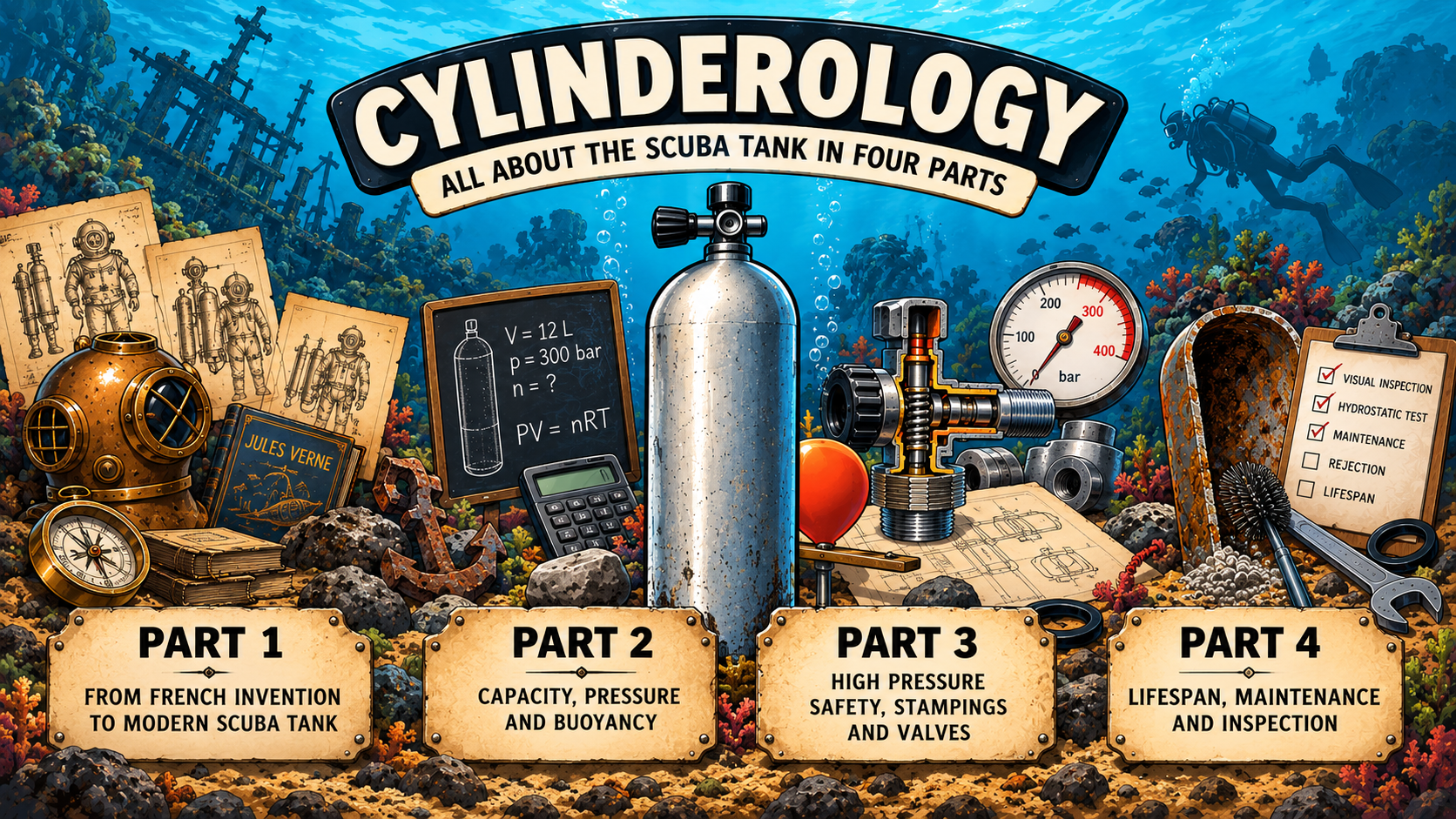 Still curious about diving cylinders? Explore the other three parts of our Cylinderology series, covering their history, properties, pressure, safety, and technology.