How Hard Can It Be? The Story Behind Air & Dive Supply
Starting your own scuba tank filling station. How hard can it be? When we decided to establish Air & Dive Supply together, we knew surprisingly little about compressors, buffer tanks, and breathing air production. What we did have, however, was some rather painful experience with just about everything that could possibly go wrong. This is the story of two stubborn entrepreneurs on Curaçao, a series of expensive lessons, and a shared ambition to do things better.
1. Two Entrepreneurs, One Idea
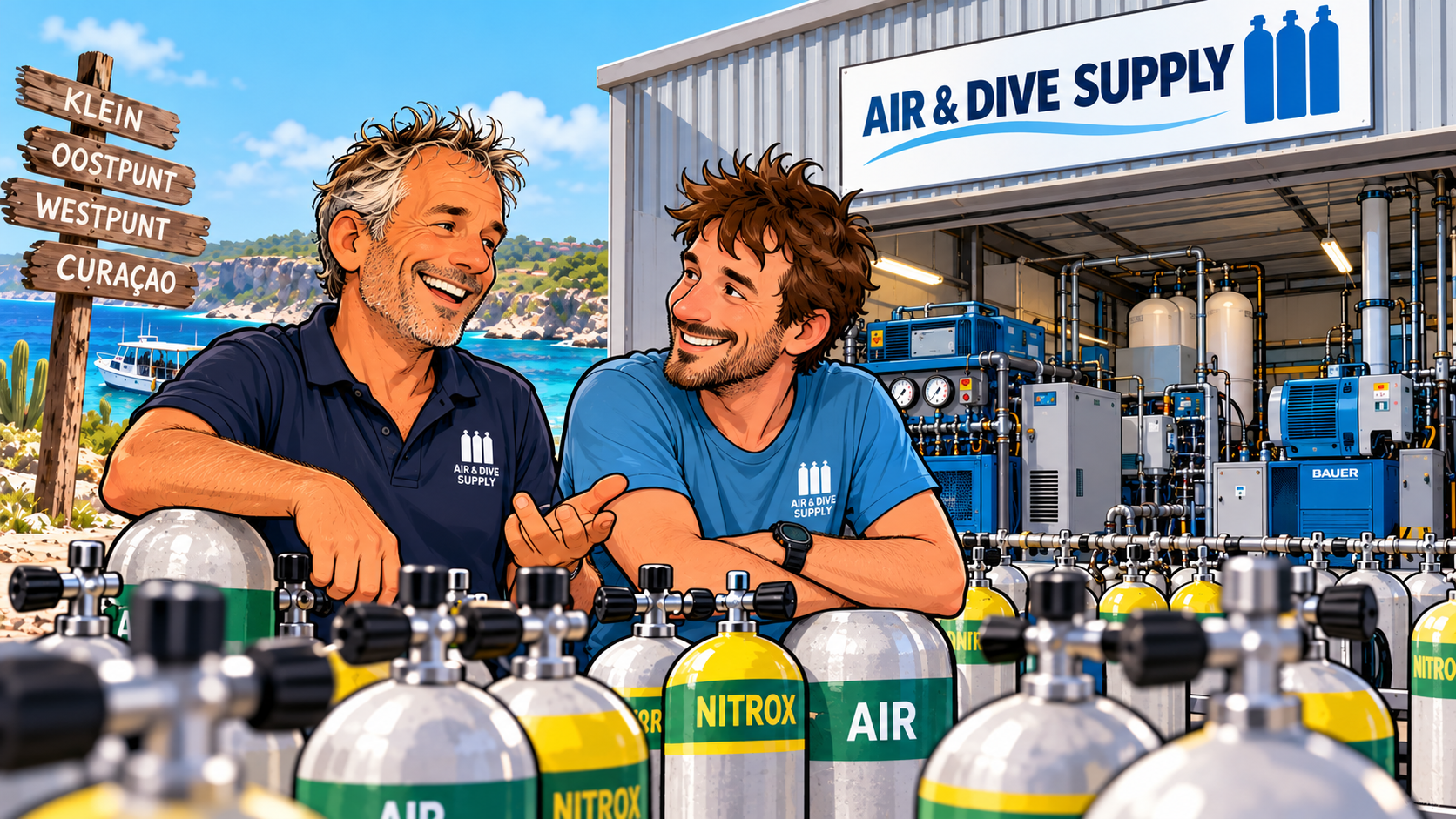
Air & Dive Supply is the story of two entrepreneurs on Curaçao who decided to set up a professional scuba tank filling station together. Two people from very different backgrounds, but with a shared interest in the diving industry and a growing suspicion that we might be able to organize the filling of scuba tanks a little better ourselves.
Gilbert has always had an entrepreneurial spirit. Originally from the Westland, the Dutch greenhouse region just south of Rotterdam, he spent many years working in horticulture and transport across the Netherlands, Scandinavia, and South Africa. Today, he runs a dive boat operation on Curaçao, organizing boat trips for various dive schools. Rather than running a dive school of his own, he provides a boat service that allows dive centers without their own vessels to take their guests to dive sites that are difficult or impossible to reach from shore.
Kasper comes from a very different background. He spent many years working as a sociolinguist and anthropologist at universities in Belgium, the Netherlands, Germany, and Luxembourg, conducting extensive research in West Africa along the way. Eventually, he traded academic life for a new adventure on Curaçao, where he became a dive instructor and the owner of Porto Mari Dive Center, one of those dive schools without a boat of its own.
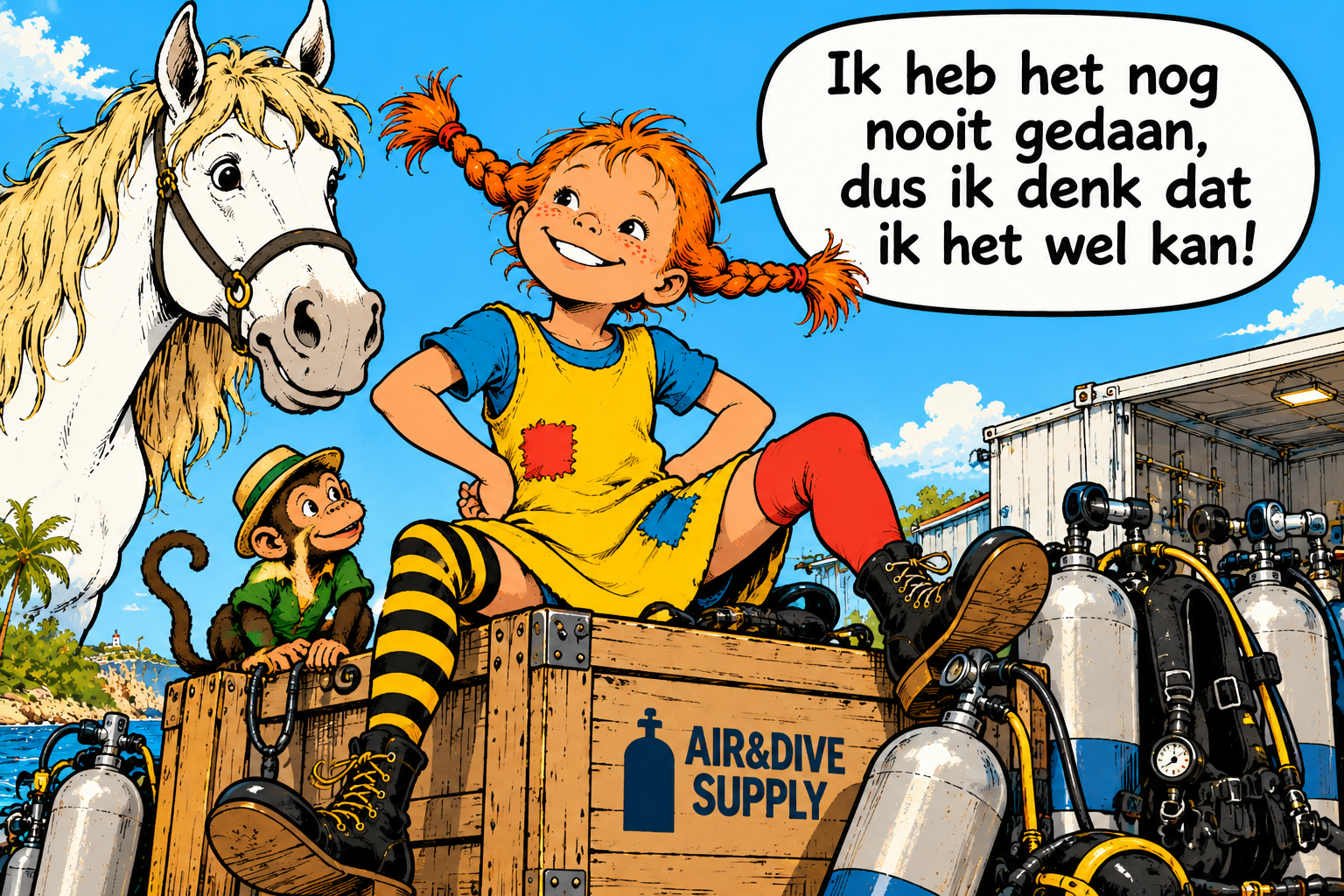
And that's how Captain Gilbert and instructor Kasper first got to know each other: on boat trips to Eastpoint. Despite our different backgrounds, we found ourselves facing the same practical question in our daily work: where should we get our scuba tanks filled? And how happy were we with the way things were being done? Could we perhaps do it ourselves? And maybe even do it better? Those who know us will probably recognize a little of Pippi Longstocking's philosophy in both of us: We've never tried it before, so we can probably do it! One thing was certain: neither of us was short on confidence or entrepreneurial ambition.
Like many other dive businesses on Curaçao, we relied on existing filling stations to fill our tanks. And there was nothing inherently wrong with that. We had both enjoyed years of good service from the companies that supplied our air, and things generally ran smoothly. Still, there were occasional minor frustrations. A tank that wasn't quite full, for example. Particularly annoying when a customer was the one to point it out: "There's only 190 bar in my tank." Or opening hours that didn't quite match the rhythm of our businesses. Or a delivery that arrived a little later than promised. Nothing dramatic, just those little things that gradually get you thinking.
Over time, we both became increasingly interested in taking the filling of our scuba tanks into our own hands. Not because others were doing a bad job, but because the advantages of having our own filling station were becoming harder to ignore. Being able to decide when to fill, depending less on other people's schedules, and, perhaps most importantly, having greater control over the entire process: from the ambient air entering the compressor to the breathing air that eventually ends up in a scuba tank.
And so, during conversations out on the water near Oostpunt or on the way back to the harbor in Spanish Water, the idea of setting up a filling station together slowly began to take shape.
2. Our First Attempt
But we weren't starting entirely from scratch. At Porto Mari Dive Center, we had already made an earlier attempt to take the filling of our scuba tanks into our own hands. And let's just say it hadn't been an overwhelming success.
For years, we had relied on another dive center to fill our tanks. We had a good relationship with the owners, and the arrangement worked perfectly well. But Porto Mari had grown into a fairly busy dive center, and we felt we had reached a point where investing in our own filling station made sense.
That idea became more urgent when the dive center supplying our air was put up for sale. For a while, it was unclear whether the business would continue operating and whether we could keep using its filling station as before. We even briefly considered buying the business ourselves, but eventually decided that investing in our own equipment was the better option.
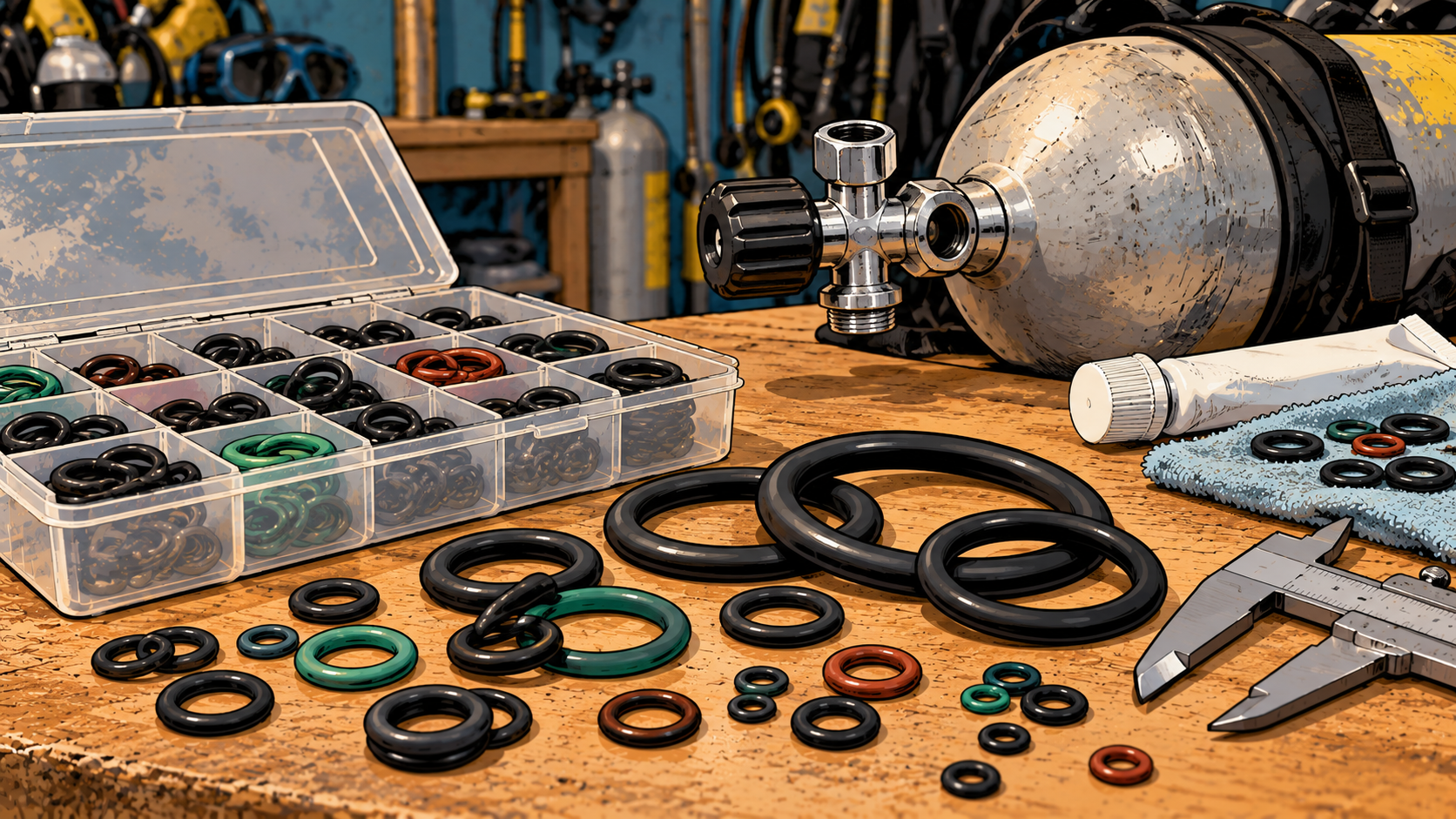
It was a substantial financial commitment. Almost everything we had managed to save during our first two years in business, along with some personal savings, went into a compressor, buffer tanks, and all the equipment needed to get the system up and running.
There was one additional complication. Porto Mari beach isn't connected to the electricity grid. Everything runs off-grid, powered by solar panels and generators. That made a large electric compressor a less obvious choice, so we started looking for a diesel-powered alternative. And before long, we came across what looked like quite a bargain.
It was a second-hand, three-stage compressor from a well-known German manufacturer. The machine had originally been purchased for a boat intended to run day trips on the Vinkeveense Plassen, a group of lakes in the Netherlands. But then the coronavirus pandemic came along, and the project never really got off the ground — or perhaps we should say, never quite set sail. By the time we found it, the compressor was three or four years old but had barely a hundred operating hours on the clock. Practically brand new, in other words, and available at a very attractive price.
We worked out how many tanks we expected to fill each day and decided to invest in eighteen buffer cylinders, each with a capacity of fifty liters. Together with the compressor, they would be housed in a ten-foot shipping container: essentially a compact steel box measuring roughly 2.5 by 3 meters. The entire installation was assembled for us in the Netherlands and then shipped to Curaçao.
The man building our system had spent a long and interesting career working with machinery and compressed air installations. He was nearing retirement, but still had plenty of experience to share. He would personally fly to Curaçao, accompanied by an electromechanical technician, to commission the installation and show our team how everything worked.
By then, our correspondence had probably made one thing abundantly clear: when it came to compressor technology, we were complete beginners. A little guidance certainly wouldn't hurt. But we were confident it would all work out. After all, we never tried it before. So probably we could do it.
3. A False Start
The plan was straightforward. The two technicians would come to Curaçao for a week. That should be plenty of time to commission the installation, fill the buffers, and teach our team how to operate and maintain the compressor. With a bit of luck, there might even be a few days left to enjoy the island. But things didn't quite go according to plan.
The first problems appeared almost immediately. The installation had been tested in the Netherlands, in the middle of summer, where it had managed to get rid of its heat without too much trouble. But Curaçao was another story. The temperatures were higher, and inside that little steel container, the heat had nowhere to go.
Additional fans had to be installed, ventilation openings cut into the container, and exhaust ducts fitted to carry the hot air outside. The ventilation system was modified to switch on automatically whenever the compressor started. There was plenty of tinkering, sawing, drilling, and improvising. We spared neither effort nor expense to make the installation work in the tropical heat. By the final day, everything finally seemed to be running as it should. Until we discovered that one of the compressor's cooling coils had cracked.
We drove around the island, visiting other filling stations in the hope that someone might have a spare cooling coil lying around. As it turned out, several people did have one. Unfortunately, they were all broken. And we were rather hoping to find one that wasn't. In the end, the damaged coil was carefully soldered back together, and the compressor was ready for another attempt.
Needless to say, there was no time left for sightseeing. Our compressor specialist and his technician had spent practically their entire week solving one problem after another. And unfortunately, that also meant there was far less time to train our team than we had originally planned.
Still, the compressor was running. It was producing compressed air, the buffers were full, and for the first time, we could fill our own scuba tanks at Porto Mari. We were finally independent! I had calculated that, if everything went reasonably well, we would recover our investment in about three years. But things didn't go reasonably well. In fact, they didn't go well at all. Or, to put it another way: just about everything that could go wrong, did go wrong.
4. Murphy’s Law
Exactly two months after we had put the compressor into operation, things started going wrong. The air coming out of the machine had developed a strange, oily smell. That was certainly not a good sign. Breathing air isn't supposed to smell suspicious, and until we knew what was causing it, there was no way we were going to supply that air to our customers. We wouldn't have wanted to dive with it ourselves, either. So we decided to empty all our scuba tanks and temporarily return to our old filling station. Fortunately, they were happy to take us back as customers, although at a slightly higher price than before.
Meanwhile, our compressor specialist was trying to work out, from a distance, what might have gone wrong. His theory was that one of the compressor's cylinder walls had developed some corrosion during the long period of inactivity brought on by the coronavirus pandemic. Once the machine was put back into service, the piston rings would have scraped against the affected surface, dislodging rust particles and causing further damage to the cylinder wall. As a result, the piston rings might no longer have been sealing properly, allowing excessive amounts of lubricating oil to enter the compression chamber. From there, the oil could have been carried along with the compressed air as a fine mist. The oil separators and filtration system weren't designed to cope with such large quantities of oil, which could explain how tiny oil droplets, known as oil aerosols, had eventually made their way into the breathing air. It sounded like a plausible explanation, but it was also a particularly unwelcome one.
He promised to order replacement parts from Germany as quickly as possible and return to Curaçao to replace the damaged cylinder. Naturally, we asked whether the other cylinders might have suffered similar corrosion. He assured us there was no reason to believe they had.
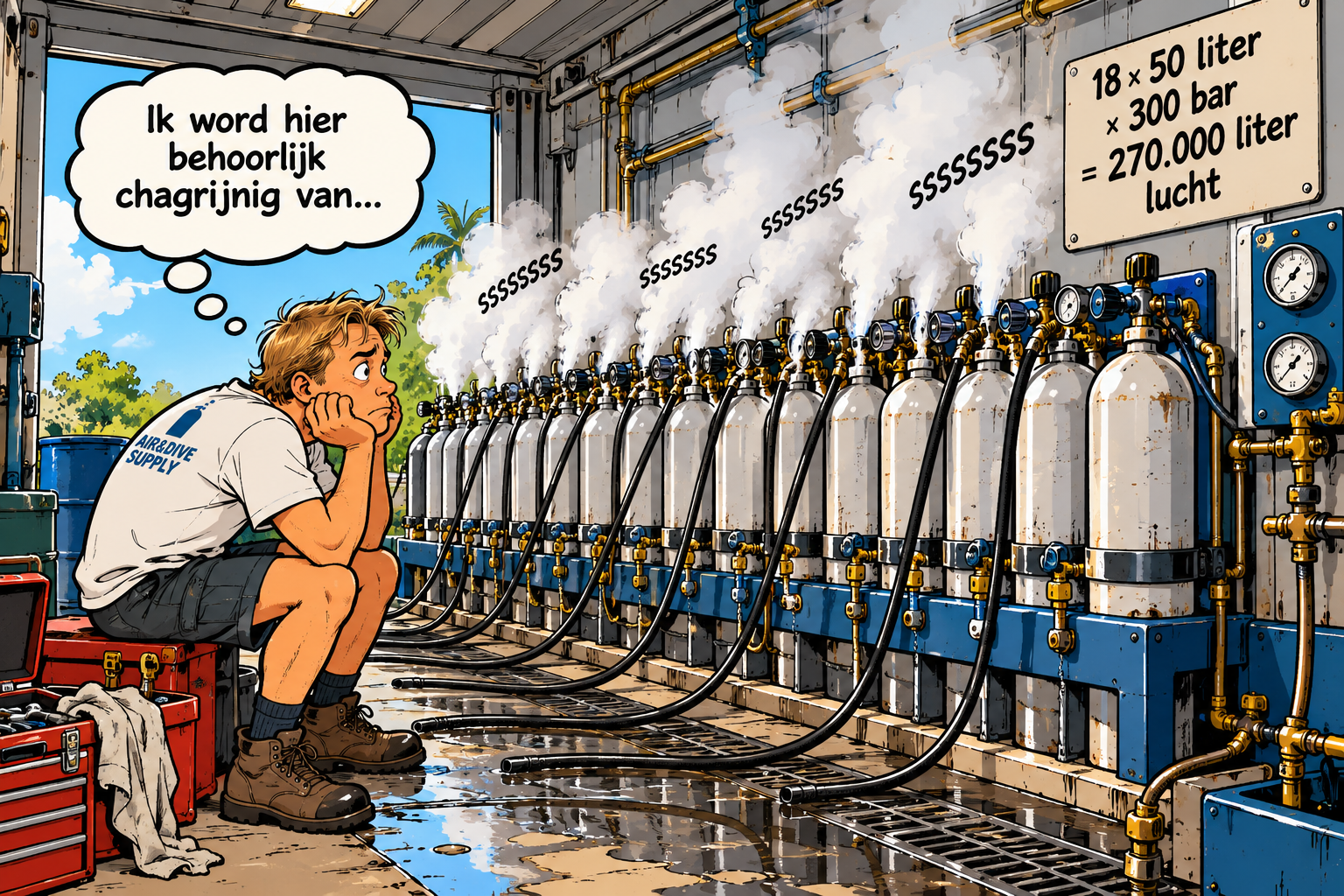
In the meantime, our eighteen buffer cylinders also had to be emptied. Eighteen cylinders of fifty liters each, pressurized to 300 bar. That's more than a quarter of a million liters of compressed air. All that carefully produced air, released straight back into the atmosphere. Two months after his first visit, our compressor specialist returned to Curaçao. He replaced the second-stage cylinder, installed fresh breathing air filters, and refilled the buffer banks. For a brief moment, it looked as though we had finally solved the problem. But that moment didn't last very long.
In fact, before his plane had even landed back in Amsterdam, we were already able to inform him that the air had developed exactly the same oily smell again. Which meant we had to empty the buffers for a second time.
Apparently, the damage hadn't been limited to that one cylinder after all. Perhaps corrosion had also affected the other compression stages. Our compressor specialist told us he had never encountered anything quite like this in his long career. By now, Murphy's law seemed to have taken a particular interest in our little project. How much could possibly go wrong with a single compressor installation? Quite a lot more, as we would eventually discover.
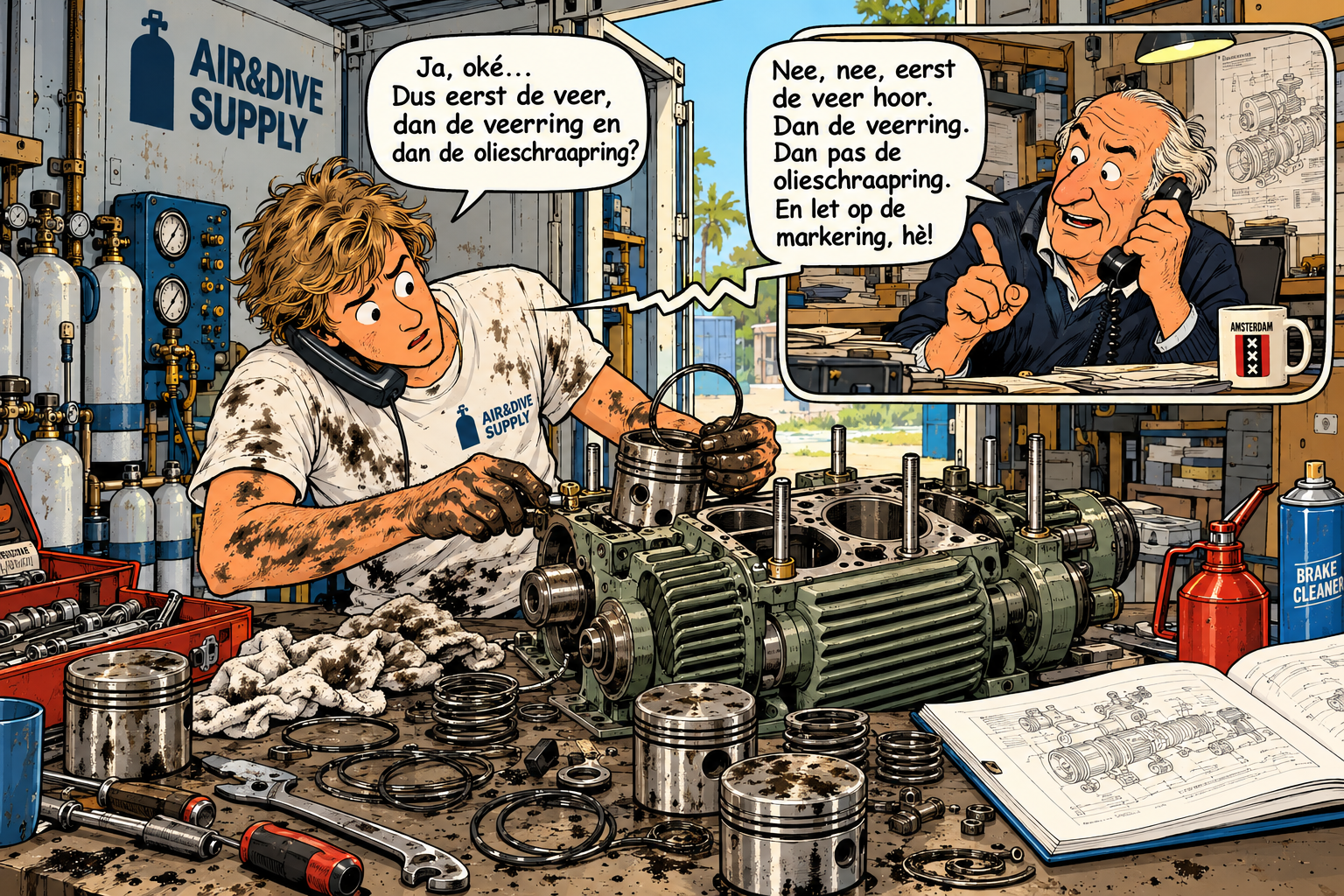
More replacement parts were shipped to Curaçao. This time, rather than flying our specialist back to the island, we attempted the repairs ourselves, guided by him over the phone. The job involved replacing the third-stage head gasket and piston rings, which was hardly a routine task for a team with very little compressor experience. Nevertheless, we worked our way through the procedure, step by step, following his instructions while he talked us through the repair from thousands of kilometers away.
Unfortunately, that didn't solve the problem either. Within a few days, the air had developed that same suspicious smell once again. And so, for the third time, we had no choice but to empty the buffers.
5. The Black Paint Bomb
For the third time in just over six months, our compressor specialist flew to Curaçao to replace yet more parts. One small consolation was that he genuinely enjoyed visiting the island, even if most of his time here was spent working. Once again, we arranged accommodation for him and set up a tab at the restaurant. But unfortunately, this visit didn't go quite as planned either.
It soon became clear that he hadn't brought enough spare parts to replace everything that might have been damaged. As luck would have it, the filling station where we had reluctantly become customers again had an old, defunct compressor of the same brand sitting around. We were allowed to salvage whatever usable parts we needed from it. Not for free, of course. It was a classic case of supply and demand, and we weren't exactly in a strong position to negotiate.
I honestly can't remember exactly which parts were replaced that time. By then, the whole process had become rather repetitive. We took things apart, repaired what we could, put everything back together, and tested the results. The filters were replaced yet again, the compressor was given another clean bill of health, and the buffer banks were filled once more. Surely, this time we had finally got it right.
And then something happened that made all our previous problems seem rather insignificant.
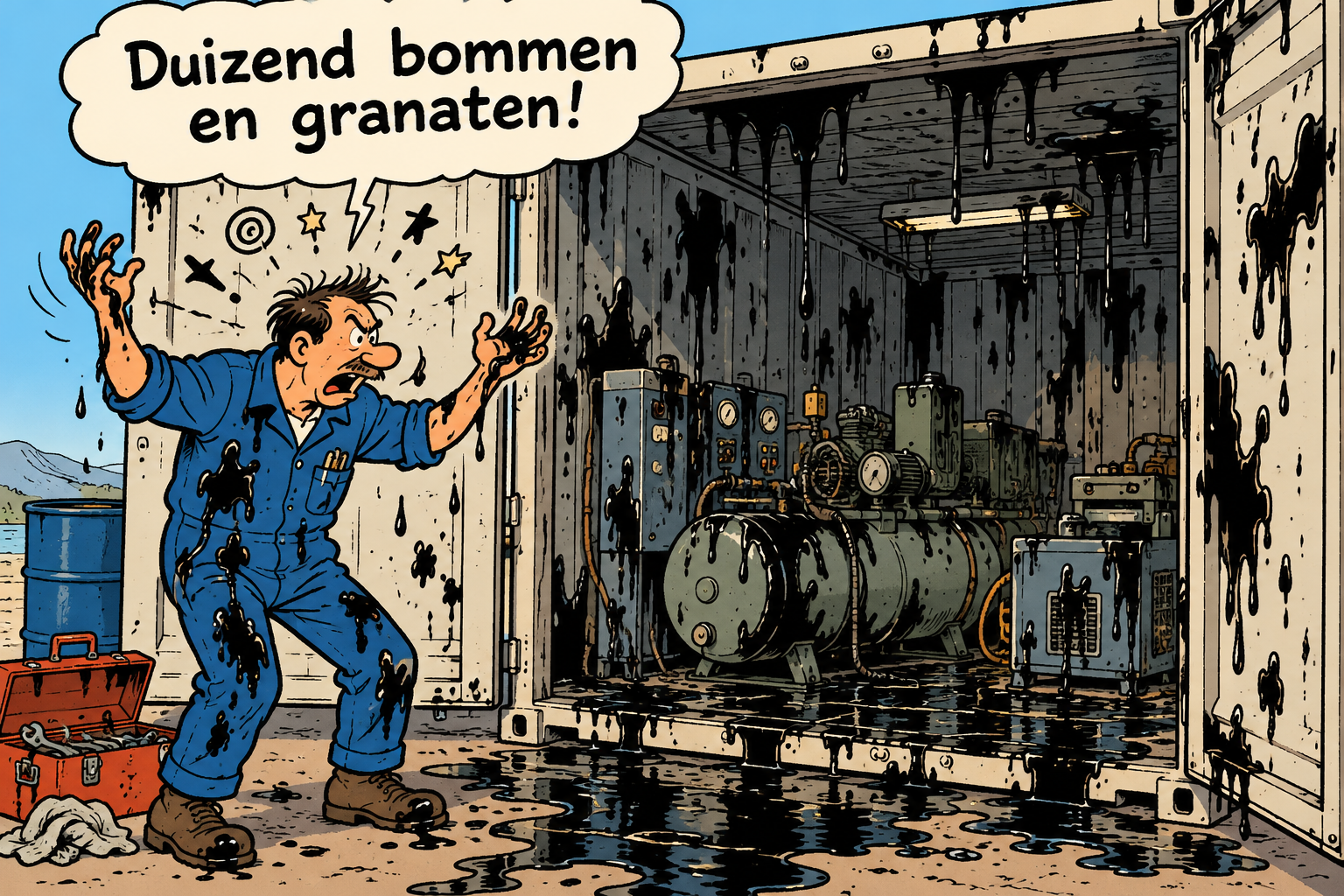
A day or two later, I opened the container door and found absolutely everything covered in black oil. It looked as though someone had set off a giant black paint bomb inside. The walls, the equipment, even the ceiling of the container: oil everywhere. It was one of those moments that called for a proper Captain Haddock outburst from The Adventures of Tintin: "Billions of blue blistering barnacles!"
Oddly enough, I didn't immediately grasp just how serious the situation was. I sent our compressor specialist, who was still on Curaçao, a rather casual message saying that something apparently hadn't gone quite according to plan. Looking back, that may have been the understatement of the year.
What I didn't realize at the time was that the entire diesel engine had seized. Presumably, it had overheated, causing some kind of catastrophic internal failure that sent engine oil spraying throughout the container. Exactly what happened remains a mystery to me, but the result was unmistakable: the engine had effectively turned itself into a rather expensive piece of scrap metal. Our compressor specialist came over to inspect the damage, but there was little left to salvage. The following day, he boarded his flight back to Amsterdam as scheduled, promising to come up with a suitable solution.
And to his credit, he did. Just a few days later, he presented us with one. In the form of a multiple-choice menu.
6. What now?
We were given three options. The first was to accept a refund of a few thousand dollar, after which our compressor specialist would walk away from the project. The second was to replace the failed diesel engine with an electric motor. That, however, would require us to arrange a three-phase power supply, which was anything but straightforward at our off-grid location. The third option was for him to find us another compressor, but we would have to pay extra for it. Needless to say, none of these options was particularly appealing.
The first option felt like putting a small bandage on a rather large wound. The electric alternative presented serious practical difficulties, and by then we had lost just about all confidence in the original compressor anyway. Even the air it had produced shortly before the diesel engine seized had developed that same suspicious smell. So, for the fourth time, we had to empty all eighteen buffer cylinders. By now, we had released more than a million liters of carefully compressed air straight back into the atmosphere. We didn't just want a different motor. We wanted a different compressor altogether. Or, to be perfectly honest, at that point we weren't particularly interested in owning a compressor at all.
Eventually, we agreed that our compressor specialist would find us a suitable replacement. He had actually suggested looking for a machine from a different manufacturer himself, believing that another brand might be better suited to the tropical climate. Given everything that had happened, we felt it was only reasonable that this replacement should come at no additional purchase cost to us. After some persuasion, he agreed.
Finding such a machine, however, proved easier said than done. Weeks turned into months. There were searches, discussions, follow-up messages, and then more follow-up messages. We were repeatedly assured that finding a suitable replacement was no simple matter. Eventually, it took a rather firmly worded letter to get things moving again. Almost a year after the whole ordeal had begun, a solution finally appeared on the horizon.
A suitable compressor had been found, this time from another German manufacturer. It had considerably more operating hours on the clock than our original machine, but it would undergo a complete overhaul and would therefore, we were assured, be technically as good as new. The replacement was supplied without any additional purchase cost, leaving us responsible only for shipping and import duties. And with that, a particularly expensive and frustrating adventure finally came to an end. Or at least, that chapter of it.
Because meanwhile, Gilbert and I had already begun making serious plans for something considerably bigger: a professional filling station that would supply not only our own dive businesses, but other dive centers across Curaçao as well.
7. Starting Over Together
While we were still trying to sort out the aftermath of the failed filling station at Porto Mari, Gilbert and I had already started turning our plans for a joint filling station into something more concrete. This time, we wanted to do things on a much larger scale, and above all, take a more thorough approach. We were determined to do everything we could to avoid repeating the mistakes of our first attempt.
There had also been an unsuccessful attempt to take over another dive school that already had its own compressor, but that's a story for another time. In the meantime, we had rented a spacious industrial building, purchased two more compressors, and ordered a considerable amount of additional equipment. And we had learned quite a few lessons from our first adventure. Perhaps the most important one was that, when building a filling station, it's probably not a good idea to assume that everything will simply go according to plan.
So this time, we went looking for advice. Lots of it. We spoke with compressor dealers in the Netherlands, fellow dive center owners on Curaçao, and dive instructors with years of experience producing breathing air. We immersed ourselves in the world of compressors, filtration systems, buffer banks, cooling, drying, and all sorts of other technical subjects we had barely known anything about a few years earlier. Our philosophy was simple: what you don't know, you can learn. What you don't know how to do, you can learn that too. And for everything else, there's always someone who can help.
We also decided that one compressor wouldn't be enough. Neither would two. We wanted three. After everything we had been through, we had developed a healthy appreciation for redundancy. If one compressor broke down or had to be taken out of service for maintenance, we didn't want to find ourselves without compressed air again. The replacement compressor from our Porto Mari adventure would therefore join the two other machines to form the heart of our new filling station.
When it came to air quality, however, we were even more determined not to take any chances. Losing more than a million liters of compressed air is painful enough, especially when you think about all the hours your compressors have spent producing it. But our experience at Porto Mari had taught us something more important: you can't simply assume that a compressor's filtration system will always protect you from everything that might go wrong inside the machine. If excessive oil enters the compressed air system, for example, the filters may become overwhelmed, potentially allowing contamination to reach the buffer banks. And once that happens, you may find yourself emptying the entire system all over again. Except that this time, we weren't dealing with eighteen buffer cylinders anymore. We had forty-five!
So we decided to invest in an additional triplex filtration system: three filter stages in series, providing an extra layer of air treatment beyond the filtration already built into our compressors. If something went wrong with the air treatment in one of the machines, the compressed air would pass through these additional stages before reaching the buffer banks. We hoped this would give us a considerably greater safety margin. After our previous experiences, the idea of having several layers of protection was particularly appealing.
We also happened to have a perfectly usable filter housing left over from the original Porto Mari installation, along with a substantial stock of matching filter cartridges. Since these cartridges weren't interchangeable with those used in our other compressors or the new triplex system, we decided to put the old housing to good use. We installed it as a final polishing filter, near the filling panels, downstream of the pressure-reducing valve. That way, the air would pass through one last filtration stage immediately before entering the scuba tanks. Another layer of protection, we thought, on top of an already extensive air treatment system.
This arrangement also proved useful for a more practical reason. The refrigerated dryers and triplex filtration system took quite some time to arrive, so we had to operate for a while without all the equipment we had originally planned. In the meantime, the polishing filter provided an additional filtration stage, although it was no substitute for the complete system we intended to install. Two of our compressors also came equipped with Bauer's SECURUS system, which monitors filter cartridge saturation and shuts down the compressor when the cartridge reaches its permitted service limit. At least that meant we wouldn't have to rely entirely on our own memory when it came to replacing filters.
And because filter cartridges are expensive, we naturally wanted to make them last as long as possible. That's where refrigerated dryers came into the picture. These units cool the compressed air to around 3°C, causing much of the moisture to condense so it can be separated and drained before the air reaches the final filtration stages. This is particularly useful on Curaçao, where temperatures inside our compressor hall can easily climb above 35°C during the day. By removing much of the moisture beforehand, we hoped to extend the service life of our filter cartridges by a factor of four to six, perhaps even more. If those estimates proved realistic, the dryers would pay for themselves relatively quickly.
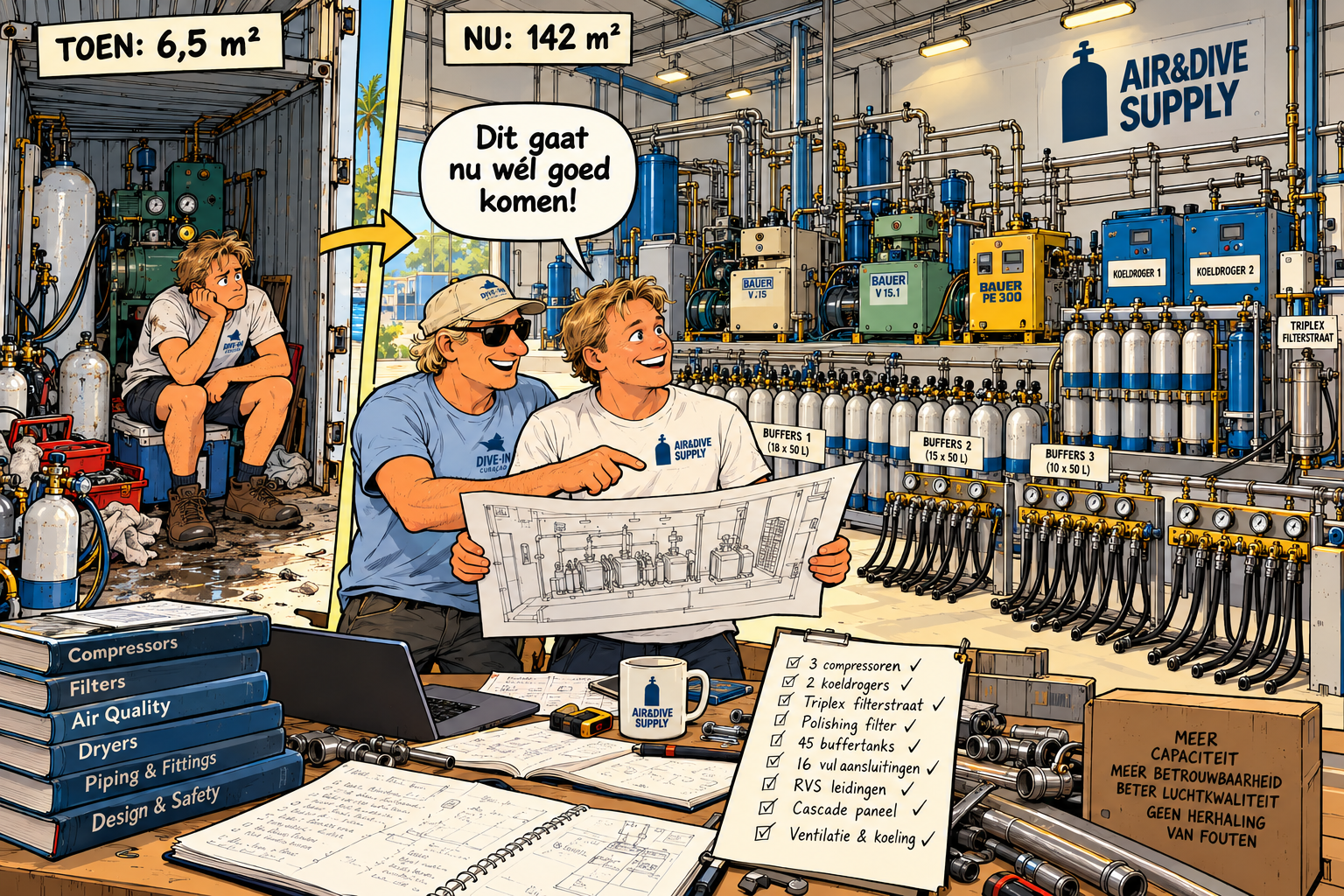
Of course, producing clean breathing air was only part of the challenge. We also needed to be able to fill a considerable number of scuba tanks at once. The original filling panel from Porto Mari, with its four connections, was moved to the new station. We then added two more panels, each with six connections, bringing the total to sixteen filling points. In other words, we could connect sixteen scuba tanks at the same time, rather than having to constantly swap cylinders on and off a small filling panel.
We also decided to organize our buffer cylinders differently. Instead of keeping them all together as we had done at Porto Mari, we divided them into three separate banks connected through a manual cascade system. The eighteen original buffer cylinders were moved to the new building one by one and reassembled as the first bank. Of the additional cylinders we had acquired, fifteen formed the second bank and ten the third. Two more cylinders, which had come secondhand with one of the compressors, were temporarily set aside because they first needed to undergo hydrostatic testing. That left us with forty-three cylinders ready for use, with a total of forty-five planned once the remaining two had passed inspection.
Gradually, the new installation began to take shape. Three compressors, multiple stages of air treatment, two refrigerated dryers, three buffer banks, and sixteen filling points. It was becoming a serious operation, certainly compared with the little container we had started with at Porto Mari.
But of course, all those components still had to be connected. For the high-pressure piping, we chose high-quality 316 stainless steel tubing with double-ferrule compression fittings. We also invested in professional tools: a tube bender, a tube cutter, and a deburring tool, so that we could install as much of the pipework as possible ourselves. That was the plan, anyway. We soon discovered that bending stainless steel tubing neatly and accurately is something of an art. Our welder and metalworker turned out to be considerably faster and better at it than we were, so we were more than happy to leave much of that work to him. After all, we weren't just building something that had to work. We wanted an installation that would still be working reliably many years down the road.
By now, our new filling station had become an entirely different project from that first little container at Porto Mari. Back then, we had tried to squeeze everything into roughly 6.5 square meters (70 sq ft). This time, we had an industrial building of no less than 140 square meters at our disposal. Plenty of room, we thought. Although, as we would soon discover, even 140 square meters (1500 sq ft) can fill up surprisingly quickly.
8. Quality through design
During our preparations, we also spent quite some time discussing air quality with various compressor suppliers. How do you make sure the breathing air you produce is actually safe? Should you constantly question what comes out of your compressors and monitor it continuously? Or can you design a filling station in such a way that you have good reason to trust the air it produces?
We looked into several systems that could continuously monitor the quality of our breathing air. Impressive technology, but also remarkably expensive. One of our technical partners offered us an interesting piece of advice: before spending a fortune on continuous monitoring, invest in proper air drying, high-quality filtration, and automatic filter monitoring. If you design the entire process carefully and maintain it properly, you can greatly reduce the chances of something going wrong in the first place. That made sense to us. We didn't want to build a filling station where we would constantly have to worry about the quality of our air. We wanted to build one that was reliable enough to inspire confidence, while still giving us the means to verify that everything was working as intended.
One particularly useful piece of equipment we brought with us from our Porto Mari adventure was our professional breathing air analyzer. This allows us to check several important air quality parameters ourselves, including moisture, carbon monoxide (CO), carbon dioxide (CO₂), oxygen (O₂), and volatile organic compounds (VOCs). And we decided to make full use of it. Rather than testing the air just once a month, or even once a week, we planned to set aside a scuba tank almost every day and fill it with a representative sample of the air we were producing. Then, once a week, we would analyze all those samples in succession. That way, we could build up a much more detailed picture of how our installation was performing over time.
The idea wasn't simply to check whether everything appeared to be working properly. We wanted to demonstrate, with actual measurements, that the system was performing as we had intended and that all those investments in drying, filtration, and monitoring were doing their job. Of course, periodic testing isn't the same as continuous monitoring, and a good result today doesn't automatically guarantee good air tomorrow. But by combining a carefully designed installation with regular measurements, we hoped to build something we could genuinely trust.
And that brings us back to a question people sometimes ask: why all this equipment? Why three compressors? Why so many filters, with the air passing through as many as five filtration stages? The answer is simple. Because we've learned from experience just how much can go wrong. We've paid quite a lot in tuition fees along the way, and we'd rather not have to pay them again. We'd rather have one compressor too many than one too few, and a few extra filtration stages than discover afterward that something has gone wrong with the air. None of this means that problems are now impossible, of course. But we've invested a great deal of time, money, and effort in making them as unlikely as we reasonably can.
And that's why we're proud of the breathing air we produce at Air & Dive Supply. We believe it ranks among the best on Curaçao, not because we simply assume it does, but because of the care, equipment, and attention to detail that go into every single scuba tank we fill. Behind that apparently ordinary cylinder of compressed air lies a surprisingly complicated process, and a rather expensive learning experience. One that has taught us never to take good breathing air for granted.